Farah Name Meaning: Arabic Origin, Pronunciation, and Use
Farah name meaning comes directly from the Arabic word فَرَح, meaning “joy,” “happiness,” or “delight.” The name is short, easy to recognize across several writing systems, and used well beyond Arabic-speaking communities. Its positive dictionary meaning is genuine, but it is not a prediction about a person’s temperament or future.
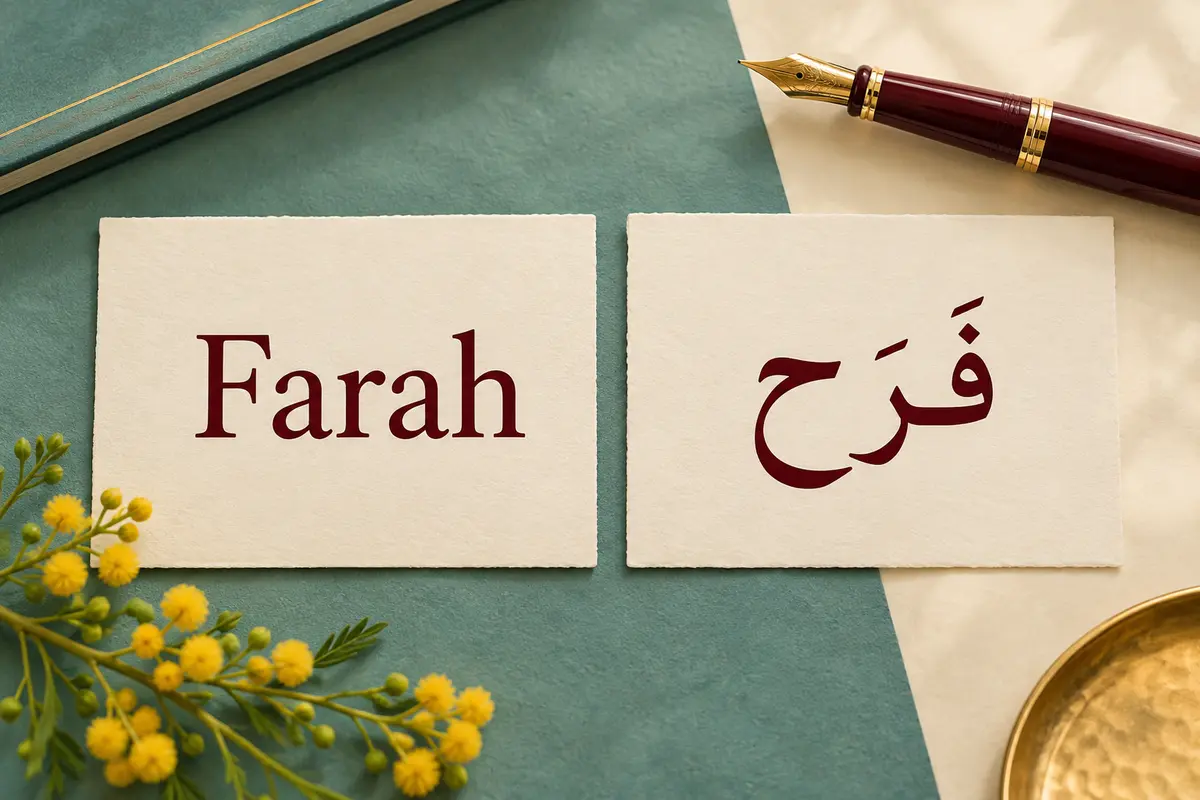
Farah is written فرح in Arabic. It appears as a given name in Arabic, Persian, Urdu, and Malay use, among other communities, while the Latin spelling Farah is common in international settings. Family language and the bearer’s own pronunciation remain more useful than a single universal phonetic rule.
Farah name meaning at a glance
| Question | Short answer |
|---|---|
| Origin | Arabic |
| Arabic spelling | فَرَح or, without vowel marks, فرح |
| Core meaning | Joy, happiness, or delight |
| Common pronunciation | FAH-rah; Arabic ends with the deeper consonant ح |
| Related spellings | Farah, Farrah, Fara |
| Use | Often feminine; usage can vary by language, country, and family |
The Academy of the Arabic Language entry for الفَرَح defines the word through pleasure and the opening of the heart in response to an immediate delight. It also records a figurative use connected with a wedding celebration. That lexical evidence supports “joy” or “happiness” as the concise translation.
How the Farah name meaning comes from Arabic
The name belongs to the Arabic root ف-ر-ح, which carries the idea of rejoicing or being happy. The noun فَرَح is an ordinary Arabic word as well as a personal name. The Farah entry at Behind the Name likewise gives “joy, happiness” and traces the name to the verb فَرِحَ, “to be happy.”
This is a straightforward linguistic connection, not a mystical one. Naming a child Farah may express a family’s joy, mark a hopeful occasion, or simply reflect affection for the sound. It does not mean that every bearer must be cheerful or that the name assigns a fixed personality.
The same distinction between word meaning and personal prediction matters for other Arabic names. Our guide to Salma name meaning explains its relationship to the Arabic root associated with safety and peace without turning that history into a character forecast.
Farah, فَرَح, and pronunciation
In many English-speaking contexts, Farah is approximated as FAH-rah, with the emphasis near the first syllable. Arabic pronunciation is often represented as fa-raḥ. The last letter, ح, is a breathy consonant produced farther back in the throat than the English h, so an English phonetic spelling can only approximate it.
Some speakers use a softer final sound, a slightly different first vowel, or stress shaped by the language around them. Persian, Urdu, Malay, English, and Arabic speakers do not necessarily say the name identically. The respectful choice is to follow the bearer’s pronunciation instead of correcting it to a single online recording.
Arabic short-vowel marks are usually omitted in everyday writing, so فرح is the normal unvocalized form. Writing فَرَح adds marks that clarify the vowels. Before printing or engraving the name, copy the exact script approved by the person or family.
Is Farah a girl’s name or a boy’s name?
Farah is often used as a feminine given name in many communities, but naming practice is not identical everywhere. The name database cited above records both feminine and masculine usage. Local custom, family tradition, and the individual bearer are therefore more reliable than an absolute gender label.
The name can also appear in family names and public records. A surname that looks like Farah should not automatically be interpreted as a feminine first name. Forms that resemble one another in Latin letters may have different family histories, especially after transliteration.
If you are choosing the name for a child, check how it is used in the countries and languages important to your family. A familiar name in one place can be uncommon or read differently in another.
Farah, Farrah, and related spellings
Farrah usually represents the same basic Arabic name in English-language spelling. The doubled r does not change the Arabic root, though an individual may treat Farah and Farrah as distinct personal spellings. Fara is a shorter Latin form, but it can also belong to unrelated naming traditions, so similarity alone does not prove a shared origin.
Transliteration is a practical bridge between scripts rather than a perfect letter-for-letter conversion. Arabic ح has no exact English equivalent, and Latin spelling choices vary. On official documents, consistency with passports, school records, and family usage matters more than adopting a supposedly ideal transliteration.
For another name whose Latin spelling crosses language traditions, see Nadia name meaning. Nadia has separate Slavic and Arabic routes, while Farah’s well-established lexical meaning comes from Arabic; the comparison shows why each name needs its own evidence.
Farah name meaning across languages and communities
Farah travels easily because it is compact and the Latin spelling is familiar in many places. Arabic-speaking families may understand the word immediately, while Persian-, Urdu-, or Malay-speaking families may use it as an established personal name. International use does not erase its Arabic etymology.
A name can gain cultural associations through notable bearers, literature, and family stories, but those associations are not dictionary definitions. It is safer to say that Farah is used in a community than to claim every use began independently there.
Our article on Lina name meaning offers a useful contrast: Lina has several independent language histories. Farah is more directly anchored in the Arabic word for joy even when it is used by families who speak other languages.
Choosing Farah for a child
Say the full name with the intended middle and family names. Check the initials, rhythm, and likely pronunciation in each home language. If Arabic script matters, save a verified copy of فرح for invitations, keepsakes, or future records.
Ask what the name represents to your family. Some parents choose Farah to remember the happiness surrounding a birth; others honor a relative or simply value its sound. That personal reason can sit alongside the documented origin without being presented as a universal meaning.
If popularity affects your decision, use a dated national source. The U.S. Social Security Administration baby-name tool lets you search recorded spellings by year. Its results describe U.S. registrations, not worldwide use, language origin, or future popularity.
Farah name meaning and personal symbolism
Because the literal word refers to joy, families may associate Farah with celebration, gratitude, welcome, or a happy memory. These are reasonable personal interpretations. They become misleading only when presented as guarantees about disposition, luck, relationships, or destiny.
A bearer may embrace the joyful association, attach a different family story to the name, or simply regard it as her name. The linguistic history belongs to the word; the lived meaning belongs to the person.
Frequently asked questions
What is the main Farah name meaning?
Farah comes from Arabic فَرَح and means “joy,” “happiness,” or “delight.” It is a documented word meaning, not a prediction of personality.
How do you pronounce Farah?
FAH-rah is a useful English approximation. Arabic is closer to fa-raḥ, ending with the deeper consonant ح. The bearer’s own pronunciation should take priority.
Are Farah and Farrah the same name?
They commonly represent the same Arabic name in different Latin spellings. However, each person’s legal and preferred spelling should be preserved rather than treated as interchangeable.
Is Farah a Muslim name?
Farah is an Arabic name used by people in varied communities. Arabic origin does not identify a bearer’s religion, and the name itself should not be used to infer faith.
For another Arabic given name taken directly from a positive everyday noun, see Amal name meaning and its Arabic origin, where the documented meaning is kept separate from personality predictions.
Sources
- Academy of the Arabic Language: الفَرَح
- Behind the Name: Farah
- U.S. Social Security Administration: Popular Baby Names
For another short Arabic name whose exact script matters, compare Sami's Arabic spelling and cross-language origins, which separates the elevated Arabic root from other same-spelling traditions.
For another Arabic name drawn from a positive abstract noun, see Iman name meaning, Arabic spelling, and pronunciation, which explains faith, pronunciation, and cross-language use.