Salma Name Meaning: Arabic Origin, Pronunciation, and Variants
Salma name meaning is most often connected with the Arabic root س ل م (s-l-m), a broad word family associated with safety, soundness, peace, and being unharmed. The feminine name is written سَلْمَى and is commonly rendered Salma in English.
That compact explanation is useful, but it needs care. An Arabic root can produce several words with related meanings, and a personal name is not a promise about someone’s health, temperament, or future. Salma can carry a hopeful association with safety or well-being without predicting the personality of the person who bears it.
Salma name meaning at a glance
| Feature | Guide | Context |
|---|---|---|
| Arabic spelling | سَلْمَى | A feminine Arabic given name |
| Usual English spelling | Salma | Diacritics are normally omitted in everyday English |
| Careful transliteration | Salmā | The final vowel is long in Arabic |
| Approximate pronunciation | SAHL-mah or SAL-mah | Vowels and stress vary by family and accent |
| Root family | س ل م (s-l-m) | Connected with safety, soundness, peace, and related ideas |
| Traditional use | Feminine | Individual identity is not determined by a name guide |
Arabic roots behind Salma name meaning
The name Salma belongs to the wide Arabic root family س ل م. The Quranic Arabic Corpus entry for the root shows related forms translated with ideas such as peace, safety, soundness, greeting, and submission. Its examples also demonstrate an important point: a root is a family of related words, not a single English definition that can be pasted onto every form.
Arabic dictionaries commonly connect سَلْمَى with being safe, sound, or delivered from harm. In a name guide, “safe,” “sound,” “unharmed,” or “peaceful” are therefore reasonable short glosses. “Peace” is the most familiar English summary, although it describes the wider root association more neatly than the full grammatical history of the feminine name.
The distinction protects the name from exaggerated claims. Salma does not linguistically mean “a woman who will always bring peace,” nor does it prove calmness, kindness, or spiritual favor. Families may value those ideas as personal wishes, but they are interpretations rather than facts about a child.
How to pronounce Salma
In careful Arabic, Salma has two syllables: Sal-ma. The first consonant is an ordinary s, followed by a short a; the l closes the first syllable, and the final vowel is long. English speakers often approximate it as SAHL-mah or SAL-mah.
There is no need to force one English accent into a supposedly perfect universal version. Arabic accents differ, and names often adapt slightly when families live in other language communities. The most respectful pronunciation is the one used by the person or family.
The final Arabic letter is alif maqṣūrah, written ى. It looks like a dotless yāʾ at the end of the word but represents a long ā sound here. The Library of Congress Arabic Romanization Table documents the letters and diacritics used in formal transliteration. Everyday English normally drops the macron, so Salmā becomes Salma.
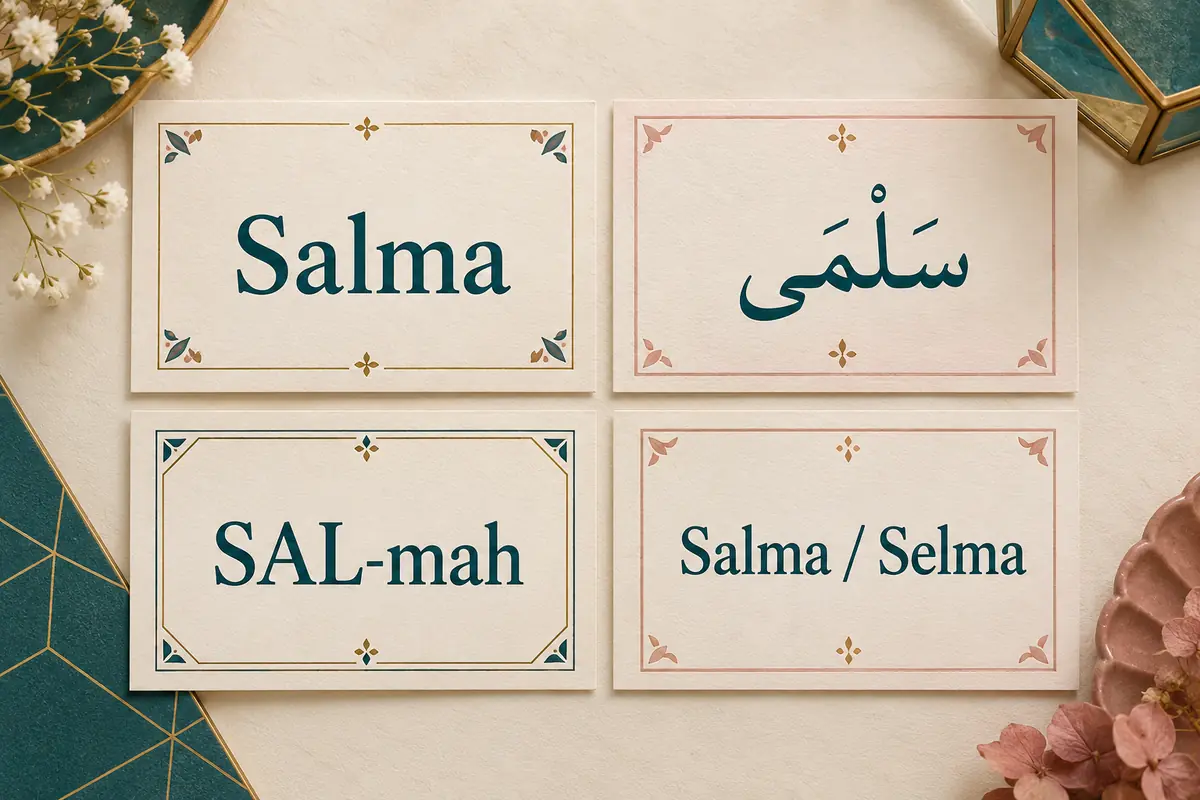
Salma, سَلْمَى, pronunciation, and spelling
The Arabic spelling سَلْمَى can appear without vowel marks as سلمى, which is normal in everyday Arabic writing. In English, Salma is the clearest and most established spelling. Salmah adds an h that does not represent a separate final Arabic consonant in this name, so it may create more confusion than clarity.
Selma should be handled carefully. Some families use it as a regional or language-specific rendering related to Salma, while elsewhere Selma has a separate naming history. The two spellings may sound similar, but one should not assume that every person named Selma has the Arabic name or that every Salma prefers Selma.
Forms with formal diacritics, including Salmā, are valuable in academic writing because they show vowel length. They are less practical on many English-language forms, tickets, email addresses, and databases. A family can use Salma for documents while preserving سَلْمَى in Arabic contexts.
History and cultural use of Salma
A clear account of Salma name meaning also needs historical context. Salma is an old Arabic personal name rather than a newly invented sound. It appears across Arab and Muslim communities and has also become familiar internationally through migration, literature, cinema, sport, and public figures. Its reach does not erase its Arabic linguistic background.
The name is not a Quranic personal name in the sense of being the name of a woman identified in the Quran. The Quranic corpus is useful here because it documents the root and related vocabulary, not because it contains a character named Salma. Keeping those two claims separate avoids a common online shortcut.
Salma can be used by Muslim, Christian, secular, and other families. Arabic-language origin does not restrict a name to one faith. At the same time, families may have religious, regional, literary, or personal reasons for choosing it, and those reasons deserve more weight than a generic name list.
For another short Arabic feminine name with a different linguistic history, see Aya name meaning. You can also compare how a modern name travels between Persian and Arabic-speaking communities in Yara name meaning.
What the name can symbolize without making predictions
In family use, Salma name meaning may be understood as a hopeful wish for well-being because the root family includes safety, soundness, and peace. Others may connect it with reconciliation, steadiness, or the relief of coming through difficulty. These can be meaningful family interpretations when they are presented as associations.
A name cannot establish personality. No responsible etymology can promise that a Salma will be calm, nurturing, lucky, spiritually protected, or successful. Environment, relationships, choices, and individual character matter far more than the historical meaning of a name.
This approach leaves room for personal symbolism without disguising it as linguistic proof. The documented core is an Arabic feminine name connected with the s-l-m word family. Everything beyond that should be described as family meaning, cultural association, or individual reflection.
Is Salma popular?
Searches for Salma name meaning often include questions about popularity, but popularity depends on country, year, spelling, and the way records group names. A name can be familiar across several Arabic-speaking countries while appearing less often in one English-language dataset. It can also be split between Salma, Selma, and other spellings.
For the United States, the Social Security Administration baby-name database is the primary source for annual registrations recorded on Social Security card applications. Search the exact spelling and year rather than relying on an undated “popular names” list. The database reflects U.S. records, not worldwide Arabic usage.
Middle names and sibling names for Salma
Name pairings are questions of rhythm, family language, and personal meaning rather than rules. With a two-syllable first name, both short and longer middle names can flow well. Say the full name aloud with the surname, check the initials, and test how it sounds in every language the family regularly uses.
Families who want Arabic pairings might consider names with a clear contrast in rhythm, such as Salma Noor, Salma Mariam, Salma Yasmin, or Salma Leen. These are examples, not prescriptions. A family name may carry more significance than any stylistic match suggested online.
For sibling ideas, shared origin is optional. Salma can sit naturally beside names such as Omar, Aya, Noor, Zayn, or Layla, but siblings do not need a coordinated theme. Our guide to Layla name meaning offers another example of an established Arabic feminine name whose documented word history should be kept separate from personality claims.
Frequently asked questions
What does the name Salma mean?
Salma is an Arabic feminine name connected with the root س ل م. Short English glosses include “safe,” “sound,” “unharmed,” and “peaceful.” “Peace” is a familiar summary of the wider root family, not a personality prediction.
How is Salma written in Arabic?
It is written سَلْمَى with vowel marks or سلمى in ordinary unvowelled text. The final ى represents a long ā sound in this name.
How do you pronounce Salma?
A practical English guide is SAHL-mah or SAL-mah, with two syllables. Pronunciation varies across Arabic and English accents, so the bearer’s own pronunciation is the best guide.
Are Salma and Selma the same name?
Sometimes Selma is used as a regional or language-specific variant, but it can also have a separate naming history. Do not treat the spellings as automatically interchangeable; ask the person or family which form they use.
Sources
- Quranic Arabic Corpus: the Arabic root س ل م
- Library of Congress: Arabic Romanization Table
- U.S. Social Security Administration: Popular Baby Names
For another concise name with an Arabic connection, compare Lina name meaning and its different origins, which distinguishes the Arabic explanation from European short-name traditions.
A further cross-cultural example appears in Nadia's Arabic and Slavic name origins, where Arabic and Slavic explanations are documented separately.
A name with an Arabic happiness connection and a separate Japanese flower use appears in Hana's Arabic and Japanese name origins, with script and pronunciation notes.