Aya Name Meaning: Origins, Pronunciation, and Cultural Context
Aya name meaning is most often traced in Arabic to آيَة (āyah), a word used for a “sign,” “evidence,” or “verse.” It is a concise feminine given name in many Arabic-speaking families, and the spelling Aya has also become familiar far beyond the region.
The same three Latin letters can represent names from more than one language. In Arabic contexts, Aya and Ayah commonly point to آيَة; in Japanese contexts, Aya can represent a separate name whose meaning depends on its written characters. This guide keeps those traditions distinct and explains pronunciation, spellings, religious context, and practical naming choices without predicting personality or destiny.
Aya name meaning at a glance
| Feature | Guide | Context |
|---|---|---|
| Arabic spelling | آيَة | A feminine noun and established personal name |
| Common meanings | Sign, evidence, verse | The best translation depends on context |
| Arabic pronunciation | AH-yah | Two syllables, with stress on the first |
| Common spellings | Aya, Ayah, Āyah | Latin spelling varies by system and preference |
| Traditional use | Usually feminine in Arabic | Usage can differ in other languages |
| Japanese use | A separate name tradition | Meaning depends on the exact kanji or kana |
Arabic Aya name meaning and origin
The Arabic noun آيَة has a range of connected senses rather than one rigid English equivalent. “Sign” is a useful broad translation. Depending on the sentence, it may refer to an indication, proof, remarkable sign, or a verse of the Quran. That range is why responsible name explanations should give context instead of presenting a single decorative slogan.
The Quranic Arabic Corpus entry for the root hamza-yā-yā records the noun āyat hundreds of times and shows English glosses including “sign,” “signs,” and “verses.” The corpus also warns that an Arabic word can carry different meanings according to context. As a personal name, Aya can therefore evoke the established Arabic word without requiring every family to choose exactly the same English gloss.
A name’s dictionary origin does not define its bearer. “Sign” or “verse” can be meaningful to a family because of language, faith, literature, or heritage, but it does not make a child spiritually gifted, unusually perceptive, lucky, or destined for a particular life.
Aya name meaning in Quranic context
آيَة is an important Quranic term, and āyah is the usual word for an individual Quranic verse. The text also uses the word in the broader sense of a sign. For that reason, many Muslim families understand Aya as a Quran-connected name.
“Quranic” describes the word’s presence and use in the Quran; it does not mean the name belongs only to Muslims or that every bearer has the same religious identity. Aya is used across different communities and countries. When discussing a specific person, it is better to follow how that person and family explain the name.
People sometimes translate Aya as “miracle.” That may express a personal or devotional interpretation of a remarkable sign, but “sign” and “verse” are more direct general glosses. Keeping the literal range separate from family symbolism avoids presenting an interpretation as the only dictionary definition.
How to pronounce Aya
For Arabic آيَة, a practical English guide is AH-yah: two syllables, with the first vowel held slightly longer than the second. The first part is closer to the a in “father” than the sound in “day.” Pronunciation still varies with accent and family preference.
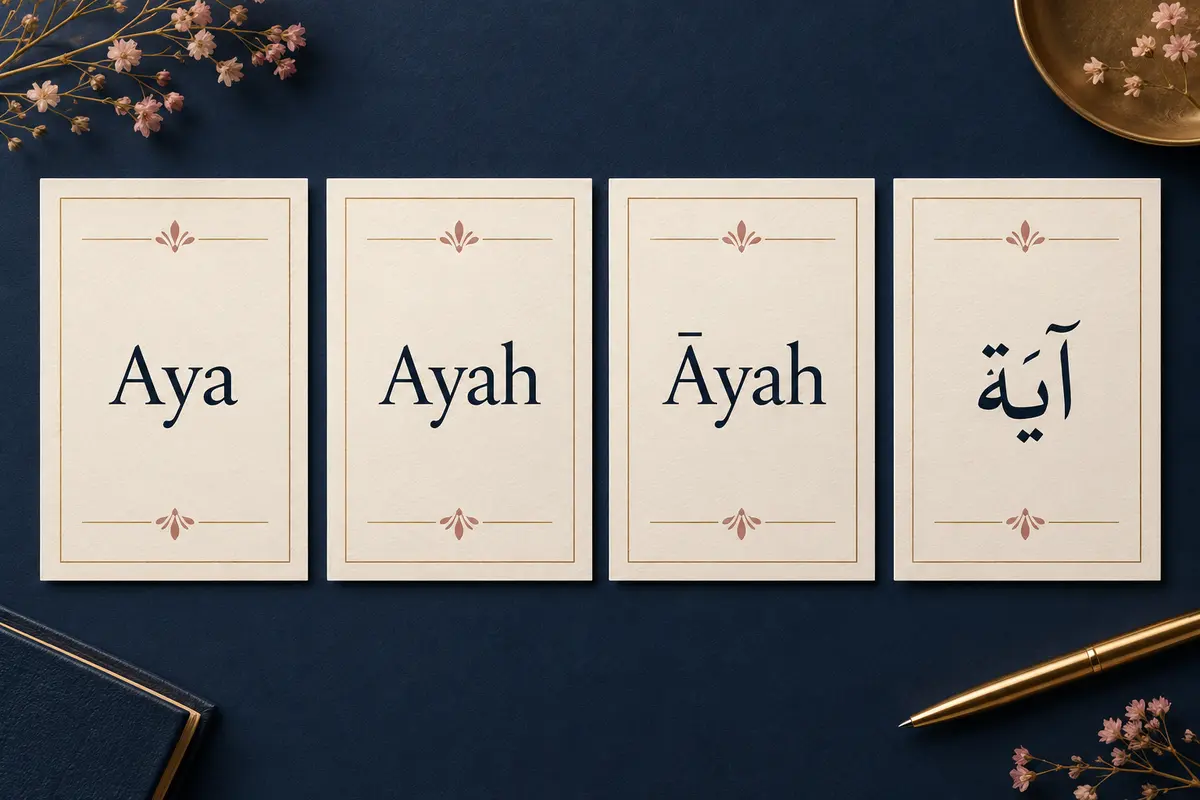
Formal romanization writes the name as Āyah. The macron over Ā marks a long vowel, while the final h helps represent the Arabic ending. The Library of Congress Arabic romanization table documents the scholarly marks used to represent Arabic letters and long vowels.
In everyday English, Aya may be read as EYE-ah, AY-ah, or AH-yah. Those readings are not interchangeable for every bearer. If accuracy matters, ask the person or family and repeat their pronunciation rather than correcting it from the spelling alone.
Aya, Ayah, and Āyah spellings
Aya is the shortest and most internationally portable spelling. Ayah adds a final h, which can make the connection to Arabic āyah clearer but may also lead some English readers to pronounce the first syllable like “eye.” Āyah is useful in dictionaries, academic writing, and careful transliteration, although official records often omit diacritics.
These spellings can refer to the same Arabic name. They are not rankings of authenticity, and a person using Aya does not have a “less complete” name than someone using Ayah. What matters most is the spelling the family intends and can preserve consistently.
Aya in Arabic and Japanese naming traditions
The Latin spelling Aya can also represent a Japanese given name, but that does not give it one automatic Japanese definition. Japanese names may be written in kana or with different kanji, and the written form supplies information that the Latin spelling leaves out. Two people both called Aya may therefore have different written names and different intended meanings.
It is misleading to merge an Arabic definition such as “sign” with an unrelated Japanese character meaning and present the result as a universal name meaning. Start with the language, script, and family explanation. If a Japanese name is involved, ask for the exact characters before assigning a meaning.
This distinction also matters for pronunciation. Japanese Aya is often rendered in three morae, approximately a-ya with relatively even timing, while Arabic Āyah begins with a long vowel. Real speakers and families may use different accents, so written guides are only approximations.
Is Aya a girl’s name?
In Arabic naming practice, Aya is commonly feminine. The Japanese name Aya is also widely associated with women, though names and readings do not operate identically across languages. Modern families may make different choices, and a person’s identity cannot be inferred from a name alone.
Aya’s brevity helps it travel across scripts and languages. It is easy to write in English, fits many surnames, and does not usually need a nickname. Those practical qualities may matter as much as etymology for families who live across countries.
If current popularity is important, check the year and country rather than relying on an undated ranking graphic. The U.S. Social Security Administration baby-name database lets readers search official U.S. registration data by year. Other countries use their own records and may group spellings differently.
Aya name meaning and personal symbolism
Families may connect the Arabic word behind Aya with guidance, clarity, revelation, wonder, or something worth noticing. Those are personal associations built around “sign” and “verse,” not testable personality traits.
An Aya is not automatically intuitive, spiritual, creative, calm, or wise. Temperament develops through biology, relationships, culture, circumstances, and personal choices. A name can carry a story without acting as a forecast.
For nearby Arabic naming traditions, compare Noor name meaning and its “light” origin, Layla name meaning and pronunciation, and Amir name meaning and variants. Each word has its own history, so shared cultural use does not make the names synonyms.
Nicknames and related forms
Aya is already short, and many people use the full name in every setting. Affectionate forms may be family-specific, such as Ay, Yaya, or initials, but Yaya also has independent uses in several languages. The bearer’s preference should come first.
Ayah is a spelling variant of the Arabic name, while Ayat is related to the Arabic plural آيَات and is also used as a personal name. Ayeh, Aia, and Aja can resemble Aya visually or phonetically but may belong to different languages or naming histories.
Do not assume that every person named Aya uses the Arabic spelling or meaning. The safest question is simple: “How do you spell and pronounce your name?” That respects both multilingual origins and individual usage.
Middle names for Aya
Aya’s two open syllables pair easily with many middle names. Rhythm-only examples include Aya Noor, Aya Layla, Aya Mariam, Aya Selene, Aya Rose, Aya Camille, Aya Yasmin, and Aya Grace. These combinations are suggestions, not claims that the meanings form a prediction.
Say the full name with the surname and listen where vowels meet. Aya Amira, for example, may flow beautifully for one family and feel too vowel-heavy for another. A middle name beginning with a consonant can create a clearer boundary, but there is no universal rule.
Family honor, cultural connection, legal spelling, and everyday pronunciation are more durable criteria than online “perfect match” lists. Also check initials and how the name appears in both the Latin alphabet and any heritage script the family uses.
Sibling-name ideas
Names that can sit comfortably beside Aya include Noor, Layla, Salma, Yara, Zayn, Omar, Sami, Lina, Adam, and Hana. Some share Arabic use, while others simply match Aya’s concise international style.
Siblings do not need coordinated initials or identical origins. Choose each name on its own merits, then say the set aloud to make sure the names remain distinct when spoken quickly.
How to decide whether Aya fits
When researching Aya name meaning, first decide which naming tradition you intend. For Arabic Aya, confirm آيَة, the pronunciation AH-yah, and whether Aya or Ayah will be easier in your documents and community. For a Japanese Aya, record the exact kana or kanji rather than borrowing an Arabic definition.
Next, identify why the name matters: sound, heritage, a namesake, the Arabic idea of a sign or verse, or another family-specific reason. Keep that reason separate from claims about intelligence, luck, spirituality, or future character.
Finally, check the full name, initials, likely pronunciations, and how government systems handle diacritics. A durable choice is one the family can spell and explain consistently while leaving the child free to define the name personally.
Frequently asked questions
What does the name Aya mean in Arabic?
In Arabic, Aya comes from آيَة and can mean “sign,” “evidence,” or “verse.” Context determines the most suitable translation, and “verse” is especially familiar in Quranic usage.
Is Aya mentioned in the Quran?
The Arabic noun āyah appears throughout the Quran with senses including “sign” and “verse.” Aya is used as a personal name from that established word, but bearing it does not determine a person’s faith or qualities.
Are Aya and Ayah the same name?
In an Arabic context, they are usually spelling variants of آيَة. Aya is concise, Ayah makes the final consonant visible, and scholarly romanization may write Āyah. A family’s chosen spelling should be respected.
Does Aya have a Japanese meaning?
Aya is also used as a Japanese name, but there is no single meaning without the written form. Different kanji can carry different senses, and kana records the sound rather than assigning one universal definition.
Sources
- Quranic Arabic Corpus: Quran Dictionary entry for أ ي ي
- Library of Congress: Arabic Romanization Table
- U.S. Social Security Administration: Popular Baby Names
For another concise name used across languages, compare Yara name meaning, origins, and pronunciation, which also separates documented origins from modern interpretation.
Another concise Arabic feminine name appears in Salma name meaning, spelling, and pronunciation, with the Arabic spelling سَلْمَى and careful notes on sound and transliteration.