Noor Name Meaning: Origin, Pronunciation, and Variants
Noor name meaning begins with the Arabic word نُور, pronounced roughly like “noor” and commonly translated as “light.” The name carries a clear linguistic image: illumination that makes something visible. In religious, literary, and everyday language, light can also suggest guidance, clarity, learning, beauty, or hope.
Those associations help explain why Noor is widely appreciated, but they are not predictions about a child’s personality, faith, or future. Noor is a compact Arabic name used across many regions, with established spellings such as Nur and Nour. This guide separates the documented word origin from personal symbolism and practical naming choices.
Noor name meaning at a glance
| Feature | Guide | Context |
|---|---|---|
| Arabic spelling | نُور | The same letters form the common Arabic noun for light |
| Common meaning | Light, illumination, or radiance | Symbolic readings are wishes or interpretations, not guarantees |
| Pronunciation | Approximately NOOR, one syllable | The vowel is long, similar to the sound in “tour” in many accents |
| Major spellings | Noor, Nur, Nour, Nūr | Different languages and romanization systems favor different forms |
| Usage | Used for more than one gender | Gender conventions vary by country, language, and family |
Noor name meaning in Arabic
The name comes directly from Arabic نُور. Its three root letters are nūn, wāw, and rāʾ: ن و ر. The Quranic Arabic Corpus entry for this root identifies nūr as a noun meaning light and records it in multiple contexts. The same source also warns that brief English glosses are guides and that Arabic words can carry a range of meanings depending on context.
As an ordinary noun, nūr can refer to literal light. In poetry, conversation, and religious writing, it can also work metaphorically for knowledge, direction, goodness, or spiritual illumination. A personal name can evoke those positive images without assigning a fixed character to its bearer.
The direct connection between the name and a familiar Arabic word makes its origin unusually transparent. Families may choose Noor for language, faith, heritage, sound, or a loved one. None of those reasons requires believing that a name controls temperament or destiny.
How to pronounce Noor
Noor is normally pronounced as one syllable. Begin with n, hold a long oo sound, and finish with r: NOOR. The Arabic vowel is long, which is why scholarly romanization writes the name as Nūr with a line over the u.
The Library of Congress Arabic Romanization Table distinguishes long ū from short u. Everyday spellings usually replace the specialist mark with oo, ou, or a plain u. That produces Noor, Nour, and Nur without changing the underlying Arabic word.
Accents naturally affect the final r and the exact vowel quality. If a person or family uses a particular pronunciation, follow their preference rather than treating one English accent as the only correct version.
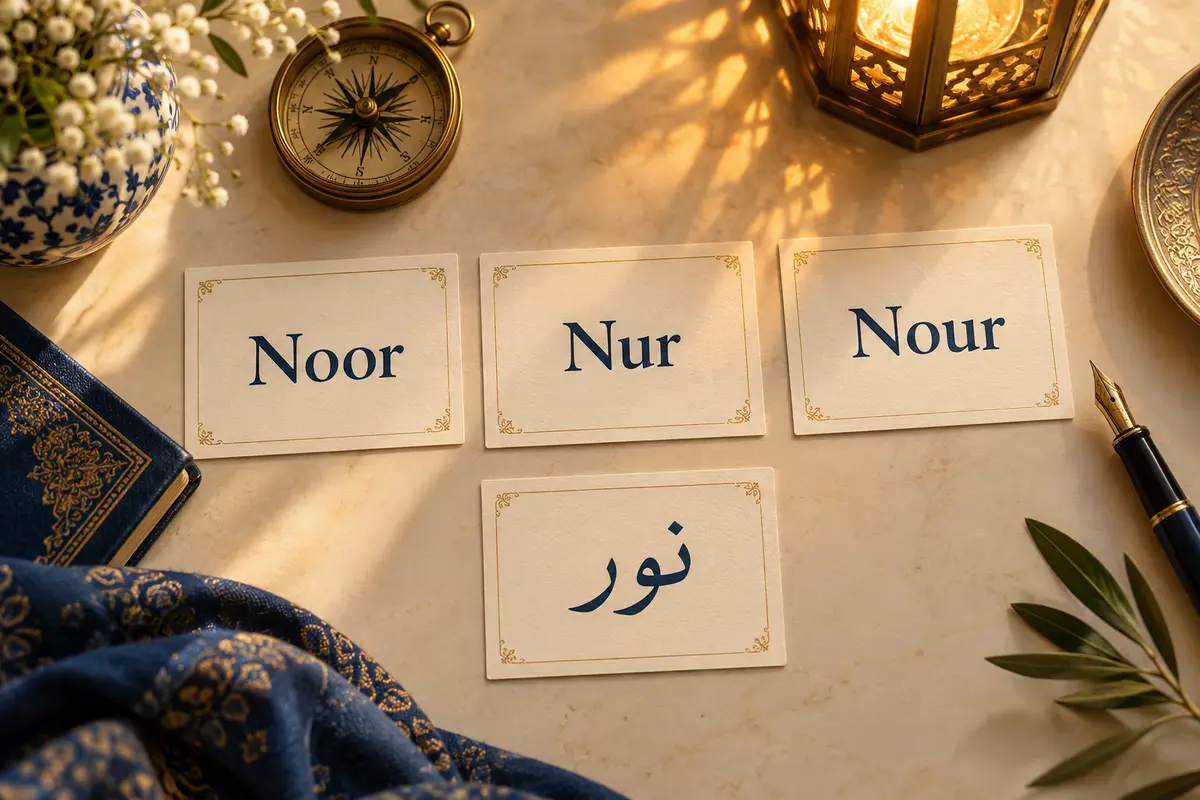
Noor, Nur, Nour, and Nūr
Noor uses two o letters to signal the long vowel to English readers. Nur is compact and common in Turkish, German-influenced, South Asian, and Southeast Asian contexts. Nour often appears in French-influenced spelling systems. Nūr is useful in academic writing because the macron marks the long vowel precisely.
All four can represent Arabic نُور. One spelling is not inherently more authentic than another. The best practical choice is usually the form already used by the family or the one that will remain consistent across passports, school records, healthcare files, and email addresses.
Some databases drop diacritics, so Nūr may become Nur. Multilingual families can write the full name in Arabic and Latin scripts before registration to catch spelling differences early.
Is Noor a girl’s name or a boy’s name?
Noor is used for more than one gender, but local patterns differ. In some Arab communities it is more familiar for girls; in other regions Nur is common for boys, girls, or as part of a compound name. A person’s country, language, and family tradition provide more useful context than a universal gender label.
Related forms can develop their own conventions. Noura, Nura, and Noora are often feminine, while Nuri is frequently masculine in several languages. These forms share a connection to light but are not always interchangeable in legal or family use.
If gender expectations matter to your decision, ask speakers from the community where the child will live. Real local usage may differ from a global baby-name list.
Noor name meaning in faith and literature
The word nūr has an important place in the Quran and in wider Islamic vocabulary, where light can appear literally or as a metaphor for guidance. This religious resonance is meaningful to many Muslim families, but Noor is also an ordinary Arabic word and a personal name used in varied cultural settings.
Compound forms show how the element works grammatically. Nur al-Din means “light of the religion” or “light of the faith.” The historical ruler Nur al-Din is discussed in the World History Encyclopedia account of Saladin, where the spelling appears as Nur ad-Din or Nur al-Din. This example documents the name element’s historical use rather than prescribing a belief for modern bearers.
Writers also use light as an image for discovery, safety, truth, memory, and renewal. A family may appreciate those associations while keeping the literal etymology—“light”—separate from later interpretation.
What Noor can symbolize today
Noor name meaning can inspire ideas of brightness, clarity, learning, warmth, or hope. In a family story, it might remember a joyful period, honor someone whose presence felt reassuring, or express a wish that a child will find knowledge and direction.
These are personal meanings rather than psychological facts. A child named Noor is not required to be cheerful, spiritual, calm, or academically gifted. Names can hold family hopes, but individuals build their own identities through experience, choices, and relationships.
For another Arabic name with a direct linguistic history, see our guide to Omar name meaning, origin, and pronunciation. The Layla name meaning guide similarly separates documented Arabic roots from modern symbolism.
Compound names and related forms
Noor can stand alone or appear in a compound. Examples include Nur al-Huda (“light of guidance”), Nur al-Din (“light of the faith”), and Nur al-Ayn, a phrase associated with the light or delight of the eye. Spelling and grammar may change when Arabic compounds move into English.
Related personal names include Noura, Nura, Noora, Nuri, Munir, and Munira. They belong to the same broad light-related word family, but each has its own grammatical form, pronunciation, and regional usage. Parents should verify the exact form rather than assuming every related name means precisely the same thing.
Compound names can also create spacing and hyphenation questions. Decide early whether official records will use Nuruddin, Nur al-Din, Nour El Din, or another established family spelling.
Middle names for Noor
Noor’s single syllable pairs easily with many middle-name lengths. A longer middle name can create a balanced rhythm, while another short name gives a crisp, modern sound. Examples for sound only include Noor Amelia, Noor Yasmin, Noor Alexander, Noor Elias, Noor Salma, and Noor Zayn.
Check the full name aloud, write the initials, and consider how the sounds meet at the boundary between Noor and the middle name. If the surname begins with r, say the combination several times to make sure it remains clear.
Meanings do not need to form a perfect slogan. Family significance, cultural fit, spelling consistency, and the sound of the complete name are usually more useful than forcing two symbolic glosses together.
Sibling-name ideas
Names that can sit comfortably beside Noor include Omar, Layla, Zayn, Lina, Sami, Adam, Hana, Yusuf, Mira, and Salma. Some share Arabic roots; others simply match Noor’s short, international sound.
Siblings do not need coordinated initials or matching meanings. Test the names when spoken quickly and make sure each child’s name remains distinct and complete on its own.
How to decide whether Noor fits
For parents researching Noor name meaning, start with the Arabic spelling, the pronunciation your family prefers, and the Latin spelling that will appear on official records. Compare Noor, Nur, and Nour beside the surname. If relatives use different languages, ask how each version will be read.
Next, decide which associations actually matter to you: the literal meaning of light, a religious connection, a family namesake, or the name’s concise sound. Document those reasons in your own words instead of relying on claims that the name guarantees luck, intelligence, or a radiant personality.
Finally, check initials, likely nicknames, database compatibility, and any compound-name spacing. The strongest choice is one your family can pronounce, spell, and explain with confidence.
Frequently asked questions
What does the name Noor mean?
Noor comes directly from Arabic نُور and means “light.” It can also carry contextual associations with illumination, guidance, clarity, or radiance.
Is Noor an Islamic name?
Noor has important Quranic and Islamic associations because nūr is used for light and guidance. It is also an Arabic word and personal name used across varied cultures; the name alone does not determine someone’s beliefs.
Are Noor and Nour the same name?
Usually, yes. Noor and Nour are established Latin-script spellings of Arabic نُور. Nur and scholarly Nūr are other common representations of the same word.
Is Noor a unisex name?
Noor is used for more than one gender. The balance varies by country and community, so local family usage is more informative than a single universal label.
Sources
- Quranic Arabic Corpus: root nūn-wāw-rā
- Library of Congress: Arabic Romanization Table
- World History Encyclopedia: Saladin and Nur ad-Din
For another short Arabic name with several established international spellings, explore Zayn name meaning, pronunciation, and spellings, which traces its beauty-and-adornment root without treating meaning as destiny.
A different Arabic naming tradition appears in Amir name meaning and Arabic origin, including how a historic title became a modern personal name.