Omar Name Meaning: Origin, Pronunciation, and Variants
Omar name meaning is usually explained through the Arabic name عُمَر, written more precisely in scholarly romanization as ʿUmar. It belongs to an Arabic root associated with life, lifetime, living, building, and flourishing. That is why English summaries often give meanings such as “long-lived,” “flourishing,” or “full of life.”
Those short glosses are useful, but they should not be treated as a promise about a child’s lifespan, fortune, or personality. Omar is a personal name with deep Arabic and Islamic history, several established spellings, and pronunciations that change naturally across languages. This guide explains the root, sound, variants, and cultural context without turning the name into a prediction.
Omar name meaning at a glance
| Feature | Guide | Context |
|---|---|---|
| Arabic spelling | عُمَر | Often romanized ʿUmar in academic writing and Omar or Umar in everyday English |
| Common meaning | Long-lived, flourishing, or full of life | A name meaning is linguistic heritage, not a guarantee about a person |
| Pronunciation | Roughly OO-mar in Arabic; OH-mar is common in English and Spanish | The initial Arabic consonant ʿayn has no exact everyday English equivalent |
| Major variants | Umar, ʿUmar, Omar, Omer, Ömer, Oumar | Some forms reflect different languages rather than a single “correct” spelling |
Omar name meaning in Arabic roots
The Arabic letters in Omar are ع م ر: ʿayn, mīm, and rāʾ. The Quranic Arabic Corpus entry for the root shows a broad word family. Its documented forms include verbs connected with maintaining, building, and granting life, as well as the noun ʿumur, meaning a lifetime or age.
Personal-name dictionaries often compress that word family into “long-lived” or “flourishing.” Both capture part of the association, but neither is a word-for-word biography of everyone named Omar. Arabic roots can generate related words with different grammatical patterns and meanings, so one concise English equivalent cannot express the whole family.
The name is traditionally masculine in Arabic usage. Families may choose it for its sound, heritage, a relative, or a respected historical namesake. A parent does not need to adopt every historical or religious association for the name to feel meaningful.
How to pronounce Omar
In careful Arabic, عُمَر is close to ʿUmar: two syllables, with a short u sound at the start and stress that may sound slightly stronger on the first syllable. The opening letter, ʿayn, is produced in the throat and does not have an exact equivalent in ordinary English spelling.
The Library of Congress Arabic Romanization Table represents ʿayn with a special mark and distinguishes short u from long ū. In practical English, most people omit the ʿayn mark and say either OH-mar or OO-mar. Spanish speakers commonly use an OH-mar sound, while speakers familiar with Arabic may begin closer to ʿU-mar.
There is no need to correct a family’s own established pronunciation. If you are meeting someone, the respectful choice is to follow how that person says and spells the name.
Omar, Umar, and ʿUmar
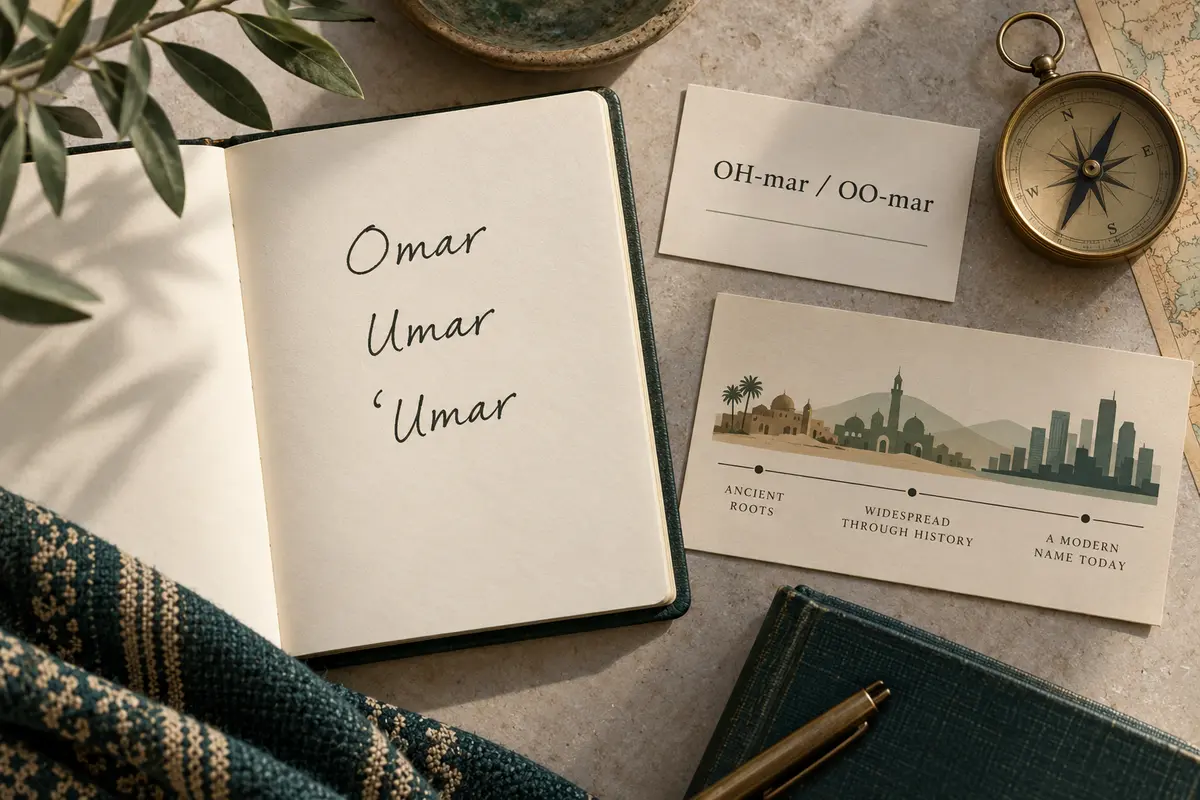
Omar, Umar, and ʿUmar can all point to the same Arabic name. ʿUmar is the most precise of these forms for formal romanization because it signals the initial ʿayn and the short u vowel. Umar keeps the initial vowel without a specialist character. Omar is a widely established international spelling and often matches local pronunciation conventions.
Choosing among them is usually a practical decision. Omar is immediately familiar in many English- and Spanish-speaking settings. Umar may make the Arabic vowel clearer and is common across South Asia, Southeast Asia, and other Muslim communities. The diacritic in ʿUmar is helpful in academic or historical writing but can be inconvenient in forms, email addresses, and databases.
None of the three makes the bearer more authentic. Legal documents should use one consistent spelling, while family members can still recognize the other forms as equivalents.
Other international spellings
The name traveled through many languages, producing forms such as Turkish Ömer and French-influenced Oumar. Omer may be a regional form related to Omar, but it can also represent a separate Hebrew name and word. The identity of the bearer matters more than the letters alone.
Amr, written عَمْرو, is another Arabic masculine name and should not automatically be treated as a spelling of Omar. The words share a root and look similar in Latin letters, but the Arabic spelling and pronunciation differ. The Library of Congress table even lists ʿAmr as a special personal-name example, helping distinguish it from ʿUmar.
For passports or multilingual families, compare how a spelling will appear in Arabic, English, and the language of the issuing country. Consistency can prevent mismatches across school, travel, and medical records.
Omar name meaning in history and culture
The best-known early bearer is ʿUmar ibn al-Khaṭṭāb, the second caliph of the Rashidun period, who ruled from 634 to 644 CE. A historical overview from World History Encyclopedia describes his place in the formation and expansion of the early caliphate. His prominence helped keep the name visible across Arabic-speaking and Muslim communities for centuries.
Another internationally known bearer is Omar Khayyam, the Persian mathematician, astronomer, poet, and scholar. The name has also appeared among artists, athletes, politicians, scientists, and fictional characters across many countries. These bearers show the name’s geographic reach, but they do not define the personality of a new child.
Religious and political interpretations of historical figures can differ among communities. A name guide can document influence without asking every family to share one view of history.
What the name can express today
For some families, Omar expresses continuity with Arabic language and Muslim heritage. For others, it honors a grandparent, works smoothly in several languages, or simply has a strong, compact sound. Its four letters in English make it easy to read, while the Arabic form preserves a distinctive consonant and older linguistic history.
The Omar name meaning may inspire associations with vitality, endurance, growth, or a life well lived. Those are symbolic wishes, not personality traits established by a name. An Omar can be quiet or outgoing, traditional or unconventional, and his choices will matter more than an etymological gloss.
If you are comparing Arabic names, our guide to Layla name meaning, origin, and pronunciation uses the same distinction between documented language and modern associations. You can also browse the English names and origins guides as more entries are published.
Nicknames and short forms
Omar is already short, so many families use it without a nickname. Affectionate forms depend on language and household. English-speaking families may use O or Omi; Arabic-speaking relatives may create pet forms based on local dialect, family habit, or a child’s early pronunciation.
A nickname does not need a separate dictionary origin to be valid. Before printing personalized items, confirm whether the family prefers Omar, Umar, a diacritic, or a familiar short form.
Middle names for Omar
Omar pairs easily with both short and long middle names. Rhythm usually matters more than a hidden symbolic formula. A one-syllable or three-syllable middle name can balance Omar’s two syllables, while repeating an m or r sound can make the full name feel more connected.
Examples for sound only include Omar Zayn, Omar Elias, Omar Alexander, Omar Kareem, Omar Sami, and Omar Gabriel. Families should check the full meaning, initials, surname, and cultural fit before choosing. If the child will use Arabic and Latin scripts, write the complete name in both to catch spelling or order issues early.
Sibling-name ideas
Names that often sit comfortably beside Omar include Layla, Noor, Zayn, Sami, Adam, Lina, Salma, Yusuf, and Hana. The best match depends on whether parents want shared Arabic roots, similar length, a cross-cultural sound, or completely independent names.
Siblings do not need coordinated meanings. Avoid forcing a theme that makes one child’s name feel secondary, and check that the names remain distinct when called quickly at home.
How to decide whether Omar fits
For parents researching Omar name meaning, the clearest starting points are the Arabic spelling, the family’s preferred pronunciation, and the practical spelling needed for official records.
Say the full name aloud in the languages your family uses. Write Omar and Umar beside the surname, test the initials, and ask close relatives how they naturally pronounce each version. Check official transliteration rules if birth registration or dual citizenship is involved.
Then separate personal reasons from internet claims. A strong choice can honor family, language, faith, history, or sound without promising longevity, prosperity, or a particular character. The most lasting meaning will come from the person and the relationships around him.
Frequently asked questions
What does the name Omar mean?
It comes from an Arabic root associated with life, lifetime, living, building, and flourishing. Common short translations include “long-lived,” “flourishing,” and “full of life.”
Is Omar the same name as Umar?
Usually, yes. Omar and Umar are established Latin-script spellings of Arabic عُمَر; ʿUmar is a more precise scholarly romanization. Families may prefer different forms.
Is Omar an Islamic name?
Omar has major Islamic historical associations, especially through ʿUmar ibn al-Khaṭṭāb, and it is common in Muslim communities. It is also used across languages and cultures, and choosing it does not determine a person’s beliefs.
Does Omar mean long life?
“Long-lived” is a traditional English gloss connected to the Arabic root, but a name cannot predict lifespan or health. It is better understood as linguistic heritage and a positive wish.
Sources
- Quranic Arabic Corpus: root ʿayn-mīm-rā
- Library of Congress: Arabic Romanization Table
- World History Encyclopedia: Umar ibn al-Khattab
For another Arabic name with several established international spellings, explore Noor name meaning, pronunciation, and spellings, which explains how root history differs from personality predictions.
A concise Arabic name from a different root appears in Zayn name meaning and Arabic origin, including how Zayn, Zain, and Zein represent the same name across writing traditions.