Amal Name Meaning: Arabic Origin, Pronunciation, and Gender Use
Amal name meaning comes directly from Arabic: أَمَل means “hope” or “aspiration.” It is a short name with a clear dictionary connection, but its simplicity can hide useful details about pronunciation, gender use, and related forms such as آمال.
The name offers a positive idea without predicting a person’s character or future. A family may choose Amal for its language, sound, or personal history. Those reasons belong to the family; the etymology explains the word behind the name.
Amal name meaning at a glance
| Detail | Amal | Why it matters |
|---|---|---|
| Arabic script | أمل | The singular noun and given name |
| Meaning | Hope, aspiration | A documented word meaning, not a personality forecast |
| Pronunciation | AH-mal | Two syllables; the Arabic form begins with a glottal onset |
| Gender use | Feminine and masculine | Actual patterns vary by country, family, and community |
| Related form | آمال (Amaal) | A plural form meaning “hopes” or “aspirations” |
The most reliable explanation is therefore concise: Amal is an Arabic given name built from the ordinary word for hope. More specific claims should be checked against the spelling and naming tradition the family actually uses.
How Amal name meaning comes from Arabic
The Arabic name is written أمل, or أَمَل when short vowels are shown. The Arabic Amal entry at Behind the Name gives the meaning “hope, aspiration,” records the pronunciation /ˈʔa.mal/, and connects the name with the Arabic root أمل, “to hope for.” Its citation points to Hans Wehr’s dictionary of modern written Arabic.
The Academy of the Arabic Language root entry places الأَمَل in the same word family. That primary lexical evidence supports the direct “hope” explanation without requiring a symbolic story or a list of imagined traits.
Hope is an idea a family may value, yet the name does not guarantee optimism, success, patience, or any other temperament. A name can express an intention at the time of naming while its bearer develops as an individual.
For another Arabic name tied to an ordinary positive noun, compare Farah’s connection with joy. The two words are related by theme, not by root.
Amal, أَمَل, and pronunciation
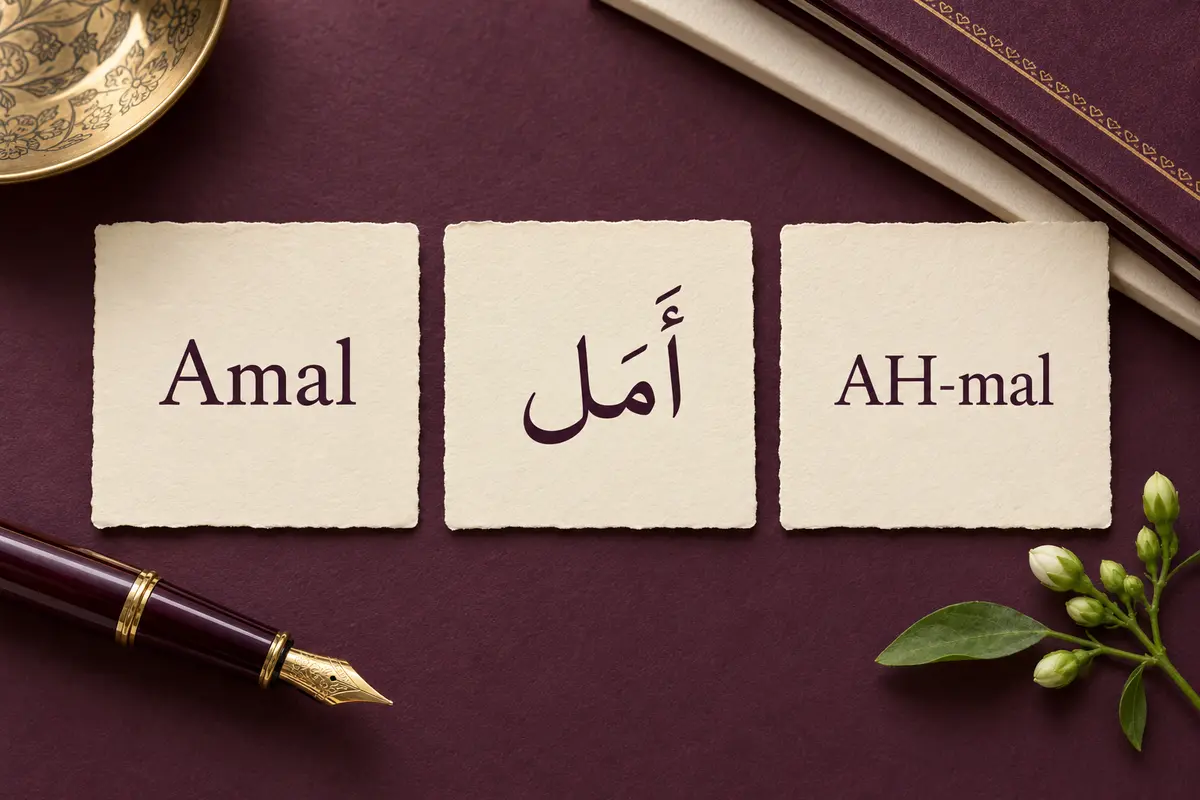
AH-mal is a practical English guide. Arabic pronunciation begins with a brief glottal onset represented by the letter hamza on alif, followed by two clear syllables. The first syllable receives the main stress in the pronunciation recorded by Behind the Name.
No English spelling can capture every accent exactly. The final consonant should remain a clear l, while the vowels may sound slightly different across Arabic dialects and multilingual families. The person’s own pronunciation is always the best guide.
In everyday Arabic, short-vowel marks are usually omitted, so أمل is the normal written form. The marked version أَمَل is helpful in a pronunciation guide. If the name will be engraved, tattooed, or printed permanently, have an Arabic reader check the final artwork; decorative fonts can separate letters or misplace marks.
Is Amal a girl’s name or a boy’s name?
Amal is documented in Arabic as both feminine and masculine. That does not mean the balance is identical everywhere. A name may be strongly associated with women in one country or generation and have established masculine use in another.
It is safer to describe Amal as an Arabic name with feminine and masculine usage than to impose one universal label. Family records, local naming customs, and the bearer’s identity provide the context that a global baby-name list cannot.
This is similar to many names whose use crosses communities. Our guide to Sami’s Arabic and Finnish histories shows why the original language and family context matter more than assumptions based on Latin spelling alone.
Amal and Amaal are related but not identical
أمل (Amal) is singular: “hope” or “aspiration.” آمال (Amaal) is a related plural form: “hopes” or “aspirations.” The Aamaal name entry records that plural relationship and a distinct Arabic pronunciation.
The difference is visible from the first Arabic letter and the longer opening vowel in آمال. Because English records do not always mark vowel length consistently, Amal and Amaal may be confused in databases. They should not be treated as automatically interchangeable when checking a person’s official spelling.
Amel can add another layer of ambiguity. A Maghrebi Arabic form written آمال may be represented as Amel in French-influenced spelling, while a separate Bosnian Amel also exists. Script, country, and family pronunciation are better evidence than a single Latin-letter match.
Spelling Amal across documents
Amal is already a compact transliteration and usually needs no punctuation. Even so, passports and certificates should follow the family’s established Latin spelling exactly. Changing one vowel to match an English speaker’s expectation can create mismatched records.
When both Arabic and Latin forms appear, save a verified reference that pairs Amal with أمل. Ask the bearer or family before “correcting” a record to Amaal, Amel, or another related form. Those alternatives may represent a different Arabic spelling or a different naming tradition.
For comparison, Nadia’s Arabic and Slavic origins also demonstrate how a familiar Latin spelling can carry more than one documented history.
Popularity and public records
Name popularity depends on place, year, spelling, and the sex category used by the dataset. The U.S. Social Security Administration baby-name tool allows searches by year and sex category. Its background notes explain that its lists are based on U.S. Social Security records meeting defined reporting conditions.
That tool can answer a narrow question about recorded U.S. use. It cannot establish the name’s worldwide popularity, combine every transliteration, or decide how a family understands Amal. Use local civil data where available and avoid converting a ranking into a prediction about whether a name will feel unique.
Choosing Amal for a child
The Amal name meaning is positive and easy to explain, but a good naming decision also considers sound, records, and family use.
Start with the full name. Say Amal with the middle and family names, check initials, and consider how both Arabic and Latin forms will appear on school, travel, and medical records. If relatives use different dialects, listen to their pronunciations before settling on an English guide.
Then write a short family explanation: “Amal is Arabic for hope,” followed by the personal reason for choosing it. This keeps dictionary meaning separate from family symbolism. It also gives the child room to decide what the name means in their own life.
Finally, avoid personality promises. The Amal name meaning can be a thoughtful source of association, but it does not determine whether someone will be hopeful, gentle, ambitious, spiritual, or successful.
Frequently asked questions
What is the main Amal name meaning?
Amal means “hope” or “aspiration” in Arabic. It comes from the Arabic word and root أمل, connected with hoping for something.
How do you pronounce Amal?
AH-mal is a useful two-syllable English guide. Arabic begins with a brief glottal onset, and exact vowels vary slightly by dialect and speaker.
Is Amal used for girls or boys?
Both. Reliable name references document feminine and masculine Arabic use, although the balance can differ by country, generation, and family.
Are Amal and Amaal the same name?
They are related but not identical. Amal أمل is singular, “hope,” while Amaal آمال is plural, “hopes” or “aspirations.” Follow the bearer’s actual spelling.