
Artemis Name Meaning: Origin & Pronunciation Guide
Artemis name meaning often appears online as “goddess of the hunt,” “moon,” or even “bear.” Those phrases describe parts of Greek mythology or possible interpretations, but they do not settle the name’s original linguistic meaning. If you are curious about Artemis as a name for a child, a character, or a historical reference, the most useful answers are its Greek forms, how to pronounce it, what scholars can confirm, and which popular definitions remain uncertain.
Quick answer: Artemis is an ancient Greek feminine name associated with the Greek goddess of hunting, wild nature, and the protection of young people. Scholars have not established its exact etymology; proposed connections with Greek words for “safe” or “bear” are debated rather than proven translations. English speakers usually stress the first syllable, roughly AR-tuh-miss in American usage.
Artemis Name Meaning: Greek Origin, Uncertain Etymology
Artemis is a name with a long history in Greek language and religion. Its ancient Greek spelling is Ἄρτεμις, while modern Greek typically writes Άρτεμις. The familiar English spelling, Artemis, is a Latin-letter representation of the Greek name. For Artemis name meaning, the documented spelling is more secure than any proposed literal translation.
You may find websites saying the name means “safe,” “unharmed,” “bear,” or “butcher.” These ideas come from attempts to connect Artemis with older Greek words or a possible non-Greek linguistic background. However, the arguments disagree, and the word’s original derivation remains unresolved. An academic study of the name’s etymology reviews competing explanations, including possible non-Greek influences, without settling one literal translation. For Arabic readers, see معنى اسم أرتميس: دليل الأصل والنطق والكتابة for the same distinction in Arabic, with an interactive name guide.
Some researchers look to Bronze Age records written in the Linear B script for early forms possibly related to the name. Others compare Anatolian languages, historical cult titles, and Greek vocabulary. These are scholarly investigations into a very old name, not an answer that can be summarized responsibly as one certain English word.
For practical use, an accurate Artemis name meaning entry should say: Greek name traditionally borne by the goddess Artemis; precise word origin uncertain. Anyone who prefers the associations of wilderness, archery, or independence may mention them as cultural symbolism, without presenting them as dictionary definitions or built-in personality traits.
That distinction is also valuable with names that have several possible histories. Our guide to Zara name meaning shows how a familiar modern spelling may connect to multiple traditions, while Hana name meaning explores different languages rather than assuming one universal origin.
Artemis Name Meaning: Interactive Origin & Pronunciation Guide
Artemis Name Origin Guide
Explore the name by topic
Choose a topic to see the documented form, pronunciation, and historical distinction. The illustration changes with the selection.
Accuracy note: The name’s exact linguistic derivation is uncertain. Mythological roles are not the same as the original meaning of the word. This guide cannot predict personality, identity, or destiny.
Check the sources: Cambridge Dictionary · Behind the Name · Graeco-Latina Brunensia.
Choose “Origin & etymology” first. The result explains the documented Greek form and why a proposed root is not automatically a proven meaning. Then select “Pronunciation” to compare the sounds used in English, or “Greek spelling & related names” to see how Artemis differs from Artemisia and Diana. The illustration changes with each choice so the topics are easy to distinguish.
Finally, open “Mythology versus name meaning.” That panel explains why the goddess’s activities are part of the name’s cultural history but are not an exact translation of its syllables. For example, “huntress” may describe the mythological figure, while “Artemis means huntress” claims a settled derivation that the sources do not establish.
This Artemis name meaning guide works as a reference selector. It does not calculate someone’s future, assign a personality, or generate a supposedly authentic ancient Greek name. You can change choices without entering personal details. For a different name with well-known Arabic roots, compare our Aaliyah name meaning article, which explains why the strength of an etymological claim depends on the actual language evidence.
How to Pronounce Artemis: English and Greek Spelling
In English, Artemis normally has three syllables, with the main stress on the first. Studying Artemis name meaning also means checking how different accents pronounce it. A useful American-style approximation is AR-tuh-miss. English speakers in Britain may make the middle vowel closer to the short “i” in “sit.” Accent and individual usage can vary, but stressing the last syllable is not the typical English dictionary pronunciation.
The Cambridge Dictionary pronunciation entry gives UK /ˈɑː.tɪ.mɪs/ and US /ˈɑːr.t̬ə.mɪs/, along with audio examples. Listening to both is more reliable than trying to recreate the entire sound from an English phonetic spelling. The English r sound, in particular, can differ across accents.
In Greek writing, the ancient name is Ἄρτεμις, while the modern Greek form Άρτεμις uses today’s accent convention. The acute accent identifies stress on the first syllable. An English pronunciation cannot reproduce the voice of every ancient Greek speaker of how every ancient Greek speaker pronounced the word; languages and regional accents change over centuries.
Do not confuse **Artemis**, **Artemisia**, and **Diana**. Artemisia is a related but distinct name with its own history. Diana is the Latin name of a Roman goddess whom Romans identified with Artemis. Diana is not a different spelling of Artemis, nor an English translation of the uncertain original meaning.
Artemis the Greek Goddess: History Is Not a Literal Name Definition
Greek mythology portrays Artemis as a divine huntress associated with wild animals, forests, and young people. Many stories identify her as the daughter of Zeus and Leto and the twin sister of Apollo. Ancient worshippers also connected her with childbirth and transitions in childhood. These descriptions help explain why modern people may associate the name with independence, wilderness, or protection.
The Behind the Name historical entry identifies Artemis as a figure of Greek mythology and the twin of Apollo, and it separately notes the uncertainty of the original name. The mythology continued to develop through many local and regional traditions beyond the familiar image of a huntress.
Some Artemis name meaning summaries call the mythological figure a moon goddess. Moon associations appear in later traditions, but she should not be reduced to a single fixed identity, and “moon” is not a verified literal translation of her name. Greek and Roman myth developed through centuries of storytelling, artistic representation, and local traditions.
The Romans identified Artemis with Diana, which is why an artwork or a book may refer to “Artemis/Diana.” The pair shares mythological roles, but the two written names have separate language histories. A baby called Artemis is named after, or shares a name with, the Greek figure; the name does not imply that the child has supernatural qualities.
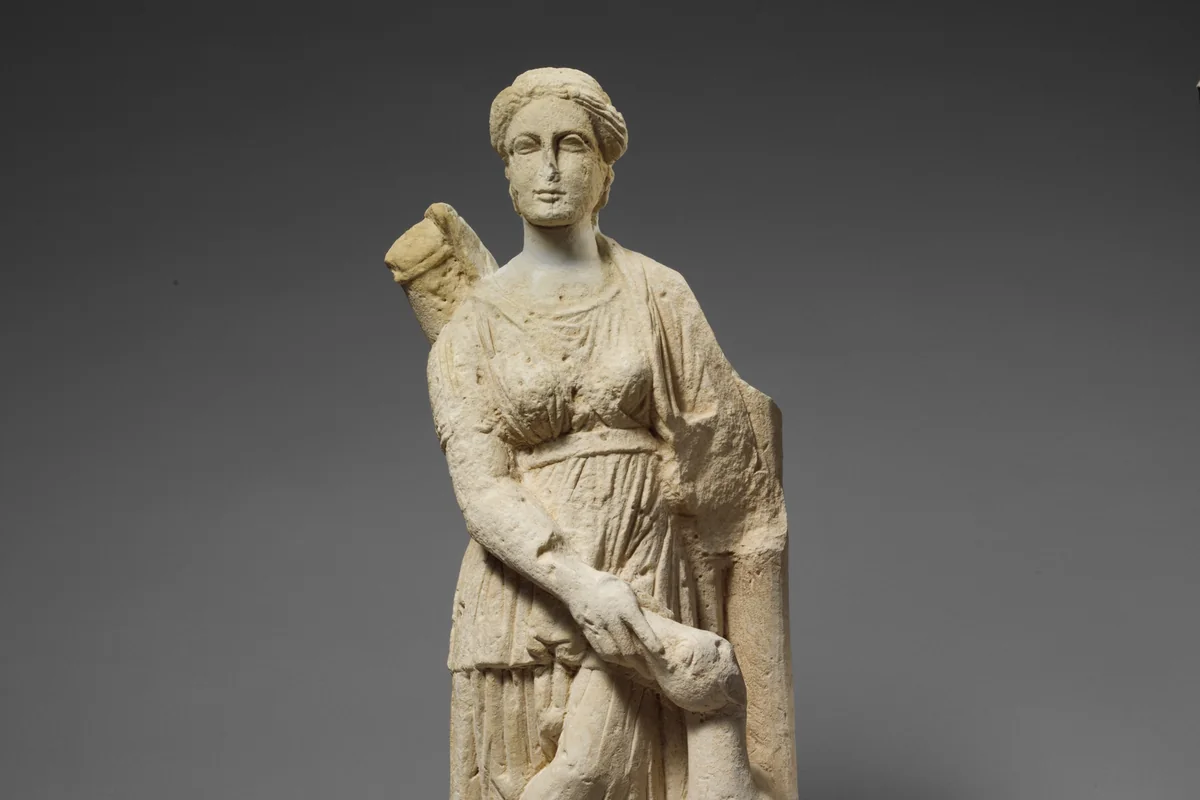
A concrete object can make the historical context clearer. The Metropolitan Museum of Art’s Hellenistic limestone statuette of Artemis with a fawn dates to approximately 310–30 BCE and illustrates the figure’s association with animals. Its caption describes an ancient artwork, not proof of any proposed linguistic derivation.

Artemis as a Modern Given Name: What Matters Beyond the Myth
Today, families use Artemis as a feminine given name, especially where readers recognize Greek cultural references. English readers also encounter it in books, games, popular culture, and discussions of mythology. However, without a country and date, it would be misleading to claim a universal popularity rank or a sudden rise in every region.
For someone considering the name, there are a few grounded questions. Can family members comfortably pronounce it? Is the spelling familiar enough for forms and school records where you live? Would you be happy to explain the connection to Greek mythology? These practical issues matter more than internet promises that a name makes a person brave, mysterious, or naturally independent.
Some readers prefer names with clearer linguistic roots. For comparison, our Iman name meaning guide explores a word with documented language use, while Artemis offers a well-attested mythological bearer even though researchers still debate its linguistic root. This helps distinguish “we know who bore the name” from “we know exactly what the root means.”
When you see a long list of supposed Artemis name meaning traits—loyal, creative, independent, protective—treat it as modern symbolism or opinion, not linguistic evidence. The same applies to numerology scores, lucky dates, or rankings without sources. A carefully sourced name profile should make clear which details come from dictionaries and history, and which are personal associations.
Frequently Asked Questions About Artemis Name Meaning
Does Artemis literally mean “goddess of the hunt”?
No established etymology translates the word Artemis as “goddess of the hunt.” Hunting was an important role of the mythological Artemis, and that is why the association is common. The linguistic root of the name remains uncertain. It is more accurate to separate the deity’s role from a literal word meaning.
How do you pronounce Artemis in English?
English usually stresses the first of three syllables, roughly AR-tuh-miss in the United States. The Cambridge Dictionary also provides a slightly different British pronunciation. Use its audio and IPA spelling to hear the distinction rather than relying on one approximate transcription.
Is Artemis the same name as Diana or Artemisia?
No. Diana is the Roman counterpart of the mythological goddess, but not an interchangeable spelling of the Greek name. Artemisia is a related historical given name with a distinct form. Similar mythology or word roots do not make different names identical.
Is Artemis considered a girl’s name?
Artemis is traditionally feminine in Greek mythology and is used as a feminine given name. Modern naming practices differ between languages and families, so avoid treating any one culture’s convention as a universal rule. The historical character gives the name cultural context without restricting a person’s identity.
Is the meaning of Artemis “moon,” “bear,” or “safe”?
Those are associations or proposed etymological links, not an agreed dictionary definition. Some historical theories compare the name with words for “bear” or “safe,” and moon imagery connects with the mythological figure in some traditions. Academic sources still describe the root as uncertain.
The Takeaway: A Well-Known Name With an Unsettled Root
Artemis name meaning is best explained in two parts: the name has a documented Greek history connected to the goddess Artemis, while its original literal derivation remains debated. The pronunciation has standard English dictionary forms, and the Greek spellings are known. Use the name guide in the second section to compare origin, pronunciation, spelling, and mythology without confusing one with another. A name can carry rich cultural associations even when no single-word translation is historically secure. For more examples, browse our Names & Origins collection.
For a related guide, read Elio Name Meaning: Origins & Variants Comparison.
Artemis belongs to an ancient Greek naming tradition. To see why a familiar-looking spelling can have separate histories, compare Ayla name meaning and origins, which distinguishes Turkish “halo” from a Hebrew tree-related transcription.