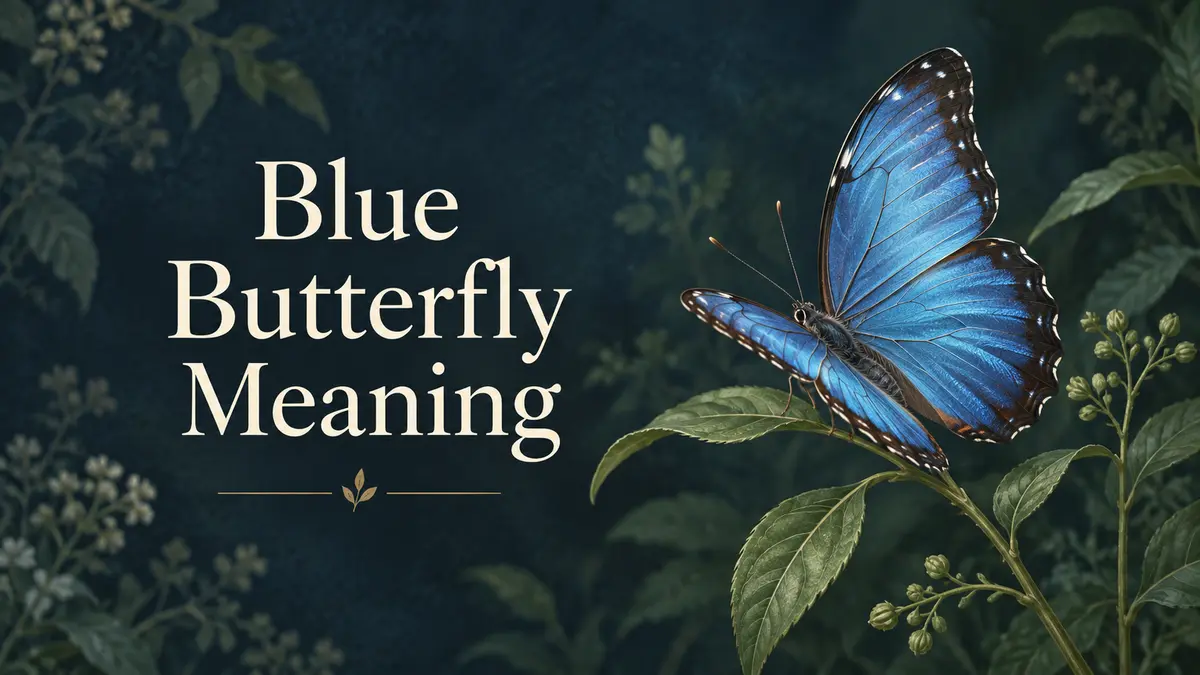
Blue Butterfly Meaning: Symbolism, Color, and Context
Blue butterfly meaning depends on where you encounter the image and what it means to the person using it. Someone might choose a blue butterfly to express calm, hope, a personal change, or a treasured memory. These are possible interpretations, not a fixed code or a prediction that follows from seeing an insect.
The most useful distinction is between the butterfly itself and the story we attach to it. A living butterfly has a species, a habitat, and a life cycle. A butterfly in a tattoo, painting, or message can carry an intention that only its creator fully knows. Keeping those layers separate makes the symbol more interesting, not less meaningful.
What does a blue butterfly symbolize?
A blue butterfly can serve as a personal symbol of change with a gentle or hopeful tone. For example, someone starting a new chapter might connect the butterfly’s changing form with their own experience. Another person might simply love blue wings. Neither interpretation needs to speak for everyone else.
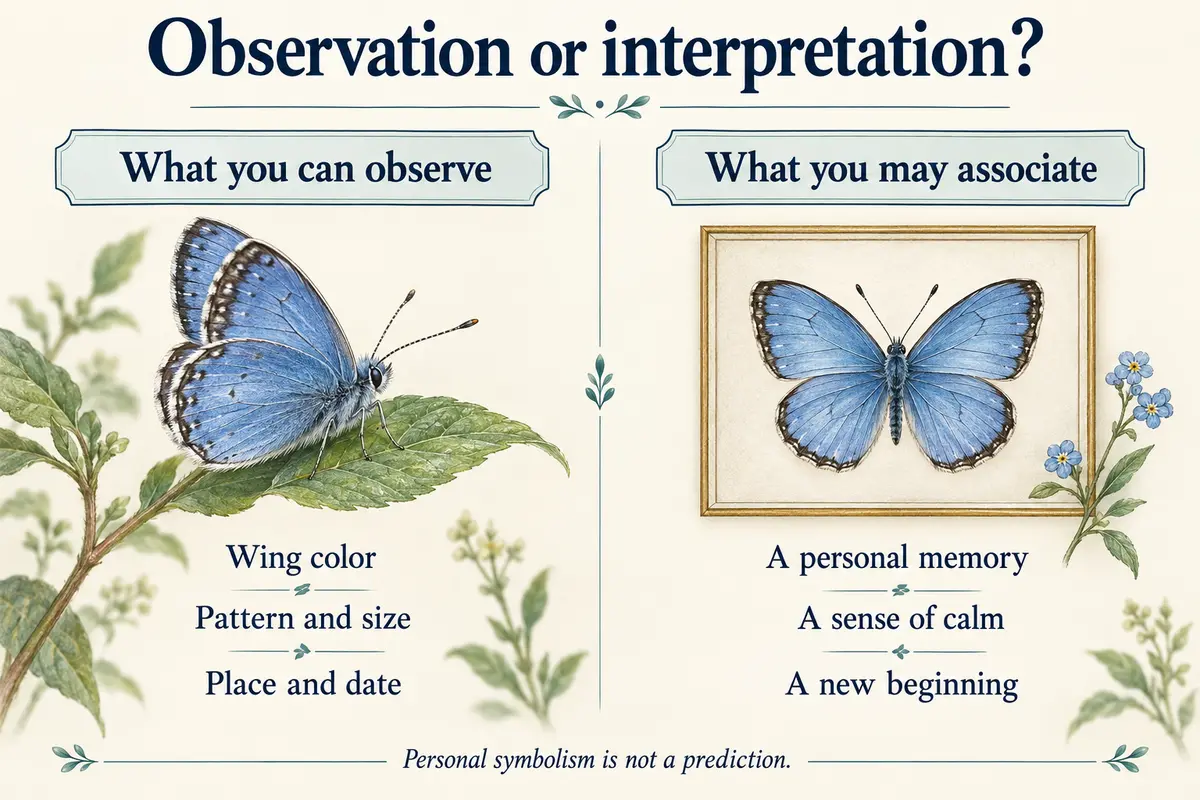
Rather than asking for the one correct definition, consider what surrounds the image. A date can point toward remembrance. A handwritten message might explain a wish for encouragement. Meanwhile, a butterfly in a field guide is there to help identify an animal, not to communicate a hidden message.
Blue butterfly meaning at a glance
The examples below offer ways to read the image in context. They are not evidence of universal beliefs, and several can apply at once.
| Setting | Possible interpretation | What to check |
|---|---|---|
| A personal tattoo | A new chapter, a memory, or a favorite design | The wearer’s explanation |
| A sympathy card | A gentle image of remembrance | The message and the recipient’s wishes |
| A painting or illustration | Contrast, delicacy, movement, or a chosen theme | The artist’s notes and surrounding details |
| A text message | A decorative flourish or a shared reference | The conversation, not the symbol alone |
| A living butterfly | An encounter with local wildlife | Species, wing pattern, place, and season |
Why the color blue can change the impression
Imagine the same butterfly drawn in pale blue, deep navy, and vivid turquoise. Each version may feel different to you. Pale blue might bring the sky to mind, while a darker shade could feel more reflective. However, those responses depend on the viewer, the setting, and the rest of the design.
Color therefore gives you a clue to explore, not an answer to impose. Ask whether the blue has a personal connection: a favorite dress, a place by the sea, or a color someone loved. For comparison, our guide to white butterfly symbolism in context explores how another color can shape an interpretation.
What makes a butterfly’s wings look blue?
Some blue wings have a physical explanation that is striking in its own right. A University of Vermont educational resource on the giant blue morpho explains that tiny structures on its wing scales produce the brilliant blue. Layers within those structures interact with light; the color is not simply blue pigment.
This example concerns morpho wings, not every butterfly with blue in its name. It also does not establish a spiritual property. Instead, it shows why observation matters: a beautiful effect can have a natural explanation while still inspiring wonder or an artist’s imagination.
Not every blue butterfly is a blue morpho
“Blue butterfly” is a description, not a single species name. A small blue insect in a European meadow should not automatically be identified as a tropical morpho. Size, location, wing markings, and the underside of the wings all provide better clues than color alone.
The Wildlife Trusts’ guide to blue butterflies also shows why names can mislead. Some members of the group look mostly brown, and males and females can differ. For identification, consult a local guide rather than using a symbolic illustration as a reference.
Change and new beginnings: a metaphor, not a forecast
The butterfly’s life cycle provides a clear starting point for a metaphor about change. The Florida Museum describes four stages: egg, larva, pupa, and adult. These are biological stages, each with a different role in the insect’s life.
A person can borrow that changing form to represent a move, a creative project, or another transition. However, their life does not need to follow the insect’s pattern. The symbol can encourage reflection without promising that every change will be easy or that a particular outcome is coming.
Is a blue butterfly a sign of good luck?
You can describe a pleasant encounter as lucky in an everyday sense: you happened to notice something beautiful. That is different from claiming the sighting predicts money, romance, or success. Blue butterfly meaning does not provide a reliable way to forecast events.
If someone shares a specific family belief, listen to how they explain it. A family story can matter deeply without becoming a rule for everyone. Likewise, a personal spiritual reading should remain clearly identified as a belief, rather than a fact established by the butterfly’s appearance.
Remembrance and personal connections
A blue butterfly might recall someone who loved that color or a day spent together outdoors. In that case, the connection comes from a relationship and a memory. You do not need to claim that the insect carries a message in order to value the moment.
When choosing a memorial card or gift, let the recipient’s preferences guide you. A simple line such as “This reminded me of our walk together” leaves room for their own response. By contrast, declaring what a sighting must mean can put an unwanted belief onto a deeply personal experience.
Choosing a blue butterfly tattoo
For a tattoo, start with the story you want to tell. You might want a detailed wing pattern, a small outline, or an abstract splash of blue. These are different visual choices, even if the underlying intention is the same.
Before meeting an artist, work through three questions:
- What does the image represent to me, in one plain sentence?
- Do I want a recognizable species or a clearly stylized butterfly?
- Which details are personal, and which are only decorative?
That short brief is more useful than collecting unrelated symbolic claims. If a design mixes blue and dark wings, our discussion of black butterflies in art and remembrance can help you think about context without treating colors as a rigid dictionary.
Dreams, messages, and artwork
In a dream, a blue butterfly has no single meaning that an online guide can verify for you. You can reflect on the setting and your own associations, but the image does not establish a prediction or diagnosis. A recent photograph or conversation may be a more useful starting point than a list of omens.
Similarly, a butterfly in a message does not reveal another person’s intentions by itself. Look at the words around it and your shared context. In artwork, the title or the artist’s explanation may tell you more than a general symbolism page ever could.
Frequently asked questions
What is the spiritual meaning of a blue butterfly?
Some people choose it as a personal image of hope, peace, or change. There is no single spiritual definition that applies to every person or tradition. A specific claim needs a named source and context.
Does seeing a blue butterfly mean good news is coming?
No sighting establishes that good news will follow. You can enjoy it as a welcome moment without treating it as evidence about the future.
Does a blue butterfly always represent someone who died?
No. It can have a private connection to remembrance, but it can also be decorative or refer to something entirely different. The person using the image is the best guide.
Are all blue butterflies rare?
No single rarity claim fits every species or location. Identify the butterfly first, then check a reliable local wildlife source. A color description alone cannot tell you how common an insect is.
Ultimately, blue butterfly meaning is most useful when the context stays visible. Notice the animal, ask about the artwork, and leave room for personal stories. A symbol can be important without carrying a universal message.
Sources
- University of Vermont — The Giant Blue Morpho Butterfly
- The Wildlife Trusts / BBOWT — A guide to the blue butterflies
- Florida Museum — Butterfly Life Cycle
For a warmer color comparison, explore yellow butterfly imagery in symbols and nature and how its meaning changes by setting.
For a warmer visual contrast, consider orange butterfly imagery in nature, art, and personal memory and the details that give each design its meaning.