Sami Name Meaning: Arabic and Other Origins Explained
Sami name meaning depends on the language behind the name. In Arabic, سَامِي is connected with height and elevation, giving meanings such as “elevated,” “sublime,” or “lofty.” In Finnish, Sami is a familiar form of Samuel. These are separate naming histories that happen to share the same Latin spelling.
That distinction matters more than a long list of supposed personality traits. A name can preserve language, family memory, or affection, but it does not predict temperament, luck, or destiny. The best explanation begins with the spelling, pronunciation, and tradition a particular family intends.
Sami name meaning at a glance
| Context | Meaning or formation | Useful detail |
|---|---|---|
| Arabic سَامِي | Elevated, sublime, lofty | From the root سما, associated with being high |
| Finnish Sami | Diminutive of Samuel | A different route from the Arabic name |
| Arabic سَمِيع or سَامِع | Hearing or listening | A distinct Arabic spelling sometimes transliterated similarly |
| Sámi | Name of an Indigenous people and their languages | Not a dictionary meaning of the given name |
The shared spelling does not make these entries interchangeable. Arabic vowel length, Arabic consonants, Finnish formation, and the accented spelling Sámi all carry information that plain Latin letters can hide.
How Sami name meaning comes from Arabic
The Arabic masculine name is written سامي, or سَامِي with short-vowel marks. The Arabic Sami entry at Behind the Name gives the pronunciation /saː.miː/ and translates it as “elevated, sublime, supreme.” It traces the name to the root سما, “to be high,” citing Hans Wehr’s Arabic dictionary.
The Academy of the Arabic Language entry for السُّمُوّ places the noun for elevation in the same family of words. This supports a linguistic explanation centered on height or loftiness rather than a claim that a person bearing the name is socially superior.
Parents may choose the name because the idea of aspiration feels meaningful, because it honors a relative, or simply because they value its sound. Those are personal reasons. The root supplies word history, not instructions for how a child must behave.
For another Arabic masculine name whose history should be separated from personality claims, compare our guide to Amir’s Arabic origin and use.
Sami, سَامِي, and pronunciation
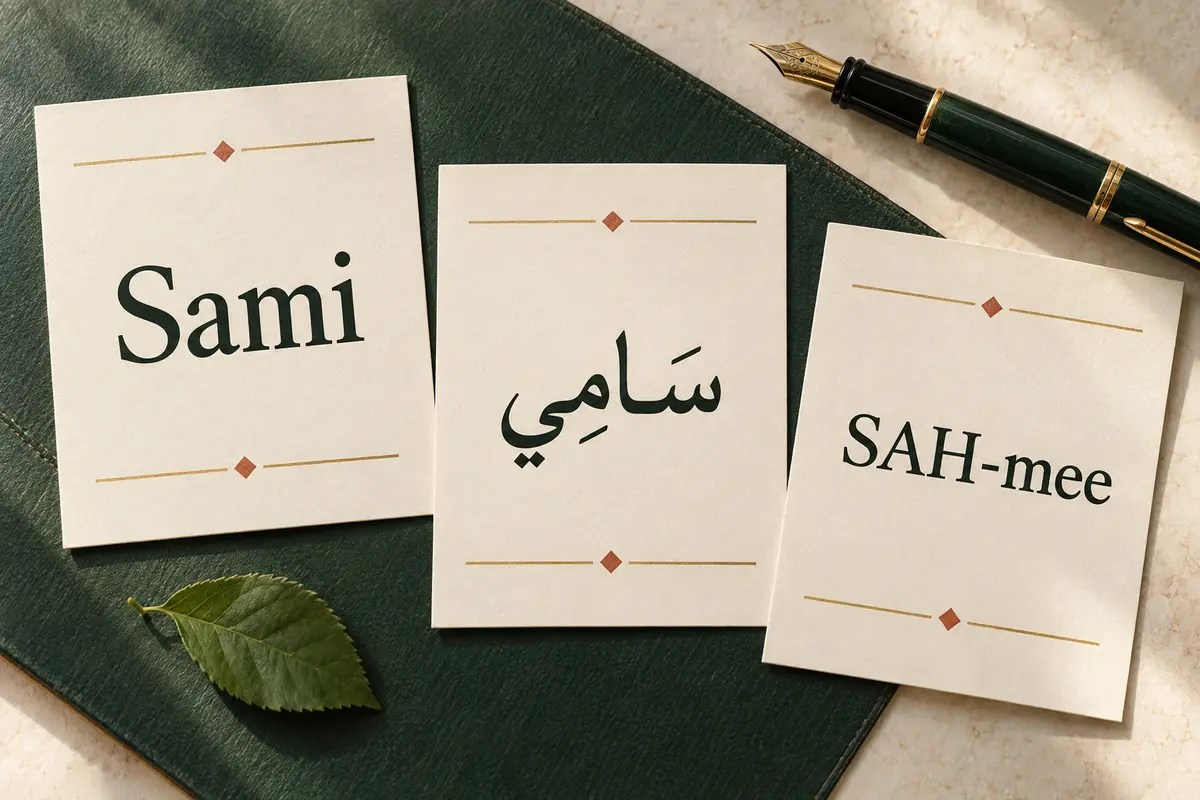
A useful English guide for Arabic سَامِي is SAH-mee. The first vowel is held longer than in many English pronunciations, and the final vowel is also clear. Exact realization varies by dialect and speaker, so the bearer’s own pronunciation takes priority over a phonetic shortcut.
Arabic is normally written without short-vowel marks in everyday contexts, making سامي the ordinary form. The marked spelling سَامِي is useful in a pronunciation guide. Before engraving or printing the name, ask an Arabic reader to check the final proof rather than relying on a decorative font preview.
Latin spellings include Sami and Samy. A spelling preference may reflect a passport, family convention, or the language in which the name was recorded. Neither version is automatically more authentic for every bearer.
Do all Arabic names transliterated Sami mean the same thing?
No. Arabic names can look alike after transliteration even when the original letters differ. The elevated name سامي is not the same spelling as سميع or سامع, forms connected with hearing or listening. The separate Sami entry for hearing or listening records those Arabic spellings and pronunciations.
This is why the Arabic script is valuable evidence. If a family writes the name سامي, the elevation explanation is the relevant one. If a document uses different Arabic letters, investigate that spelling instead of assigning a meaning from the shared Latin form.
The same care applies to other internationally written names. Our Zayn name guide also distinguishes a documented Arabic root from broad symbolic associations.
Sami name meaning in Finnish tradition
Finnish Sami has a separate history. The Finnish Sami entry describes it as a diminutive of Samuel and gives the pronunciation /ˈsɑ.mi/. In this context, the name is not derived from the Arabic root for elevation.
Samuel itself has a longer Hebrew and biblical history, but a family using Sami in Finland may understand it first as an established Finnish given name. It is better to say “Finnish form of Samuel” than to transfer the Arabic translation onto every Finnish bearer.
Sound can bring unrelated names together. Family language, older records, and the person’s own explanation are stronger clues than spelling alone. For a similar example of several independent traditions sharing one form, see Hana across Arabic, Japanese, Hebrew, and Korean contexts.
Sami and Sámi are not the same claim
The given name Sami should not be casually described as meaning “Sámi person.” The accented word Sámi names an Indigenous people and a group of Indigenous languages in northern Europe. The Sámi Parliament of Finland describes the Sámi as an Indigenous people with their own languages, culture, livelihoods, and homeland.
A Finnish person named Sami may or may not be Sámi, just as sharing a similar spelling does not establish ethnicity. When writing about the people or languages, preserve the spelling used by the source and avoid turning Indigenous identity into a decorative baby-name meaning.
This note is about accuracy and respect, not a claim that the Finnish given name and the ethnonym never appear in the same person’s life. Individual identity belongs to the person, while name etymology requires evidence for the particular naming tradition.
Choosing Sami for a child
Start by deciding which history matters to your family. If the choice is Arabic, save the verified script سامي and listen to a family pronunciation. If it is Finnish, ask whether the Samuel connection or a relative’s name is part of the story. A concise, accurate explanation is more useful than combining every possible origin.
Say the full name aloud with middle and family names. Check initials, rhythm, and likely pronunciations in the places where the child will live. If official records will use more than one script, keep a consistent reference spelling for forms and certificates.
Popularity changes by country and year. The U.S. Social Security Administration baby-name tool can show recorded U.S. usage by year, but it does not measure worldwide popularity, establish etymology, or combine every transliteration.
Sami name meaning and personal symbolism
Families may connect the Arabic sense of elevation with aspiration, learning, or a loved one’s example. A Finnish family may value the Samuel link, a name day, or a personal relationship. These can be thoughtful associations when they are presented as family meaning rather than universal fact.
A name does not make its bearer ambitious, spiritual, gentle, or successful. It can offer a story, but the person remains free to define what that story means in daily life.
Frequently asked questions
What is the main Sami name meaning?
In Arabic سامي, it means elevated, sublime, or lofty. In Finnish, Sami is a form of Samuel. The relevant answer depends on the family’s language and naming tradition.
How do you pronounce Sami?
SAH-mee is a useful English guide for Arabic Sami, while Finnish pronunciation is commonly represented as /ˈsɑ.mi/. Follow the bearer’s preferred pronunciation.
Is Sami an Arabic name?
Yes, Sami is an established Arabic masculine name, but the same Latin spelling also has a separate Finnish history. Shared spelling does not erase either origin.
Does the name Sami mean Sámi?
No. Sámi identifies an Indigenous people and their languages; it is not the dictionary meaning of the Arabic or Finnish given name. A person’s identity should never be inferred from spelling alone.