Iman Name Meaning: Arabic Origin, Pronunciation, and Cultural Context
Iman name meaning comes from the Arabic word إِيمَان, meaning “faith” or “belief.” The name is widely recognizable across Arabic, Persian, Urdu, Indonesian, and Malay contexts, but pronunciation, script, and gender patterns are not identical in every language.
That documented meaning can be important to a family without becoming a prediction about the bearer. A name may express faith, trust, heritage, or a personal connection at the time of naming; it cannot measure someone’s spirituality or determine their character.
Iman name meaning at a glance
| Detail | Iman | Context |
|---|---|---|
| Arabic script | إيمان | The ordinary unvowelled spelling |
| Meaning | Faith, belief | A dictionary meaning and religious term, not a personality claim |
| Arabic pronunciation | ee-MAHN | Two syllables, with stress on the second |
| Arabic gender use | Usually feminine | Usage can differ across countries and families |
| Other traditions | Also Persian, Urdu, Indonesian, and Malay | Script, pronunciation, and gender associations may change |
The concise answer is therefore reliable: Iman is a name built from the Arabic word for faith or belief. The fuller answer should identify which language and family tradition the bearer uses rather than blending every spelling into one universal story.
How Iman name meaning comes from Arabic
The name is written إيمان, or إِيمَان when a helpful short-vowel mark is shown. The Academy of the Arabic Language entry for الإيمان defines the word as affirmation or belief and connects it with the root أمن.
The Iman entry at Behind the Name gives “faith” as the name’s meaning, records the Arabic spelling and pronunciation, and cites Hans Wehr’s dictionary of modern written Arabic. That combination of lexical and name-specific evidence is stronger than invented lists of traits.
Arabic roots often connect several words without making them synonyms. The family around أمن includes ideas related to security, trust, faithfulness, and belief. It is accurate to translate Iman as faith or belief; it is too broad to claim that the name literally means every positive concept associated with the root.
For another Arabic name whose ordinary word meaning matters more than personality folklore, compare Farah and its connection with joy.
Iman, إِيمَان, and pronunciation
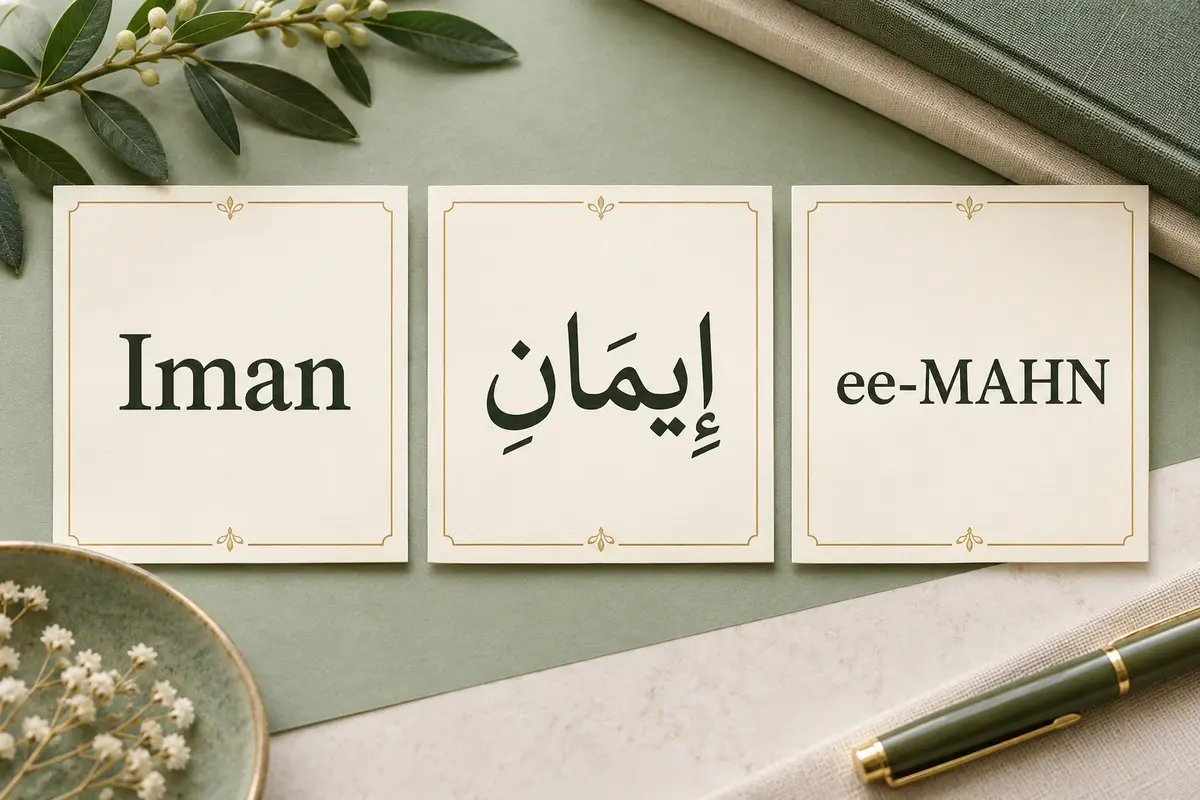
ee-MAHN is a useful English guide for Arabic Iman. The Arabic pronunciation recorded by Behind the Name is /ʔiː.ˈmaːn/: it begins with a brief glottal onset, holds the first vowel, and places the main stress on the second syllable.
English phonetic spelling is only an approximation. Vowels may sound different in Arabic dialects and in Persian, Urdu, Indonesian, or multilingual households. The bearer’s own pronunciation should take priority over a guide written for strangers.
Everyday Arabic usually omits short-vowel marks, so إيمان is normal. The form إِيمَان makes the initial vowel easier to see in a pronunciation lesson. Before engraving, tattooing, or printing the name permanently, ask an Arabic reader to check the actual artwork; decorative software can detach letters or place marks incorrectly.
Is Iman a girl’s name or a boy’s name?
Reliable name references document both feminine and masculine use across the traditions that use Iman. In Arabic naming, Iman is typically feminine. In Persian, the same Latin spelling is typically masculine, and Persian and Urdu write it ایمان.
This does not create one fixed global rule. Gender patterns can shift by language, country, generation, and family. It is more accurate to describe the intended tradition than to label every bearer from the spelling alone.
Names crossing languages often need this kind of care. Our guide to Hana across several naming traditions also shows why identical Latin letters do not guarantee identical origins or usage.
Faith as meaning and cultural context
الإيمان is not only a dictionary word; it is also an important religious term. The Arabic Academy distinguishes a general sense of affirmation from a more specific religious definition involving inward belief and spoken acknowledgment. A family may value that religious association, but the name itself does not prove how observant, devout, or morally good a person will be.
That distinction protects both accuracy and the bearer’s freedom. “The name means faith” is an etymological statement. “This person will always be faithful” is a prediction that language cannot support.
Personal naming stories can still be meaningful. Parents may choose Iman to honor a relative, mark gratitude, express a spiritual hope, or preserve a language across generations. Those explanations belong to the family and can sit alongside the documented word history without being presented as universal fact.
Iman, Eman, Imaan, Imane, and Imen
Several Latin spellings can represent Arabic إيمان. Iman is compact and internationally familiar. Imaan makes the long vowels more visible. Eman reflects a different way of representing the opening sound, while Imane and Imen are established forms in parts of North Africa.
The Imaan entry records it as an alternate transcription of إيمان, and the Imane entry identifies that spelling chiefly with Maghrebi Arabic use. These are transliteration choices, not separate personality types.
Official consistency matters. A passport spelling should be copied exactly onto school, travel, and medical records. Do not “correct” Iman to Eman or Imaan without asking the bearer, even when the Arabic source is the same. The chosen Latin form may preserve family history or match documents issued in another country.
Iman and Imani are related, but not interchangeable
Imani is often encountered as a Swahili name associated with faith. It is related in meaning and ultimately reflects Arabic influence, but it has its own form and cultural history. It should not be treated as merely a misspelling of Iman.
Similar-looking names can also be unrelated. Check the original script, language, and family explanation before assigning an origin. This is the same practical approach used when distinguishing Arabic and Slavic histories in our Nadia name guide.
Popularity and public records
Popularity claims need a place, year, spelling, and sex category. The U.S. Social Security Administration baby-name tool lets readers search recorded U.S. use by year and sex category. Its data describe applications for Social Security numbers, not worldwide naming practice.
One database may split Iman, Eman, Imaan, Imane, and Imen into separate entries. Combining them without a stated method can exaggerate or hide a trend. Local civil-registration data are preferable for a local question, and no popularity rank can tell a family whether the name will feel common in a particular school or community.
Choosing Iman for a child
The Iman name meaning is concise, but a naming decision also involves pronunciation, documents, and family context. Say the full name aloud, check initials, and listen to relatives who use the relevant language.
If more than one script will appear on records, keep a verified reference pairing Iman with إيمان or the Persian-Urdu form ایمان, as appropriate. Decide which Latin spelling will remain consistent across passports, school files, and digital accounts.
A family can explain the choice simply: “Iman means faith or belief in Arabic,” followed by its personal reason for choosing it. That preserves the documented Iman name meaning while leaving the child free to define the name in their own life.
Frequently asked questions
What is the main Iman name meaning?
Iman means “faith” or “belief” in Arabic. It comes from إيمان, a word connected with the Arabic root أمن.
How do you pronounce Iman?
ee-MAHN is a practical English guide for the Arabic form, with the main stress on the second syllable. Exact vowels vary by language, dialect, and speaker.
Is Iman used for girls or boys?
Both uses are documented across languages. It is typically feminine in Arabic naming and typically masculine in Persian, but family and regional patterns can differ.
Are Iman, Eman, and Imaan the same name?
They can be alternate Latin transcriptions of Arabic إيمان. Follow the bearer’s official spelling rather than treating the forms as automatically interchangeable.