Crow Symbolism: Meaning in Culture, Folklore, and Modern Life
Crow symbolism often centers on intelligence, adaptability, watchfulness, mystery, or change. Yet the meaning depends on where the image appears. A crow solving a problem in a fable carries a different message from a wild bird calling from a city roof, while a tattoo may express an entirely personal memory.
The best way to interpret a crow is to begin with context rather than a prediction. Ask whether you are looking at wildlife, reading a story, studying an artwork, or choosing a design. This guide explains those differences and shows why one dark-feathered bird can support several meanings without becoming a universal omen.
Crow symbolism at a glance
A useful interpretation names both the setting and the source of the meaning. The table below separates common contexts that are often blended together online.
| Context | Possible meaning | What to check |
|---|---|---|
| A living crow | An ordinary wildlife encounter | Species, behavior, food, season, and habitat |
| A fable | Resourcefulness, patience, or practical intelligence | The plot and moral of the specific story |
| Dark art or fiction | Mystery, unease, memory, or mortality | The creator’s words and the surrounding imagery |
| A tattoo or pendant | Adaptability, observation, independence, or remembrance | The wearer’s reason and the artist’s design |
| A dream or repeated sighting | A prompt for personal reflection | Your recent experiences, without treating it as a forecast |
What a real crow can tell you
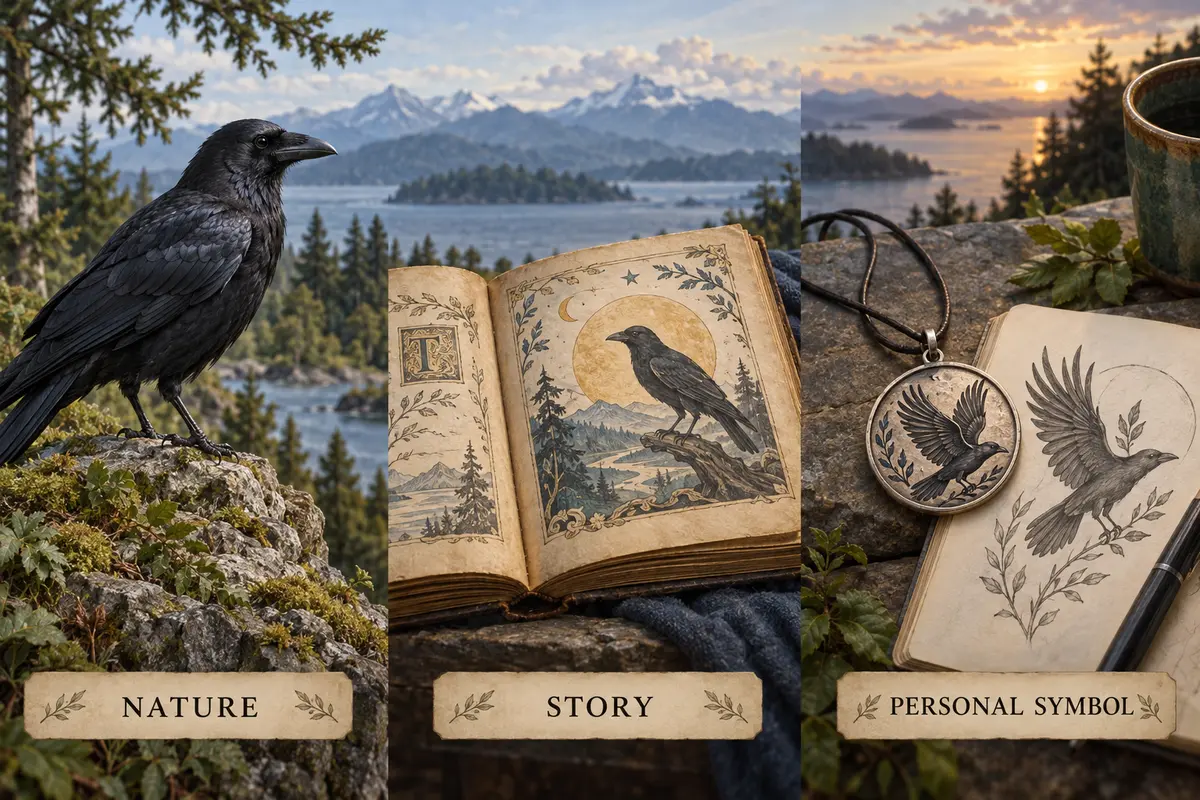
Before interpreting a sighting, identify the bird as carefully as you can. “Crow” is a general name used for several members of the genus Corvus. In North America, the American Crow is a familiar example. The Cornell Lab’s American Crow guide describes an all-black bird with a heavy, straight bill, long legs, and a relatively short tail.
Those details matter because a black silhouette alone may be a crow, raven, rook, or another bird, depending on the region. Calls, tail shape, size, and behavior can be more useful than color by itself. A stylized logo or pendant may not contain enough detail for species identification at all.
Most importantly, a wild crow is first an animal responding to its environment. It may be searching for food, watching a threat, communicating with other birds, or moving between resting places. None of those ordinary behaviors proves that an event was arranged as a message for one observer.
Why crows symbolize intelligence
The link between crows and intelligence has an observable foundation. In a peer-reviewed study available through the National Library of Medicine, researchers found that wild American Crows learned to recognize a threatening human face and that knowledge spread socially among birds.
That finding does not mean every crow action is symbolic. It does, however, help explain why artists and writers use the bird to represent memory, alertness, learning, or the ability to adapt. A person choosing a crow emblem for those qualities is making a metaphor from real behavior.
Intelligence is only one possible association. Crows also live near people, gather in groups, and use varied calls. Those visible traits can suggest community or watchfulness in one design and noise or disruption in another.
The crow and the pitcher: resourcefulness in a fable
Aesop’s “The Crow and the Pitcher” gives a clear, sourceable example of crow symbolism. In the Library of Congress version, a thirsty crow cannot reach the water at the bottom of a pitcher. It drops pebbles into the vessel until the water rises high enough to drink.
Within that story, the crow represents resourcefulness and persistence. The meaning comes from the bird’s actions in the plot, not simply from its black feathers. A crow shown beside a pitcher or stones may therefore be a direct reference to solving a problem step by step.
This is a good model for reading symbols generally: identify the work, notice what the figure does, and avoid turning one story into a rule for every culture or encounter.
Does a crow mean death or bad luck?
A crow can be used to suggest death, danger, or unease in a particular story or artwork. Dark plumage, a strong silhouette, and scavenging behavior can all contribute to that mood. Still, a living crow does not predict a death or prove that bad luck is coming.
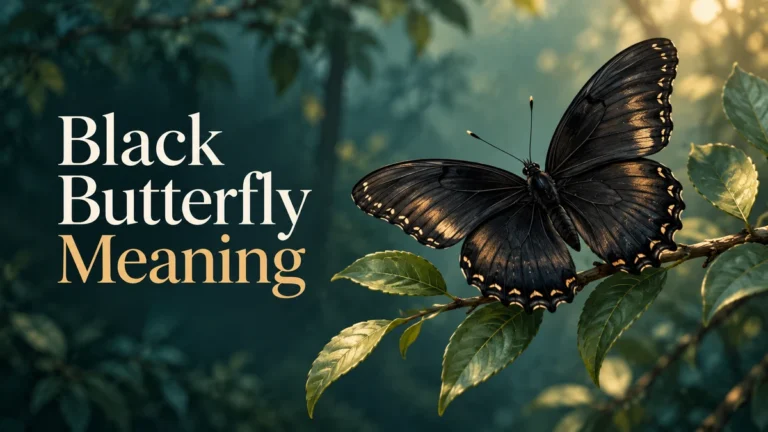
The same visual qualities can support other readings, including dignity, survival, memory, or calm observation. Our guide to black butterfly meaning makes a similar distinction between an artist’s use of dark color and an unsupported forecast about real life.
If a sighting makes you anxious, describe the event in plain terms first. Note where the bird was, what it was doing, and what was nearby. A grounded observation can remain personally meaningful without becoming evidence of future harm.
Crow versus raven symbolism
Crows and ravens are close relatives, so their modern meanings often overlap. Both may appear as symbols of intelligence, mystery, memory, or transformation. However, they are not interchangeable in every story, species guide, or artwork.
For example, a work that refers to Edgar Allan Poe’s “The Raven” should not automatically be retitled as a crow symbol. Conversely, Aesop’s pitcher story specifically uses a crow in familiar English versions. If the distinction matters, use the name given by the original source.
For identification and a separate set of literary examples, see our guide to raven meaning in myth, literature, and modern design. The comparison is useful precisely because related animals can acquire different meanings through different stories.
Crow tattoos, jewelry, and personal symbols
A crow tattoo may represent resourcefulness, independence, loyalty to family, survival, curiosity, or a favorite story. It may also memorialize a person or place. The wearer remains the best source for the design’s meaning.
Before choosing a permanent image, write one sentence about what you want it to express. Then decide whether you want a realistic bird, a fable reference, or a stylized silhouette. Those choices communicate more clearly than adding symbols whose origins you have not checked.
- Choose the personal meaning before decorative details.
- Check whether a borrowed motif belongs to a specific living tradition.
- Use accurate species features if natural history matters to the design.
- Ask how the image will read without a caption or explanation.
A small animal can carry a very different emotional tone while still representing resilience or memory. For comparison, explore ladybug symbolism in folklore and personal use.
Dreams and repeated crow sightings
No single dream dictionary can establish what a crow dream means for everyone. A dream may draw on a recent walk, a film, a worry, or an image you noticed earlier. Reflection can be useful, but it should not be confused with a reliable prediction.
Repeated sightings also have ordinary explanations. You may be passing a regular feeding area, noticing a local family group, or simply paying more attention after the first encounter. Recording the time, location, and behavior can reveal a pattern without assuming the birds are delivering instructions.
You can still value a personal association. Saying “the crow reminded me to stay observant” describes your response. Saying “the crow guarantees what will happen next” makes a different claim that the sighting cannot support.
How to evaluate cultural claims about crows
Claims such as “all ancient cultures believed” or “crows always meant” are warning signs. Traditions differ across communities, languages, and time periods. A reliable explanation should name the story, artwork, community, or historical source rather than merging them into one universal belief.
Also separate a traditional narrative from a modern product description inspired by it. A shop may describe a pendant as mystical, but that wording does not establish an old religious meaning. When a design borrows from a living culture, look for sources from that community and avoid presenting one account as a generic aesthetic.
Frequently asked questions
What does a crow symbolize spiritually?
People may use crows as symbols of insight, change, memory, protection, or mystery. These meanings depend on a particular belief, story, or personal practice. There is no single spiritual definition shared by everyone.
Is seeing one crow a bad omen?
No reliable prediction follows from seeing one crow. The bird is most likely feeding, traveling, resting, or communicating. An ominous role in fiction does not turn an ordinary wildlife encounter into a forecast.
What is the difference between crow and raven symbolism?
Their meanings can overlap, especially in modern art, but specific works may name one bird for a reason. Check the original story and the species involved rather than treating crow and raven as automatic substitutes.
What does a crow tattoo mean?
A crow tattoo can represent intelligence, adaptability, independence, remembrance, or a favorite story. Its clearest meaning comes from the wearer’s intention and the details of the design, not from a universal symbol list.
Ultimately, crow symbolism becomes clearer when you keep its source visible. Observe the real bird, read the complete story, or ask about the design. Context gives the image depth without turning it into a guaranteed message about the future.
Sources
- Cornell Lab of Ornithology — American Crow Identification
- Proceedings of the Royal Society B via PubMed Central — Social learning about dangerous humans in American Crows
- Library of Congress — The Crow & the Pitcher
For a related guide, read Cardinal Bird Meaning: Symbolism, Memorials, and Context.
To compare another animal associated with darkness in art, consider moth symbolism in folklore, light, and transformation, where species and story matter more than assuming one universal meaning.