Ladybug Meaning: Symbolism, Folklore, and Cultural Context
Ladybug meaning often centers on good luck, protection, joy, or a welcome change. Those ideas come from folklore and personal association, not from a universal message carried by every beetle. A useful interpretation starts by asking whether the ladybug is a living insect, a decorative motif, or part of a specific story.
The tiny red-and-black figure appears on cards, jewelry, garden signs, and children’s books. In a garden, however, it belongs to a diverse beetle family with real ecological roles. Keeping the natural animal separate from the symbol makes both easier to understand.
What does a ladybug symbolize?
In modern designs, a ladybug can express cheerfulness, gentle protection, or good fortune. Its rounded form, bright color, and familiar spots make it an approachable image. A person may also choose it to remember a garden, a relative, or a happy season.
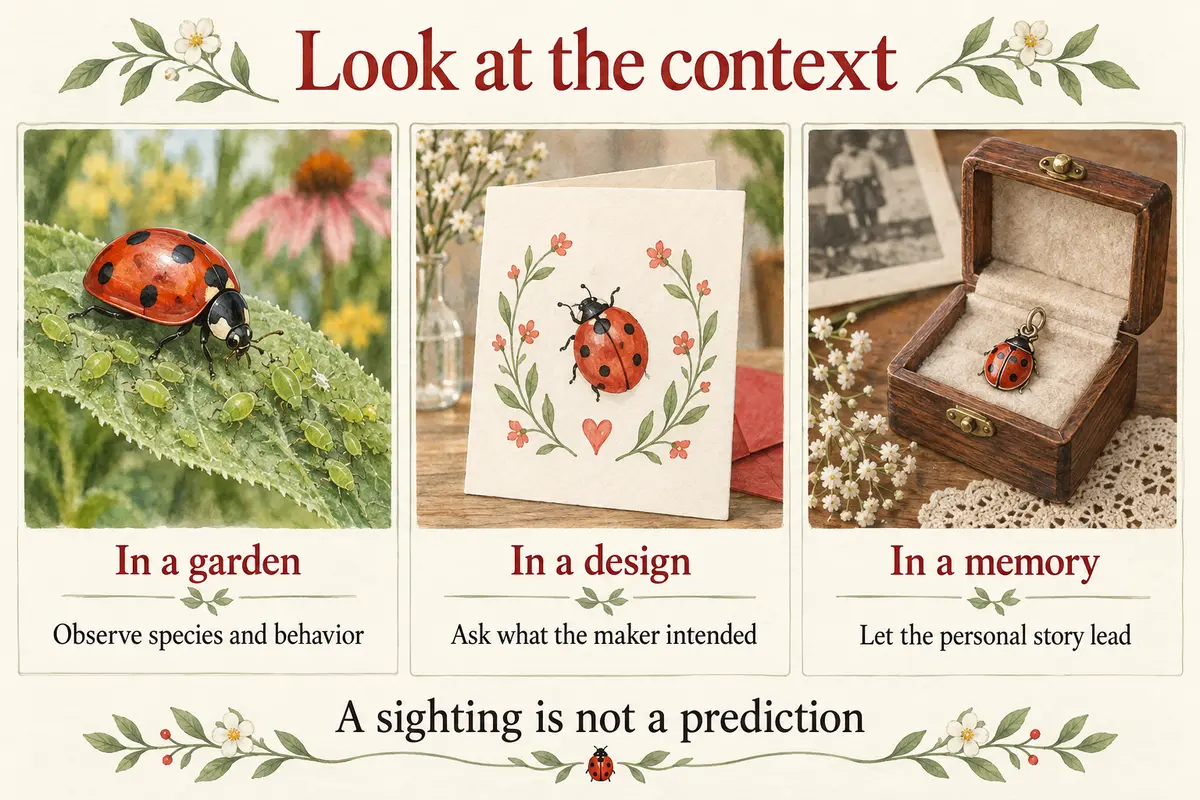
Context still leads. A ladybug charm given before an exam may be intended as encouragement. The same motif on seed packets may simply suggest gardening. When another person chose the image, their explanation is more reliable than a fixed list of meanings.
Ladybug meaning by context
This table separates several common settings. The interpretations are starting points, not rules or predictions.
| Setting | Possible reading | Best source of context |
|---|---|---|
| A living beetle on a plant | A wildlife observation | Species, markings, behavior, and habitat |
| A greeting card or charm | Encouragement or good wishes | The giver’s message |
| A tattoo | Joy, resilience, memory, or visual preference | The wearer’s own story |
| A garden illustration | Beneficial insects or a cheerful theme | The surrounding plants and text |
| A religious or historical reference | A tradition attached to the name or image | A named source, community, and period |
Why ladybugs became signs of good luck
One practical reason for their positive reputation is easy to see in gardens. Many lady beetles and their larvae eat aphids and other small plant-feeding insects. The University of Minnesota Extension guide to lady beetles explains that larvae feed on small, soft-bodied insects and that adults search plants for food.
For growers, a beetle reducing aphids can feel genuinely fortunate. That useful role sits comfortably beside stories about luck. Still, a sighting does not predict money, romance, or success.
The same distinction appears in other insect symbols. Our guide to dragonfly imagery in culture and personal change also separates documented associations from forecasts.
Ladybug, ladybird, or lady beetle?
These names usually refer to members of the beetle family Coccinellidae. “Ladybug” is common in North American English, while “ladybird” is standard in British English. Entomologists often use “lady beetle” because these insects are beetles, not true bugs.
The word itself has a religious history. Merriam-Webster’s history of “ladybug” traces “lady” to an allusion to the Virgin Mary, or Our Lady. That etymology is a documented language history; it does not mean every use of a ladybug motif is religious.
A word may preserve an old connection even when a modern speaker uses it without that meaning in mind.
Color and spots do not tell the whole story
The familiar red beetle with black spots is only one possible appearance. Lady beetles can be red, orange, yellow, pink, or dark, with spots that vary by species. Counting spots alone is not always enough for identification.
The same University of Minnesota Extension overview notes the group’s varied colors and generally domed, round-to-oval adult bodies. A reliable identification also considers size, pattern, head markings, location, and sometimes features that require a close view.
If you find one indoors or outdoors, take a clear photograph without handling it unnecessarily. Record the location and season, then compare it with a regional guide. A stylized red-and-black drawing, including the illustrations here, should not be used as a species chart.
The lady beetle life cycle
Lady beetles undergo complete metamorphosis: egg, larva, pupa, and adult. Their larvae look very different from the rounded adults and are sometimes mistaken for harmful insects. That difference makes the life cycle useful to know before removing an unfamiliar creature from a plant.
The University of California IPM profile of the convergent lady beetle describes those four stages and its role as a predator. The details apply to that species, not automatically to every lady beetle worldwide.
Metamorphosis may inspire a personal metaphor about growth. Even so, biology does not provide a schedule for human events. A person can borrow the image to describe change without claiming that a sighting announces what will happen next.
Protection as symbolism and biology
“Protection” can have two meanings in discussions of ladybugs. In a garden, predatory species may help protect plants by feeding on pests. In art, a person may use a ladybug as a comforting emblem or a small protective charm.
Ecological protection is an observable interaction between insects and plants. Symbolic protection is an intention assigned by people. Both may be meaningful, but only the first describes what the animal is doing.
For another example of how color changes a motif, compare our article on orange butterflies in nature, art, and remembrance. The surrounding story matters more than color alone.
Ladybug tattoos and jewelry
A ladybug tattoo can represent a hopeful period, a garden connection, or someone remembered. It can also be chosen simply because the wearer likes the compact shape and bold pattern. No explanation is more valid merely because it sounds mystical.
Before choosing a permanent design, write one plain sentence about its purpose. Then decide whether you want a recognizable species or a playful illustration. A specific number of spots may matter to you, but it is not a universal code.
- Choose the personal story before adding extra symbols.
- Decide whether biological accuracy matters to the design.
- Consider how the red, orange, or dark palette changes its mood.
- Ask the artist how small details will age at the selected size.
Remembrance without imposing a message
A ladybug may remind someone of a parent who gardened, a childhood book, or a place visited together. That connection is real because it belongs to the relationship. It does not require a claim that the insect delivered a message from the person who died.
Gentle wording leaves room for different beliefs. “This ladybug reminded me of her garden” describes a sincere memory. Saying what another person’s sighting must mean can instead place an unwanted interpretation on grief.
If color is central to the memory, our discussion of yellow butterfly symbolism and personal context offers a useful comparison.
Dreams, wishes, and repeated sightings
A ladybug in a dream has no single meaning that a website can verify. Reflection may still be useful: notice the setting, your feelings, and any recent experience involving gardens, insects, or gifts. The dream does not establish a prediction or diagnosis.
Likewise, repeated sightings may have a biological explanation. A nearby food source, seasonal activity, or a place suitable for shelter can bring several beetles into view. Start with observation before assuming the pattern carries a message.
People can keep a wish or spiritual association as a personal practice. The important distinction is to label it as belief or reflection, not evidence that a future event is guaranteed.
How to evaluate ladybug symbolism claims
Symbolism pages often repeat attractive statements without showing where they came from. A careful explanation distinguishes word history, named folklore, personal interpretation, and insect biology. Each type of claim needs a different kind of support.
- Ask whether the claim describes an insect or a human belief.
- Look for a named culture, period, or source.
- Check that the linked source actually supports the sentence.
- Treat guaranteed outcomes and predictions as unsupported claims.
This approach lets a symbol carry a personal story without turning it into a rule for everyone.
Frequently asked questions
What is the spiritual meaning of a ladybug?
Some people connect ladybugs with protection, gratitude, hope, or good fortune. There is no single spiritual definition shared by every person or tradition. Specific religious claims should be tied to a named source and context.
Does a ladybug mean good luck is coming?
A ladybug is widely used as a good-luck symbol, but seeing one does not predict a future event. You can enjoy it as a welcome moment without treating it as a guarantee.
Do the number of spots have a fixed meaning?
No universal symbolic code is established by the number of spots. Spots can help with identification, but they must be considered with other physical features and a reliable regional guide.
Can a ladybug represent someone who died?
Yes, it can become a personal memorial symbol when it connects to that person’s garden, favorite objects, or shared memories. That meaning belongs to the people involved and should not be imposed on every sighting.
Ultimately, ladybug meaning is clearest when the context remains visible. Observe the beetle, ask about the design, and listen to the story attached to it. A small image can carry sincere meaning without becoming a prediction.
Sources
- University of Minnesota Extension — Lady Beetles
- Merriam-Webster — Word History of Ladybug
- University of California IPM — Convergent Lady Beetle
To compare a very different animal motif, explore raven meaning in literature, folklore, and personal designs and the distinction between a living animal and the stories people attach to it.
A darker bird motif offers a useful contrast: crow symbolism in folklore and personal design also changes between natural observation, folklore, and personal design.