Spider Spiritual Meaning: The Symbolism Behind Web, Patience, and Context
Spider spiritual meaning is often linked with patience, creativity, pattern-making, and the tension between building something carefully and feeling caught inside it. Those themes are not universal rules, and a spider is not evidence that a specific event is about to happen. The more useful approach is to look at the spider, the web, your reaction, and the cultural associations you already carry.
This guide uses “spiritual meaning” in the broad contemporary sense of symbolic reflection. For contrast, our hair falling out dream meaning article separates private reflection from scientific evidence and medical hair loss. It does not treat a spider encounter as a supernatural message, and it does not assume that one symbol means the same thing in every culture.
The web is the strongest clue behind spider symbolism
Many common spider meanings come from a simple visual fact: some spiders build intricate webs. A web can suggest construction, repetition, connection, strategy, and patience because it is made one thread at a time. It can also suggest entanglement because the same structure that supports the spider can trap prey.
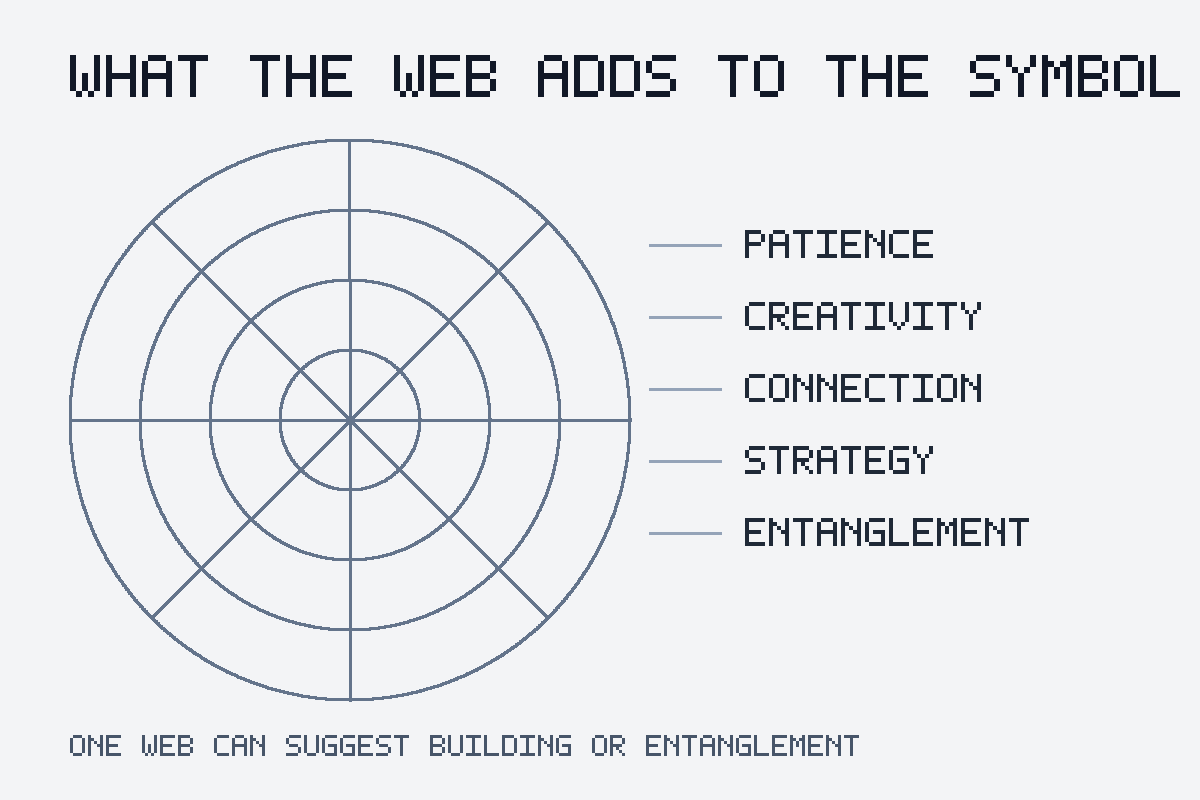
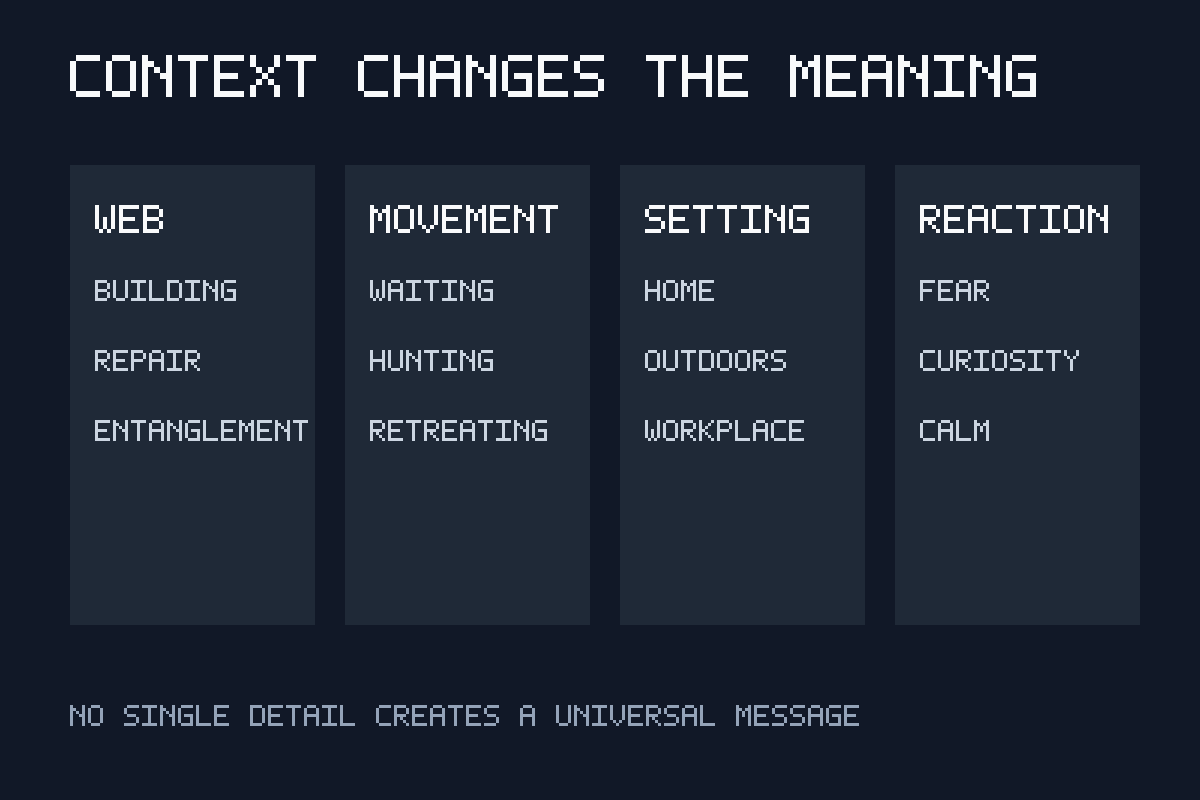
That double meaning is what makes the spider a flexible symbol. In one situation it may feel like a reminder to build patiently. In another, it may reflect a situation that has become too complicated or controlling. The symbol changes with context rather than carrying one fixed message.
Five recurring themes in spider spiritual meaning
1. Patience without passivity
Spiders are often associated with patience because web-building species invest time in construction and then wait for vibration and movement. At Fort Matanzas National Monument, the U.S. National Park Service notes that golden silk spiders may repair damaged webs and can replace a substantial part of a web after it is torn. That behavior makes patience a grounded metaphor, but the symbol is stronger when it includes maintenance, not just waiting.
A reflective question here is simple: are you waiting because you have prepared carefully, or waiting because you are avoiding the next step?
2. Creativity and pattern-making
The spider’s strongest creative association comes from weaving. A web is not random decoration; it is a functional structure. This is why spider symbolism often appears around craft, design, writing, planning, and any process in which a larger result emerges from repeated small actions.
The connection between spiders and weaving also appears in art and story. The Metropolitan Museum of Art discusses Arachne, the mythological weaver who was transformed into a spider, as part of a long artistic tradition linking webs, textile-making, and human creativity.
3. Interconnection and consequences
A web visually links many points to one structure. That makes it an intuitive symbol for networks, relationships, systems, and consequences. Pull one strand and another section moves. In personal reflection, the image can be useful when you are thinking about how one decision affects several parts of life at once.
This meaning is especially relevant when the spider itself feels less important than the architecture around it. A large, complex web can draw attention to the system you are part of rather than to a single person or event.
4. Boundaries, control, and entanglement
The same web that represents connection can also represent a trap. This is where spider symbolism becomes more ambiguous. If your reaction to the image is tension, confinement, or caution, the useful question may be about boundaries rather than creativity.
That does not mean a spider “warns” you that someone is deceptive. It is more grounded to ask whether a current commitment, relationship, project, or routine feels increasingly hard to leave or simplify.
5. Attention to what is easy to overlook
Spiders are often noticed in corners, along edges, or only after a web catches the light. That visual experience can make them a symbol of noticing details, hidden structure, or small patterns that were already present.
If this theme resonates, the practical interpretation is not “a sign is following you.” It is that the encounter may have become memorable because your attention was already focused on complexity, uncertainty, or something you had not fully examined.
Seeing a spider, seeing a web, and seeing many spiders are different symbols
| Detail | Common symbolic theme | A grounded question to ask |
|---|---|---|
| A single spider | Focus, skill, patience, unease | What has my attention right now? |
| A spider building a web | Creation, planning, repetition | What am I building through small repeated actions? |
| An empty web | Structure, absence, unfinished work | What remains after the main activity is gone? |
| A damaged web | Repair, disruption, adaptation | What needs rebuilding rather than replacing? |
| Many spiders | Overload, complexity, heightened attention | Am I dealing with many small pressures at once? |
| A spider close to the body | Boundary, vulnerability, intensity | Why does this feel personally intrusive or important? |
Spider symbolism in culture is not one single tradition
It is easy to flatten “spider meaning” into one global definition, but cultural references vary. In Greek mythology, Arachne became strongly associated with weaving and transformation. In Akan folklore, Anansi is a famous spider figure connected with stories, wit, and trickster intelligence. The Smithsonian’s National Museum of African Art describes Anansi as an important figure in Ghanaian and Asante storytelling, where spider imagery can carry associations with wisdom, storytelling, and cleverness.
These examples do not prove that every spider encounter carries the same meaning. They show why modern symbolic language around spiders repeatedly returns to weaving, intelligence, strategy, stories, and the ability to work through complex structures.
What real spider behavior adds to the symbolism
Biology makes the symbol more interesting because not all spiders behave the same way. The National Park Service notes that many spiders use silk for purposes beyond catching prey, including signal lines, egg cases, retreats, and dispersal. Jumping spiders, for example, actively hunt and do not rely on prey-catching webs in the same way orb-weavers do.
That matters symbolically. If the image in your mind is a web-building spider, themes such as structure and patience fit naturally. If it is an active jumping spider, observation, timing, and direct action may be the stronger metaphor. The more specific the behavior, the less useful a generic “spider means X” answer becomes.
Repeated spider encounters do not automatically mean a message
Once something becomes emotionally or symbolically important, you tend to notice it more easily. A spider may also simply be common in the season, building, or environment you are in. Repetition can still be useful as a reflective prompt, but it should not be treated as proof of destiny, prediction, or hidden communication.
A practical way to use repetition is to keep the question personal and observable: what did you notice, what were you thinking about, and what part of the encounter felt unusually memorable?
Spider symbolism compared with other animal symbols
Spider symbolism often centers on structure, strategy, and patient construction. That gives it a different tone from moth symbolism, which more often focuses on attraction to light and transformation, or owl symbolism, where night, observation, and wisdom dominate the imagery. Crow symbolism tends to draw more heavily on intelligence, social behavior, and folklore.
Comparing symbols this way is useful because it prevents a vague list of traits from becoming interchangeable. A strong interpretation should explain why the physical behavior, visual form, or cultural history supports the symbolic theme.
A grounded way to interpret spider spiritual meaning
- Start with the actual detail. Was it the spider, the web, movement, size, color, or location that caught your attention?
- Name your reaction. Fear, curiosity, admiration, disgust, calm, and fascination lead to very different interpretations.
- Separate biology from symbolism. A spider may be there for ordinary ecological reasons even if the encounter becomes personally meaningful.
- Use culture as context, not as a universal code. Arachne and Anansi are specific traditions, not proof of one worldwide spider meaning.
- Turn the symbol into a question. Ask what you are building, repairing, noticing, or feeling caught inside.
This approach keeps the symbol useful without turning it into a prediction. It also makes the interpretation more personal: the same spider can represent careful construction to one person and unwanted entanglement to another.
Spider spiritual meaning in a concise form
At its most useful, spider spiritual meaning is a cluster of symbolic themes rather than a fixed answer. The web supports ideas of patience, creativity, interconnection, strategy, and entanglement; the spider’s behavior and your emotional reaction decide which theme actually fits. Cultural stories add depth, but they should be treated as context rather than as universal rules.
Sources and further reading
- U.S. National Park Service — Golden Silk Spider.
- U.S. National Park Service — spiders and uses of silk.
- U.S. National Park Service — Jumping Spider.
- The Metropolitan Museum of Art — The Art of the Spider’s Web.
- Smithsonian National Museum of African Art — Artful Animals: Spiders.
For a related guide, read Blue Jay Spirit Animal Meaning: Voice, Courage, and Context.
For a related guide, read Lone Wolf Symbolism: Independence, Distance, and the Meaning of Walking Alone.