Amir Name Meaning: Origin, Pronunciation, and Variants
Amir name meaning begins with the Arabic word أَمِير, commonly translated as “commander,” “leader,” “governor,” or “prince.” The word first functioned as a title connected with authority and command, and it later became an established masculine personal name across Arabic-speaking and Muslim communities.
These meanings can express heritage, family hopes, or admiration for a concise international name. They do not predict leadership ability, social status, personality, or future success. This guide explains Amir’s documented Arabic origin, pronunciation, spellings, historical context, and practical naming choices without turning etymology into a character forecast.
Amir name meaning at a glance
| Feature | Guide | Context |
|---|---|---|
| Arabic spelling | أَمِير | Written with hamza-bearing alif, mīm, yāʾ, and rāʾ |
| Common meanings | Commander, leader, governor, or prince | The best English gloss depends on historical and social context |
| Pronunciation | uh-MEER or ah-MEER | Stress normally falls on the second syllable |
| Major spellings | Amir, Ameer, Emir, Amīr | Language and romanization conventions shape the spelling |
| Traditional usage | Masculine Arabic name | Individual and regional naming practices may vary |
Amir name meaning in Arabic
Amir is written أَمِير and transliterated more precisely as amīr. It belongs to the Arabic root family built from hamza, mīm, and rāʾ, associated with ordering or commanding. The scholarly Encyclopaedia Iranica entry on amīr gives “commander, governor, prince” as its core range and traces the term to the Arabic verb connected with command.
That range explains why short baby-name summaries sometimes disagree. “Prince” is familiar in modern explanations, while “commander” better reflects the word’s older administrative and military use. “Leader” is a broad plain-English summary, but it should not erase the term’s specific history as a title.
As a personal name, Amir can honor Arabic language, a relative, religious or regional heritage, or simply a sound that works across languages. The dictionary history tells us where the name comes from; it does not assign authority or rank to the person who carries it.
How to pronounce Amir
In Arabic, Amir is usually heard as two syllables with stress on the second: uh-MEER or ah-MEER. The final syllable has a long ee sound. The opening vowel is short and may sound closer to uh or ah depending on the speaker and surrounding sounds.
The scholarly spelling Amīr places a macron over the i to mark that long vowel. The Library of Congress Arabic Romanization Table documents this distinction in formal transliteration. Everyday names normally omit the mark, producing Amir, while Ameer spells the long vowel in a way many English readers recognize immediately.
Emir often begins with a clearer eh sound in languages where that spelling is established. Pronunciations naturally shift with accent and family tradition, so the bearer’s preference matters more than forcing one English approximation.
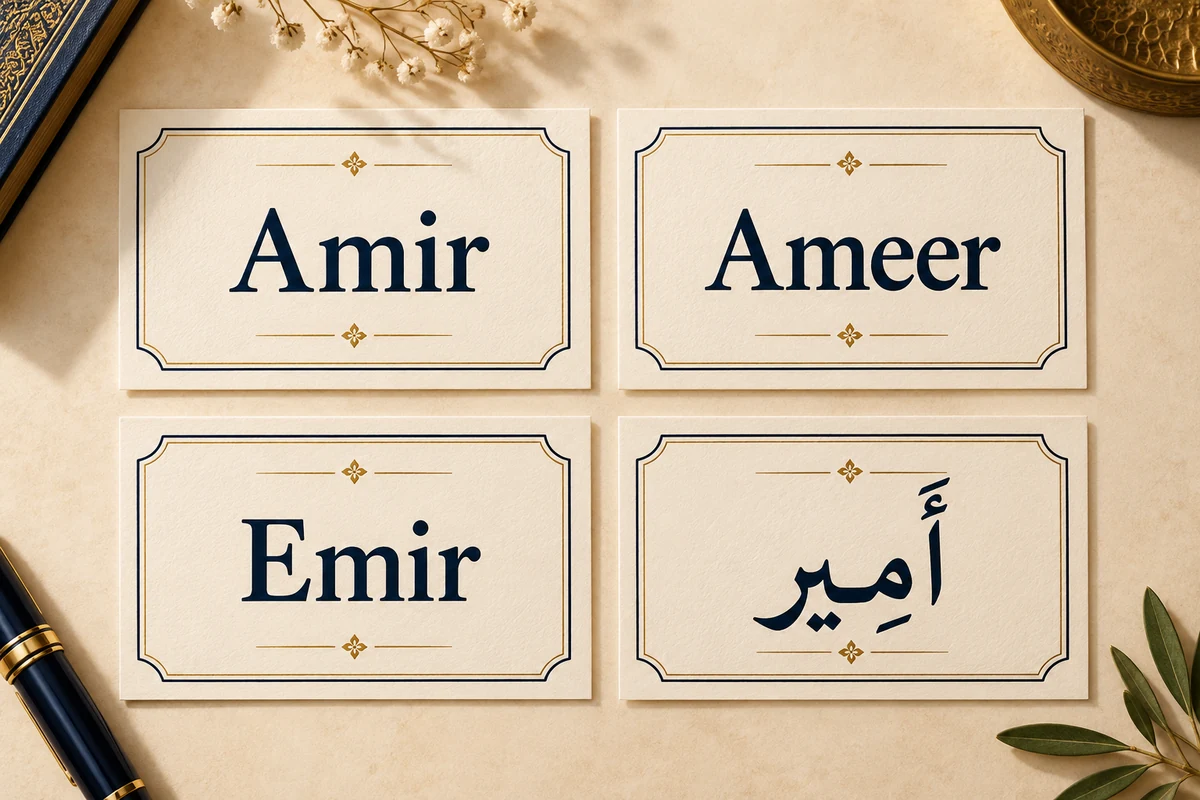
Amir, Ameer, Emir, and Amīr spellings
Amir is the compact spelling widely used in English and many international records. Ameer makes the long second vowel explicit. Amīr is a formal romanization that preserves vowel length with a diacritic. Emir is especially familiar as the English form of the historical title and as a personal-name spelling in Turkish, Bosnian, Albanian, and other regional traditions.
These spellings can point to the same Arabic source, but they are not interchangeable on legal documents. A family should consider the form already used by relatives, the languages spoken at home, and whether local databases preserve diacritics. Consistency across passports, school records, healthcare files, and email addresses usually matters more than finding a universal “correct” Latin spelling.
Amer is sometimes confused with Amir in English, but Arabic vowel patterns and family usage may distinguish them. Check the intended Arabic spelling before treating two similar-looking names as automatic variants.
From historical title to personal name
Before Amir became familiar internationally as a given name, amīr served as a title. Historical uses covered commanders, governors, princes, and other officeholders. Its meaning depended on the institution and period rather than describing one fixed rank everywhere.
Compounds preserve that history. Amir al-Mu’minin is conventionally translated as “Commander of the Faithful,” while amir al-umara means “commander of commanders” or “prince of princes.” Such phrases show how the noun works in a title; they do not mean that every modern child named Amir bears an official or religious role.
The personal name draws on this long-established word without requiring a royal family, military connection, or political claim. A title can become a name because families appreciate its sound, history, or positive association with responsibility.
Is Amir an Islamic or Quranic name?
Amir is an Arabic name with a long history in Muslim societies, and title compounds containing amīr are important in Islamic history. That makes it culturally and historically familiar to many Muslim families.
It is more accurate to describe Amir as an Arabic personal name and historical title than to claim that the modern given name is a named Quranic figure. A name can be suitable and meaningful in Muslim families without appearing in scripture as a person’s name.
Usage is not limited to one ethnicity or level of religious observance. Arab Christians, Muslims from many language communities, and families choosing an international name may all use Amir. The name alone does not establish anyone’s beliefs.
Amir name meaning across cultures
Arabic أَمِير provides the origin discussed in this guide, but similar Latin spellings can belong to other languages or naming traditions. Persian, Turkish, Bosnian, Urdu, and other communities have adopted or adapted Amir and Emir through centuries of cultural contact.
A separate Hebrew name is also written Amir in English. Depending on the Hebrew spelling, it may be associated with a treetop or with a sheaf of grain. That does not replace the Arabic etymology; it means the same Latin letters can represent more than one original word. Families should identify the source language and original script before combining definitions from unrelated traditions.
International use has made Amir easy to recognize in many countries. The U.S. Social Security Administration baby-name database records the name in annual statistics. Rankings describe registrations in a specific place and year, not a name’s meaning or worldwide importance.
What Amir can symbolize today
Amir name meaning may inspire personal ideas of responsibility, service, courage, or thoughtful leadership. A family might choose it to remember an ancestor, celebrate Arabic heritage, or express the hope that a child will use influence fairly.
Those are wishes, not psychological evidence. A child named Amir is not guaranteed to be confident, commanding, ambitious, or successful. Leadership is a behavior and relationship shaped by experience, opportunity, values, and choices—not by a name.
For other concise Arabic names with clear linguistic histories, compare our guides to Noor name meaning and pronunciation, Omar name meaning and variants, and Layla name meaning and origin.
Related names and nicknames
Amir is short enough that many people use the full name without a nickname. Informal forms can include Ami, Mir, or initials, although Ami has independent meanings and uses in several languages. The bearer’s own preference should guide everyday use.
Amira is the familiar feminine counterpart in Arabic and is often translated as “princess” or “female commander.” Emir and Ameer are close spelling variants, while names such as Omar and Samir only resemble Amir in sound and have separate roots.
Compound personal names such as Amir Ali, Amir Hassan, or Amir Hamza may be written as two given names or treated as a first and middle name. Families should decide spacing and order before registration, especially when moving between naming systems.
Middle names for Amir
Amir’s two syllables work with both short and long middle names. Examples for rhythm only include Amir Zayn, Amir Elias, Amir Gabriel, Amir Kareem, Amir Alexander, and Amir Yusuf. These combinations are not prescriptions and do not need to form a symbolic sentence.
Say the full name with the surname, check the initials, and listen for repeated sounds where Amir meets the next name. If the surname begins with r, slower pronunciation can help reveal whether the boundary remains clear.
Family significance, cultural fit, and legal consistency are usually more useful than matching dictionary meanings. A middle name can honor a person or tradition without making a claim about the child’s future role.
Sibling-name ideas
Names that can sit comfortably beside Amir include Noor, Zayn, Omar, Layla, Lina, Sami, Hana, Adam, Salma, and Yusuf. Some share Arabic origins; others simply match its concise international sound.
Siblings do not need coordinated initials or parallel meanings. Say the names together in the languages used at home and make sure each remains distinct when called quickly.
How to decide whether Amir fits
For parents researching Amir name meaning, begin with the intended source language and Arabic spelling أَمِير. Compare Amir, Ameer, and Emir beside the surname, then ask how relatives in different languages will pronounce each form.
Next, decide what matters most: the historical sense of commander or prince, a family namesake, Arabic heritage, or the name’s sound. Keep those reasons separate from online claims that the name guarantees charisma, authority, luck, or wealth.
Finally, check initials, likely nicknames, official-document compatibility, and any compound-name spacing. A durable choice is one the family can pronounce, spell, and explain consistently while allowing the child to define the name personally.
Frequently asked questions
What does the name Amir mean?
Amir comes from Arabic أَمِير and can mean “commander,” “leader,” “governor,” or “prince.” The most suitable English translation depends on whether the word is being discussed as a historical title or a modern name.
Are Amir and Ameer the same name?
Usually, yes. Amir and Ameer are established Latin-script spellings of the same Arabic name. Ameer makes the long ee sound more obvious to English readers, while formal romanization writes Amīr.
Is Amir an Islamic name?
Amir is widely used by Muslims and has deep roots in Islamic history as an Arabic title and personal name. It is not exclusive to one religion, and bearing the name does not determine belief or practice.
Is Amir a boy’s name?
Amir is traditionally a masculine Arabic name. Amira is the familiar feminine form, although individual naming practices can vary by language, country, and family.
Sources
- Encyclopaedia Iranica: AMĪR
- Library of Congress: Arabic Romanization Table
- U.S. Social Security Administration: Popular Baby Names
For a short feminine Arabic name with a different linguistic history, explore Aya name meaning, pronunciation, and spellings, which separates documented origin from personality predictions.
A different regional naming history appears in Yara name meaning and Persian connection, including the documented Persian yār connection and the modern Arabic spelling يارا.