Lina Name Meaning: Multiple Origins, Pronunciation, and Variants
Lina name meaning depends on the language and the family story behind it. In Arabic, the name is associated with softness or tenderness and sometimes with a palm-tree word. In several European naming traditions, Lina is a short form of longer names ending in -lina. Those are different routes to the same four letters, not one meaning shared by every person called Lina.
The most useful starting point is therefore simple: ask which origin matters to you. A name chosen for an Arabic-speaking grandmother may carry a different story from a nickname taken from a longer European name. Both can be meaningful without needing to share an etymology.
Lina name meaning at a glance
| Context | Meaning or formation | What to keep in mind |
|---|---|---|
| Arabic Lina, لينا | Associated with softness or tenderness | A linguistic association, not a personality description |
| Arabic palm connection | Linked by some references to līna, لينة | The Quranic word refers to palm trees, not a named woman |
| European short form | Shortened from names ending in -lina | The longer name supplies its own history |
| A family’s chosen name | May honor someone or stand on its own | Personal significance need not be a dictionary definition |
This distinction helps when comparing baby-name lists. If two explanations disagree, they may be describing different naming traditions rather than competing translations of the same word.
The Arabic origin: softness and the palm connection
Behind the Name’s Arabic entry connects Lina with lāna, “to be soft,” and gives softness or tenderness as its meaning. It also records a possible connection to līna, a type of palm tree. The entry cites Hans Wehr’s Arabic dictionary for the softness derivation.
These associations can inspire a personal story, but a name does not make someone gentle, quiet, or resilient. A parent can value kindness without treating it as a prediction about a child’s temperament. The distinction between word history and personal symbolism also matters in our guide to Salma’s Arabic name meaning.
If you want an Arabic inscription, decide on the exact spelling before ordering it. Share a written example with the maker and ask an Arabic reader to check the final proof. A pronunciation written in Latin letters is not enough to establish every letter of an Arabic design.
Lina name meaning in European traditions
A separate European Lina entry describes it as a short form of names ending in -lina. It records usage across several languages, including Italian, Spanish, German, and English. In this setting, Lina need not have an Arabic derivation.
When a particular family uses Lina as a nickname, the full name is the next thing to investigate. A shared ending does not give all the longer names identical roots. Nor should a meaning attached to one full name automatically be applied to every independent Lina.
For a family keepsake, a specific explanation is often better than a sweeping one: “We chose Lina after her grandmother” or “Lina began as our affectionate short form.” Such statements preserve a real connection without claiming a universal translation. Keep older letters, certificates, or a relative’s recorded pronunciation if the family history is important to you.
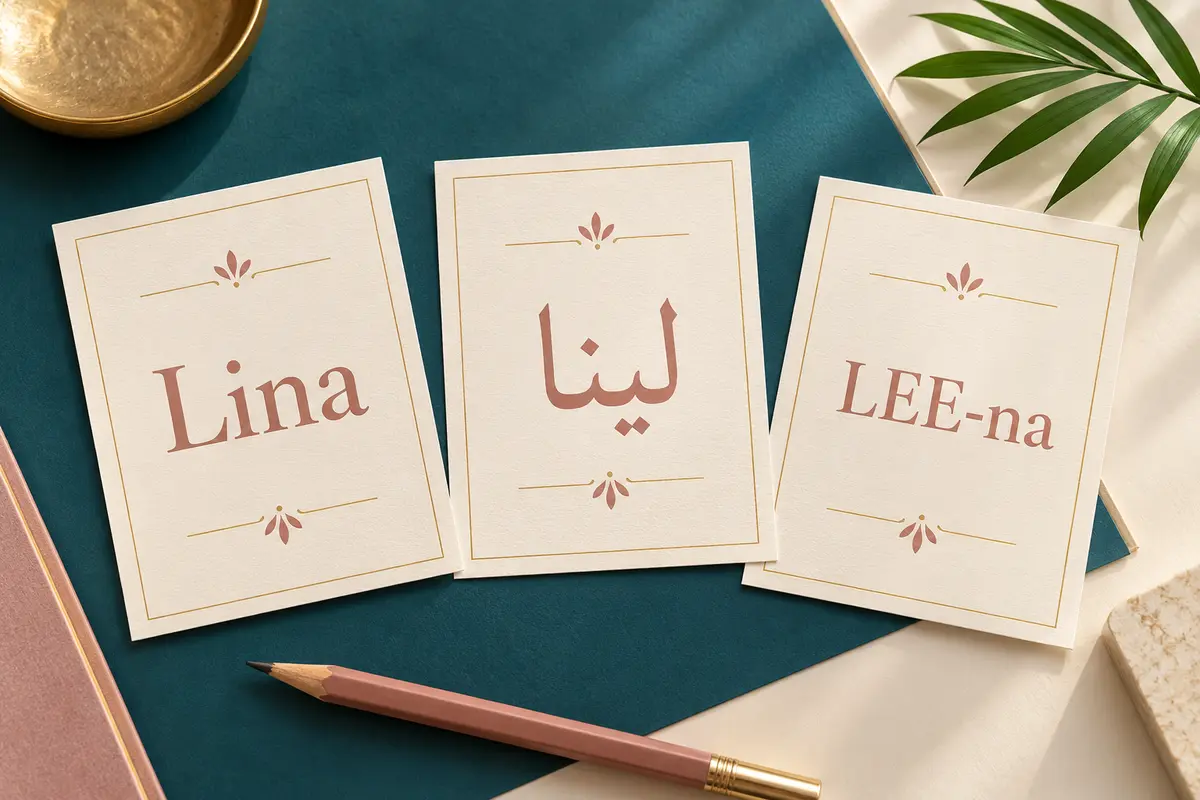
Lina, لينا, and pronunciation
A helpful English guide is LEE-nuh, with the first syllable like “see.” Arabic is commonly represented as LEE-na, with a fuller final vowel; the Arabic entry gives /ˈliː.naː/. The European entry gives /ˈliː.nə/ for English and /ˈli.na/ for Italian and Spanish. These guides are approximations, and a person’s own pronunciation takes priority.
To introduce the name, try “Lina, with Lee at the start.” If someone says it differently, a brief correction is usually clearer than a long phonetic explanation. For an audio announcement, provide a voice recording as well as the written name.
Do not assume that Lina, Lena, and every similar-looking spelling are interchangeable. Even if two people pronounce their names alike, their spellings remain part of their identities. On invitations, school labels, or a gift, copy the person’s preferred form exactly.
Is Lina a Quranic name?
The relevant textual connection is the noun līna, written لينة. The Quranic Arabic Corpus analysis of 59:5 identifies the word as a feminine noun with the root lām–yā–nūn and glosses it as palm trees. In the verse, it is not the personal name of a woman.
That is narrower than saying “Lina is the name of someone in the Quran.” It is also worth distinguishing the modern name spelling لينا from the spelling لينة in that connection. A family may find the association significant, but explaining the actual word is more accurate than inventing a named character or a religious promise.
Names and scriptural vocabulary can overlap in different ways. Our Aya name guide offers another example of why the word’s context deserves attention.
Choosing Lina as a full name or a nickname
You do not need to invent an elaborate origin story to explain why a name suits your family. Its sound, a person you love, or the ease of using it in everyday conversation may matter more than a long list of symbolic associations.
Try the full combination aloud, including middle and family names. Say it slowly, then at the pace you would use when introducing someone. Notice whether nearby vowels run together or whether two names sound confusingly alike. This is a practical listening exercise, not a rule about which combinations are correct.
If you are choosing between Lina and a longer name, consider which version you actually want people to use. A short everyday name and a longer formal name can work well together, but they do not have to be a package. For another concise choice with a different naming history, compare Yara’s origins and pronunciation.
For popularity, use a dated national source rather than a claim that a name is “rare everywhere.” The U.S. Social Security Administration’s baby-name tool lets you explore names by year and recorded sex. A result for one spelling and country should not be treated as a worldwide count.
Lina name meaning and personal symbolism
For some families, Lina name meaning becomes a reminder of a value or a relationship. You might connect it with kindness, a favorite garden, or someone whose name you want to carry forward. Describe these as your associations rather than established facts about every bearer.
The same care helps with a birth announcement. “Chosen with love for her grandmother” says something real. “Destined to bring peace to everyone” places an unnecessary expectation on a child. A name can be a gift without becoming an instruction for how its bearer must live.
Frequently asked questions
What is the main Lina name meaning?
There is no single answer for every origin. Arabic references associate it with softness or tenderness and sometimes a palm-tree word. In European traditions, its explanation may instead lie in a longer name from which it was shortened.
Is Lina only an Arabic name?
No. The same spelling occurs in multiple naming traditions. Ask about the person’s or family’s background rather than assigning an origin from the four letters alone.
How do you pronounce Lina?
LEE-nuh is a useful English approximation; LEE-na is a helpful guide in several other contexts. Listen to the person who bears the name, particularly when preparing an announcement or recording.
Does Lina mean a girl mentioned in the Quran?
The cited connection is to the palm-tree noun in verse 59:5, not a named girl. Keeping the word, its spelling, and the modern personal name distinct avoids a misleading claim.
Sources
- Behind the Name: separate Arabic and European Lina entries, linked above.
- Quranic Arabic Corpus: word-level morphology for chapter 59, verse 5, word 4.
- U.S. Social Security Administration: official baby-name lookup and year-based records.
For another short name whose shared spelling crosses distinct language histories, compare Nadia name meaning across Arabic and Slavic traditions, which separates Arabic and Slavic origins instead of merging them.
For another concise international name whose shared spelling has several independent roots, compare Hana name meaning across Arabic, Japanese, and European traditions, including Arabic, Japanese, and European uses.
Another concise Arabic-rooted name appears in Farah's Arabic origin, spelling, and pronunciation, which explains its joy meaning without turning it into a personality prediction.