Hana Name Meaning: Arabic, Japanese, and Other Origins
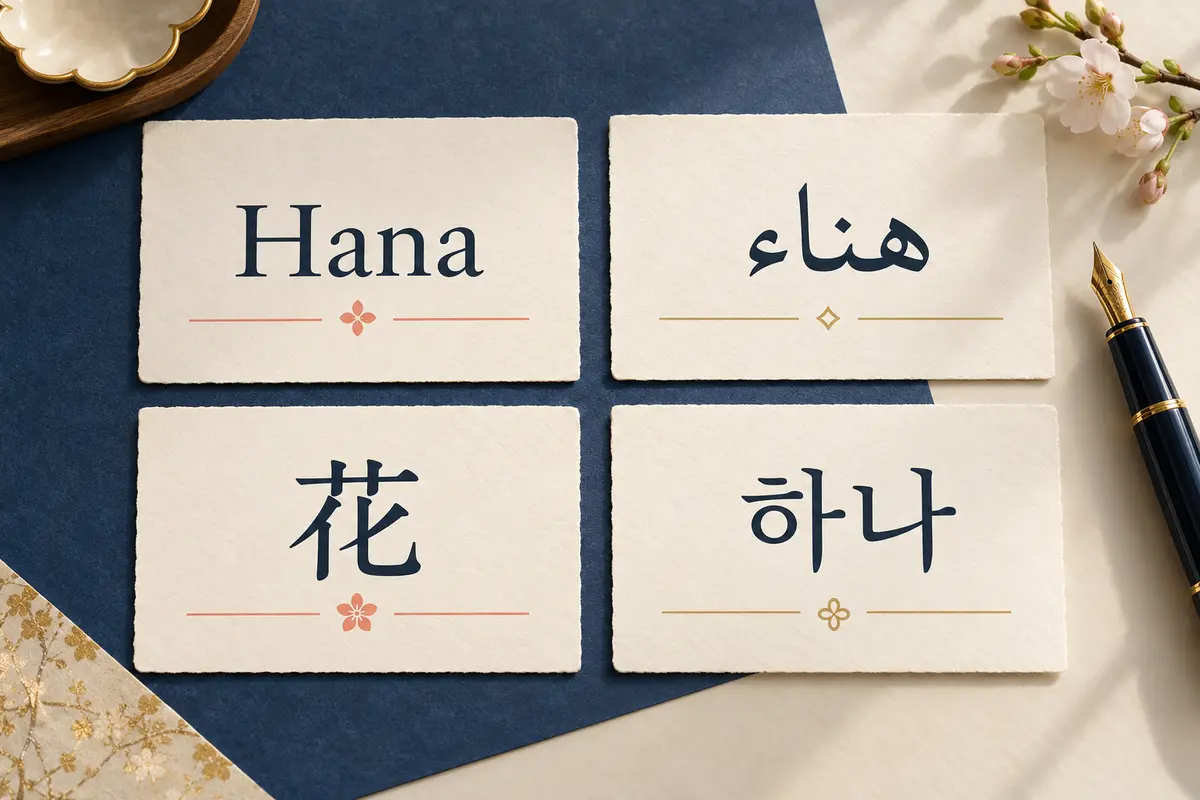
Hana name meaning changes with language, script, and family history. In Arabic, هناء is associated with happiness and ease. In Japanese, 花 or 華 can connect the name with a flower. Hana is also used as a form of Hannah in several European languages, while Korean 하나 is the everyday word for “one.” These are separate linguistic routes, not pieces of one combined definition.
This guide explains those origins carefully, shows the main spellings, and separates documented meanings from personal symbolism. It does not claim that a name predicts personality, luck, or a child’s future.
Hana name meaning at a glance
| Tradition | Common form | Documented connection | Important note |
|---|---|---|---|
| Arabic | هناء | Happiness, bliss, ease of mind | Hanaa is another Latin spelling |
| Japanese | 花, 華, or はな | Flower or blossom when written with those kanji | Meaning depends on the chosen characters |
| Hebrew and European | Hana, חַנָּה | A form of Hannah, linked with favour or grace | Used in Czech, Slovak, Croatian, Slovene, Macedonian, and Sorbian |
| Korean | 하나 | One | A distinct Korean word and name route |
Arabic Hana name meaning, هناء
In Arabic, the name is usually written هناء. The Academy of the Arabic Language entry for الهَناء defines the noun through joy and peace of mind. That makes “happiness,” “bliss,” or “contentment” reasonable English summaries, though no single English word captures every shade.
The Arabic Hana entry at Behind the Name, citing Hans Wehr’s dictionary, connects the name with the root هنأ and glosses it as bliss or happiness. It gives the Arabic pronunciation approximately as ha-NAA, ending with the sound represented by the final hamza. Everyday English speech may soften or omit that final sound.
Hana and Hanaa can therefore represent the same Arabic name. The extra a in Hanaa is a transliteration choice meant to show the long final vowel; it does not create a different meaning.
The Japanese origin: flower and chosen kanji
Japanese names must be read with their written form in mind. The Japanese Hana entry lists 花 and 華, both read Hana in this name and associated with “flower.” The name may also be written phonetically as はな in hiragana.
花 is the direct everyday character for flower or blossom. 華 can carry associations such as flower, splendour, or brilliance depending on context. Other kanji or combinations can also be chosen for the sound Hana, so a Japanese person’s actual characters are the best evidence for the intended meaning.
This is why “flower” is a strong answer for Japanese Hana written 花, but it should not be assigned automatically to every person named Hana. The Latin spelling alone does not reveal which script or characters a family uses.
Hana as a form of Hannah
Hana is also a form of Hannah in Hebrew and in several Central and South Slavic languages. The Hebrew and European Hana entry records use in Czech, Slovak, Croatian, Slovene, Macedonian, and Sorbian, among others.
In that family, Hana relates to Hebrew חַנָּה and the traditional sense of favour or grace. This route is historically different from Arabic هناء, even though both names look like Hana in English letters. The resemblance is a result of transliteration and shared spelling, not proof of a common root.
A similar naming puzzle appears in our guide to Lina’s Arabic and European origins. Short international names often travel well precisely because familiar letters can represent more than one documented history.
The Korean form 하나
In Korean, 하나 is pronounced in two clear syllables and means “one.” The Korean Hana entry records this as a separate feminine-name usage. It is not an Arabic translation of happiness and it is not the Japanese character for flower.
Families may appreciate “one” as a simple personal association, perhaps suggesting unity or uniqueness. That is a chosen interpretation rather than a promise about character or destiny.
Hana name meaning, spelling, and pronunciation
English speakers often say HAH-nah, with two open syllables. Arabic هناء generally places more weight on the second syllable and may preserve the final hamza. Czech pronunciation begins with a voiced, breathy sound that English does not reproduce exactly. Japanese and Korean each use their own sound systems.
Asking the name-bearer is always more reliable than treating one pronunciation guide as universal. The spellings Hana, Hanaa, Hannah, and Hanna can overlap in some communities, but they are not interchangeable in every language.
- Hana: the most internationally compact Latin spelling.
- Hanaa: often used to show the long final vowel in Arabic هناء.
- Hannah: a familiar English form from the Hebrew name family.
- Hanna: a common form in several European languages.
Choosing Hana for a child
Begin with the origin that actually belongs to your family or intended naming tradition. If you are choosing the Arabic name, record هناء alongside the Latin spelling. If you are choosing a Japanese name, decide which kanji or whether hiragana will be used. For a European form of Hannah, check the conventional spelling where the child will live.
Practical questions matter too: how the name will appear on documents, whether relatives can pronounce it comfortably, and whether a middle name creates an unintended rhythm or repeated sound. For another Arabic name associated with a positive state, see Salma’s root and pronunciation. Our Yara guide also shows why usage and etymology should be checked separately.
If popularity matters, use a dated national source instead of a global ranking claim. The U.S. Social Security Administration baby-name tool lets readers check the exact spelling by year and recorded sex. Its data describes United States registrations, not worldwide use.
Hana name meaning and personal symbolism
A family may personally connect Hana with happiness, flowers, grace, unity, or several family stories. Those associations can make the name meaningful without turning etymology into a personality test. A name does not prove that someone will be cheerful, gentle, artistic, fortunate, or spiritually gifted.
For a keepsake, birth announcement, or tattoo, choose one verified script and have a fluent reader review it before permanent use. Arabic هناء, Japanese 花, Hebrew חַנָּה, and Korean 하나 are not decorative variants of the same word.
Frequently asked questions
What is the main Hana name meaning?
There is no single meaning across all languages. Arabic هناء relates to happiness or bliss; Japanese 花 means flower; a Hebrew and European route connects Hana with Hannah and grace; Korean 하나 means one.
Is Hana an Arabic name?
Yes. Hana is a standard Latin spelling of Arabic هناء. It is also a name in other languages, so the spelling alone does not identify one origin.
Does Hana mean flower in Japanese?
Yes when it is written with flower-related kanji such as 花 or 華. Other characters can be used for the same sound, so the written form determines the intended Japanese meaning.
Are Hana and Hannah the same name?
Sometimes Hana is a regional form of Hannah, especially in Hebrew and several European languages. Arabic Hana and Japanese Hana have separate roots, so they should not automatically be treated as shortened forms of Hannah.
Sources
- Academy of the Arabic Language: الهَناء
- Behind the Name: Arabic Hana, citing Hans Wehr
- Behind the Name: Japanese Hana
- Behind the Name: Hebrew and European Hana
- Behind the Name: Korean Hana
- U.S. Social Security Administration: Popular Baby Names
For another Arabic name whose meaning centers on being well watered or refreshed, compare Rayyan's Arabic meaning, spelling, and pronunciation, including the spelling رَيَّان and pronunciation notes.
Another short name whose gender and pronunciation change across language traditions is Iman's Arabic meaning and cross-language use, covering Arabic, Persian, Urdu, and Southeast Asian contexts.