Dry Texting Meaning: Signs, Examples, and What It Can Mean
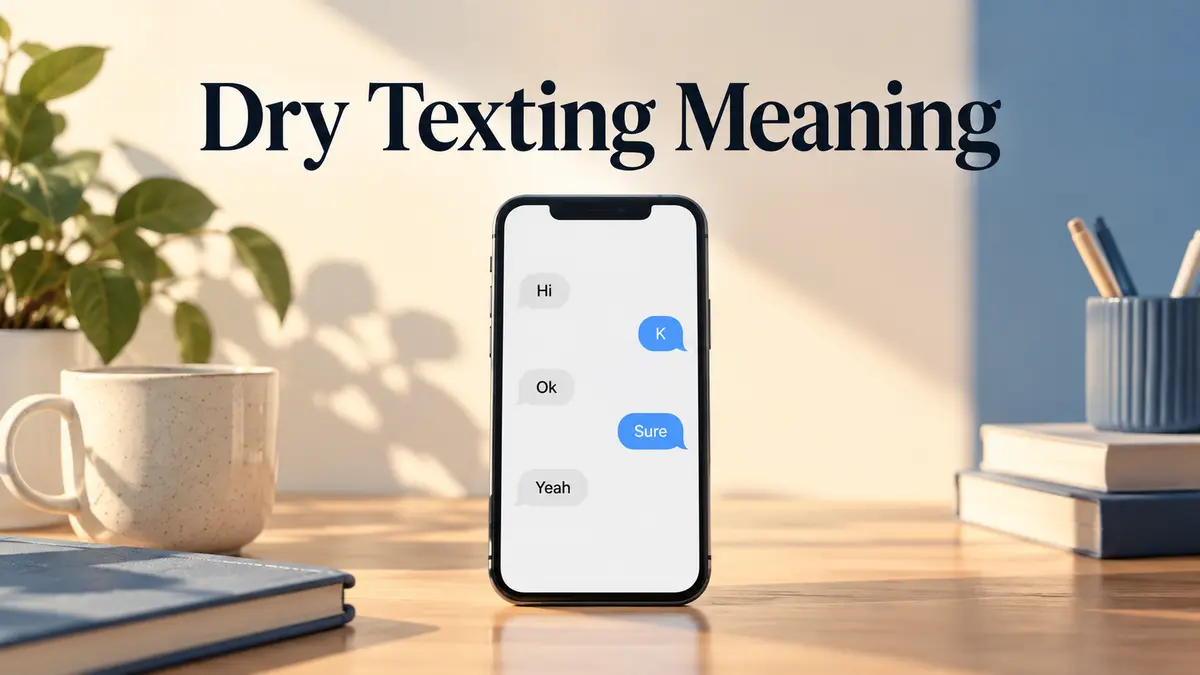
Dry texting meaning is the use of brief, low-detail replies that give the other person little to respond to. Typical examples include “k,” “yeah,” “sure,” “lol,” or an answer that closes a topic without asking a question or adding information.
The phrase describes a communication pattern, not a diagnosis. A short reply can feel distant, but it does not prove boredom, anger, rejection, or lack of interest. Some people naturally text in a compact style, and anyone can send a quick answer when busy, tired, distracted, or unsure what to say.
Dry texting meaning at a glance
| What you can observe | A possible reading | What it does not prove |
|---|---|---|
| Repeated one-word replies | The person is keeping the exchange brief | Why they are being brief |
| No questions or new details | The conversation is not moving forward | That they never want to talk |
| A sudden change from fuller messages | Their availability or tone may have changed | A specific emotion or motive |
| Short but clear practical answers | They may be communicating efficiently | That the relationship is in trouble |
The most useful definition is therefore behavioral: dry texting is a run of minimal responses that contributes little new material to a conversation. Context tells you more than any single word.
Common dry texting examples
A reply becomes “dry” mainly through contrast and repetition. “Sure” can be a complete, friendly answer to “Can we meet at six?” The same word may feel unengaged after someone shares a detailed story and asks for an opinion.
Common examples include:
- answering several open questions with only “yeah,” “no,” or “idk”;
- relying on “lol” or a reaction without responding to the point;
- giving information but never asking anything back;
- repeatedly ending topics with “cool,” “nice,” or “okay”;
- switching from an established warm style to unusually clipped replies.
None of these signs is conclusive by itself. The exchange, the question, and the person’s normal style all matter. Someone who always writes concise texts may be fully engaged even when their messages are short.
Why short messages can feel colder than intended
Face-to-face conversation includes voice, timing, facial expression, and gesture. Text removes many of those cues, so readers use punctuation, spelling, emoji, length, and response patterns to infer tone. Those clues can shape impressions, but they are not a perfect code for a sender’s feelings.
Binghamton University researchers found that punctuation and other “textisms” can carry social meaning in messages. Their summary of texting research explains that writers adapt available visual cues to communicate meaning that speech would otherwise carry.
A 2024 study published by the American Psychological Association similarly reported that participants often perceived messages with abbreviations as less sincere because the abbreviations appeared to require less effort. The APA research summary describes an average experimental effect; it does not mean every abbreviation or short reply is insincere.
Research on ambiguous digital messages also cautions against treating a cue as a universal translation. One peer-reviewed study of text and emoticons found that readers tended to perceive ambiguous messages more negatively, while emoticons changed how mood was interpreted. The broader lesson is that sparse text leaves room for the reader to supply tone.
Dry texting versus concise texting
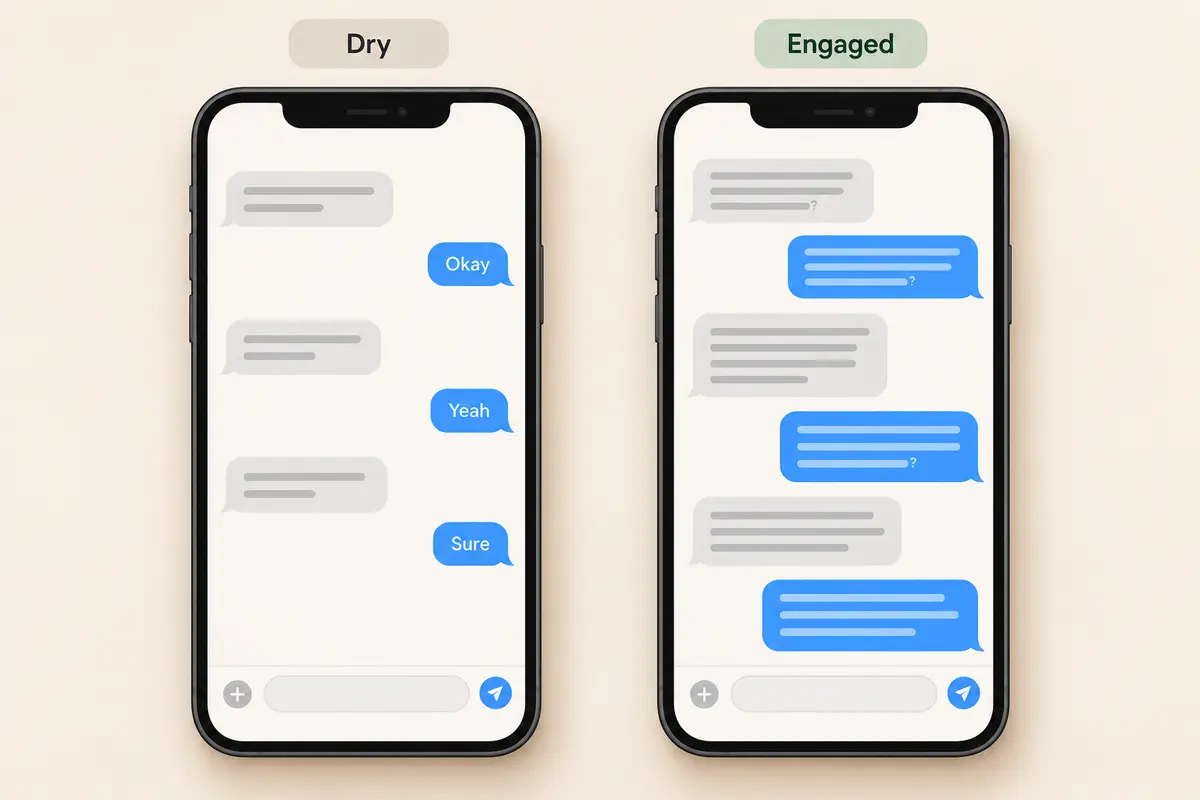
Concise texting can still be responsive. A concise message answers the question, gives the needed detail, or moves a plan forward: “Yes—6 pm at the café works for me.” It is short, but it is clear and useful.
Dry texting contributes less: “sure.” The difference is not a word count rule. It is whether the reply fits the situation and gives the conversation somewhere to go. In practical chats, brevity may be helpful. In a personal conversation that invites reflection, the same brevity may feel mismatched.
Frequency matters too. One clipped response after a busy morning is weak evidence. A repeated pattern across several conversations is more informative because it shows how the exchange is functioning, even if it still does not reveal a hidden motive.
What dry texting can mean in context
Possible explanations include limited time, low energy, multitasking, a preference for calls, difficulty typing, unfamiliarity with the language, uncertainty about the topic, or a belief that the message did not need a longer answer. Some people use messaging mostly for logistics and save emotional conversation for voice or in-person contact.
Reduced interest is another possibility, especially when brief replies appear alongside cancelled plans, no questions, and no effort to continue contact. Yet the visible behavior still supports only a modest conclusion: the current conversation is receiving little engagement. It does not establish why.
This evidence-first approach is useful with other messaging labels too. Our guide to what being left on read means separates a visible receipt from assumptions about the reader’s intention. The digital meanings collection applies the same distinction to other online terms.
How to respond to dry texting
Start by checking the shape of your own message. Closed questions often produce closed answers. Instead of “Did you have a good weekend?” try one focused, open prompt: “What was the best part of your weekend?” A specific question makes the next step easier without demanding a long explanation.
If the conversation remains flat, avoid carrying it alone through repeated follow-ups. Give the person space, then notice whether they return with a topic, question, or plan. Reciprocity is easier to assess over time than in one exchange.
You can also ask directly and neutrally: “You seem a little quieter over text today—is now a bad time to chat?” That invites context without accusing the person of ignoring you. For an ongoing pattern, a clearer preference may help: “I find it hard to read short messages. Would you rather talk by phone?”
When a practical decision is involved, state the deadline: “I need to book by 7, so please let me know before then.” This turns an uncertain conversation into a clear request. If no answer comes, make the decision you said you would make.
What not to assume
Do not use dry replies as proof that someone is manipulative, emotionally unavailable, or playing a game. Those are claims about personality and intention that a message length cannot establish. Likewise, a lively texting style is not proof of honesty or commitment.
Avoid testing the person with delayed replies, vague posts, or an artificial change in tone. If the relationship matters, direct communication produces better evidence than another round of hints.
Respect boundaries. If someone has asked for space or ended contact, do not use the ambiguity of a short reply to keep pressing for conversation. Your response can be guided by the stated boundary rather than by an attempt to decode the final message.
When the pattern matters
The pattern matters when it consistently prevents planning, leaves direct questions unanswered, or makes one person responsible for every conversation. At that point, you do not need certainty about motive to make a choice. You can reduce your effort, propose a different channel, or explain what kind of communication you need.
In dating, friendship, family, or work, focus on observable facts: how often replies arrive, whether commitments are kept, whether questions receive answers, and whether both people initiate. Those details support a practical decision more reliably than punctuation or a single “k.”
Frequently asked questions
What does dry texting mean?
It means sending consistently brief, low-detail replies that add little to a conversation. The phrase describes the message pattern; it does not prove why the sender is communicating that way.
What are examples of dry texting?
Examples include repeated replies such as “k,” “yeah,” “sure,” “lol,” or “nice,” especially when they do not answer an open question, add information, or continue the topic.
Does dry texting mean someone is not interested?
It can accompany low interest, but it can also reflect busyness, fatigue, a concise communication style, or a preference for another channel. Look at the wider pattern and ask directly when clarity matters.
How should I reply to a dry text?
Try one specific open question, give the person time, or ask whether another time or channel would work better. Avoid repeated messages and base boundaries on the ongoing pattern rather than a guessed motive.
Sources
- Binghamton University: Punctuation in text messages helps replace face-to-face cues
- American Psychological Association: Texting abbreviations and perceived sincerity
- Journal of Experimental Psychology: General: Shortcuts to Insincerity
- Frontiers in Psychology: Mood detection in ambiguous messages
Short replies can invite guesswork; hard launch relationship meaning explains the difference between interpreting a dry message and making an explicit public relationship announcement.
A short reply is still direct communication, while orbiting dating meaning describes passive social activity after direct contact has stopped.
Brief replies still form a direct conversation; how breadcrumbing differs from dry texting explains the wider pattern in which attention returns but plans and clarity do not develop.