Orbiting Dating Meaning: When Someone Watches but Does Not Engage
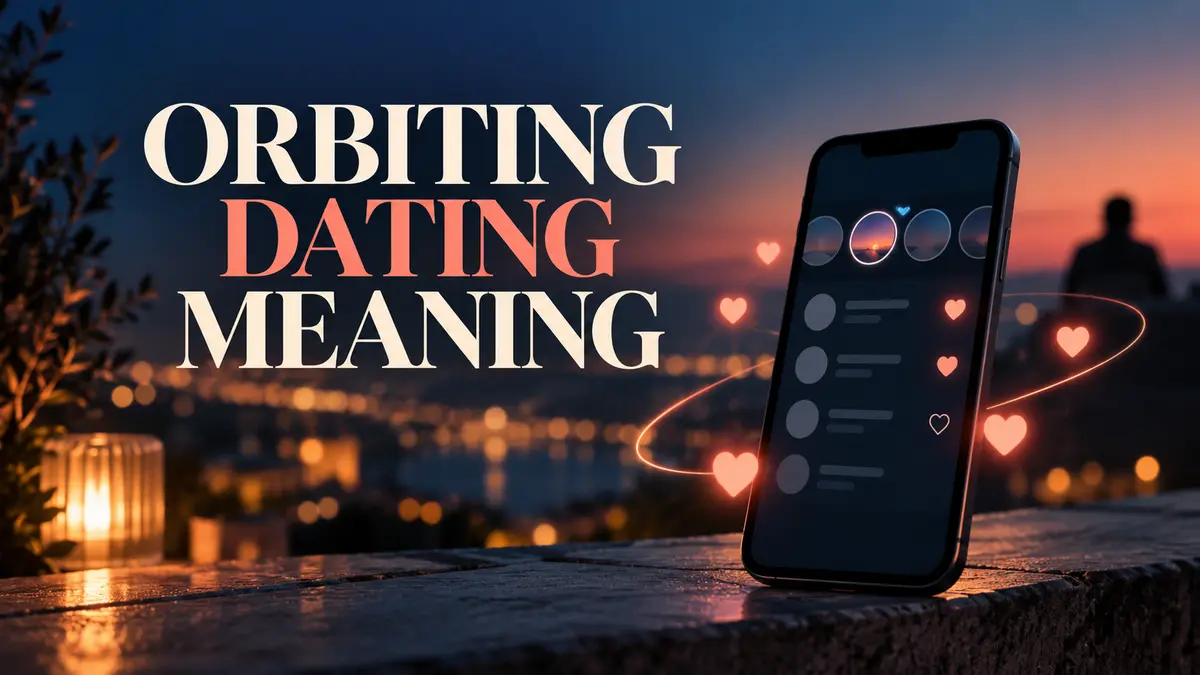
Orbiting dating meaning is the practice of ending or avoiding direct communication with someone while continuing to appear around their social media activity. An orbiter may stop replying to messages but still view stories, like posts, react to updates, or follow the account.
The term describes an observable pattern, not a diagnosis or a reliable explanation of someone’s intentions. A story view can be deliberate, habitual, accidental, or produced by the way a platform presents content. The useful question is what the pattern means for your boundaries, not whether one click reveals a hidden motive.
Orbiting dating meaning at a glance
| Online behavior | What you can observe | What it does not prove |
|---|---|---|
| Orbiting | Direct contact stops while passive social activity continues | Why the person stays visible or whether they will return |
| Ghosting | Replies and direct contact stop without explanation | The person’s private reason |
| Breadcrumbing | Occasional direct messages or signals keep contact open without clarity | A serious plan or commitment |
| Ordinary story viewing | A person appears in a viewer list once or occasionally | A continuing relationship pattern |
The combination matters. A single like is not enough to establish orbiting. The label is usually used when direct engagement has ended but repeated, visible social media activity continues.
Where the term orbiting came from
Writer Anna Iovine coined the dating term in 2018 after describing a person who stopped responding to her messages but continued to watch her Instagram stories and interact with her online presence. Her portfolio records the original article and the term’s later recognition. Contemporary coverage from ABC News also documented Iovine’s explanation of the behavior.
The metaphor is simple: the person remains in your digital orbit without coming close enough for a direct conversation. Dictionary.com’s dating-slang guide summarizes orbiting as ending real-life contact while continuing social media engagement.
Like many informal dating terms, orbiting names a recognizable experience. It is not a clinical category, and people may use the word differently. Some reserve it for repeated activity after ghosting; others use it more broadly for any former date who stays visibly present online.

Orbiting versus ghosting and breadcrumbing
Ghosting concerns the disappearance from direct communication. Orbiting adds continued passive visibility: the person does not answer, yet their name keeps appearing in story views or reactions. The two can occur together, but orbiting specifically points to the online traces left after contact has stopped.
Breadcrumbing normally includes intermittent direct signals such as a vague message, a late-night check-in, or a suggestion that never becomes a plan. Orbiting may involve no message at all. The person stays visible through low-effort platform actions rather than a conversation.
Other digital patterns can look similar but mean something different. Dry texting still involves replies, even when they are brief. Being left on delivered describes a message status, while being left on read confirms only that a message was opened. None of these signals, by themselves, reveals a person’s motive.
Why a story view is weak evidence
Social platforms make passive observation easy. Stories may advance automatically, feeds may surface familiar accounts, and a like can take less than a second. That makes a viewer list emotionally noticeable but informationally thin.
Checking a former partner’s profile is also not rare. In a U.S. survey, the Pew Research Center found that 53% of social media users had used a platform to check up on someone they used to date or be in a relationship with. The figure shows that looking happens; it does not explain the reason in any individual case.
A person might be curious, bored, scrolling automatically, trying to stay friendly, or hoping to reconnect. Those possibilities are guesses unless the person communicates. Repeated activity can establish a pattern of visibility, but it cannot establish intent.
Common examples of orbiting
Imagine that two people go on several dates. One stops answering, yet watches nearly every story the other posts. That is the classic example. Another is a former partner who no longer speaks to you but regularly likes new photographs. A dating-app match might also stop replying while continuing to react to public posts on another platform.
Context changes the interpretation. Friends, colleagues, and former partners may naturally remain connected online. If direct contact ended clearly and respectfully, continued following may simply reflect a settled digital connection. If contact stopped abruptly, the same activity may feel intrusive or confusing.
A single view, an old like, or an algorithmic recommendation is not a strong pattern. Frequency, timing, prior communication, and your own response are more relevant than one isolated notification.
How to respond without guessing motives
You do not need to decode the orbiter before deciding what works for you. Start with the practical effect. If the activity does not bother you, no response is required. You can leave the connection as it is and avoid treating every view as a message.
If the visibility keeps pulling your attention back to an unclear situation, use the platform controls available to you. Muting can reduce reminders without changing the connection. Restricting may limit interactions. Removing a follower, unfollowing, or blocking creates a firmer boundary. Choose the least disruptive option that gives you the space you want.
If you want clarity and direct contact feels safe, one concise message is enough. Ask whether the person wants to resume a conversation rather than referring to every story view. If the answer is absent or vague, treat the lack of direct engagement as the clearest available information. Repeated messages rarely make an ambiguous online signal more reliable; our guide to double texting meaning explains how a follow-up can be reasonable without becoming a cycle.
When online monitoring affects your well-being
Repeatedly checking who viewed a story can keep an ended or uncertain connection mentally active. A study of Facebook surveillance after a breakup found associations between monitoring an ex-partner and greater breakup distress and longing in its sample. The authors did not show that viewing a profile causes those outcomes for everyone, and the study’s design cannot explain any one person’s experience. Still, the peer-reviewed findings support paying attention to whether monitoring is helping or prolonging distress.
Small changes can reduce the loop: hide viewer counts when possible, mute the account, remove shortcuts to the profile, or take a temporary break from the app. Talk with a trusted person if the situation is occupying more time than you want. If online attention becomes threatening, persistent across new accounts, or connected to offline safety concerns, document the behavior and use the platform’s reporting and blocking tools.
What orbiting can and cannot tell you
Orbiting can tell you that direct communication and visible social media behavior do not match. It may also show that the digital connection is still open enough for one person to see or react to the other’s posts.
It cannot tell you whether the person misses you, wants another chance, is trying to manipulate you, or is simply scrolling. Those are interpretations, not facts. A direct and consistent conversation would carry more information than a sequence of likes.
In short, orbiting dating meaning refers to staying visibly present online after direct engagement has stopped. The label can help describe the pattern, but your next step should be based on clear communication and comfortable boundaries rather than a prediction about the orbiter’s mind.
Frequently asked questions about orbiting dating meaning
What does orbiting mean in dating?
It means that someone stops or avoids direct communication but continues to view, like, follow, or react to the other person’s social media activity.
Is orbiting the same as ghosting?
No. Ghosting is the unexplained end of direct contact. Orbiting describes continued passive online visibility after contact has stopped, so someone can ghost and then orbit.
Does watching every story mean someone wants to come back?
Not necessarily. Repeated views show attention to the content, but they do not prove romantic interest or an intention to reconnect. Only direct, consistent communication can clarify that.
Should I block someone who is orbiting me?
Blocking is one option, not a requirement. You can mute, restrict, remove, unfollow, or block depending on how the activity affects you and how much distance you want. Use stronger controls if the behavior feels intrusive or unsafe.
Sources
- Anna Iovine: The origin of the term “orbiting”
- ABC News: Contemporary account of the orbiting dating term
- Dictionary.com: Dating slang terms
- Pew Research Center: Dating and Relationships in the Digital Age
- Cyberpsychology, Behavior, and Social Networking: Facebook surveillance after a breakup
Watching stories without direct contact is orbiting; how zombieing differs from orbiting explains what changes when the person actively restarts the conversation.