Double Texting Meaning: When You Send Two Messages in a Row
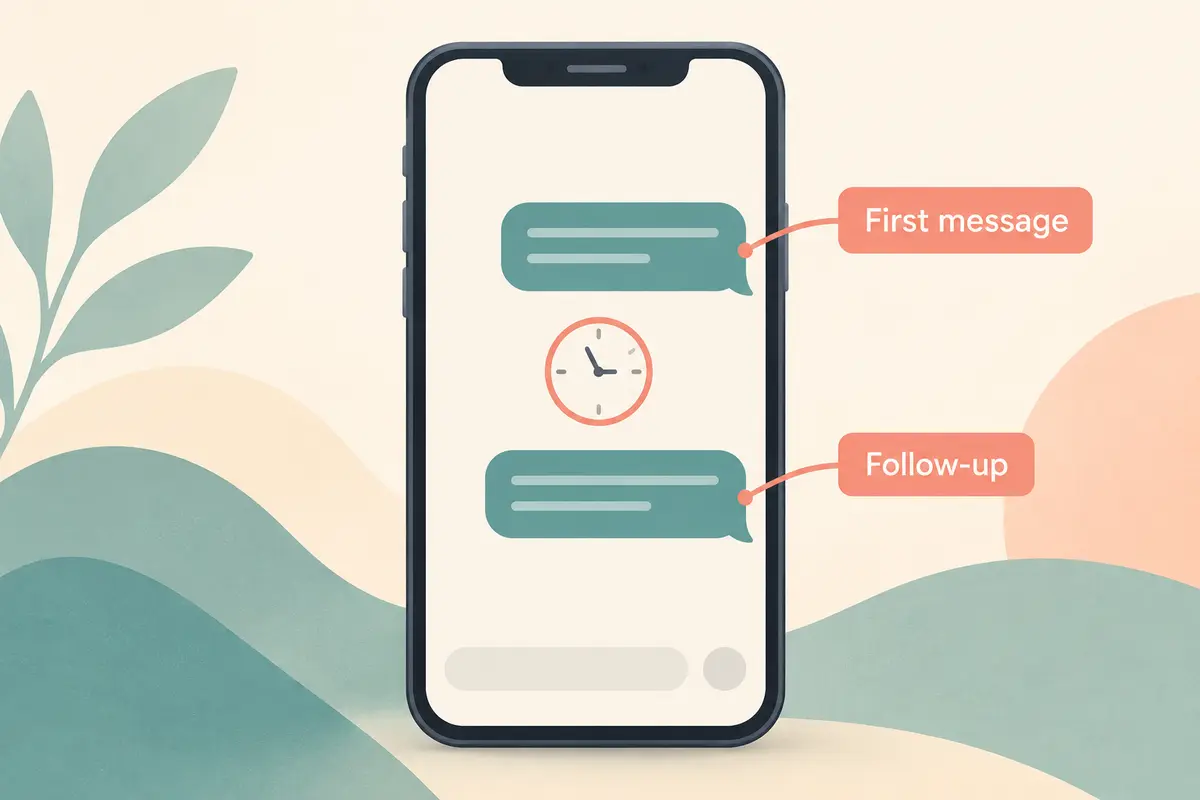
Double texting meaning is straightforward: you send a second message before the other person has replied to the first. The follow-up may arrive seconds, hours, or days later. It can add information, correct a mistake, change the subject, or simply ask whether the earlier message was seen.
The phrase describes the order of messages, not the sender’s personality. A second text is not automatic proof of neediness, strong interest, anxiety, or poor boundaries. Its meaning depends on the reason, timing, relationship, urgency, and whether the recipient has asked for space.
Double texting meaning at a glance
| Situation | What the second message does | A useful reading |
|---|---|---|
| “Meet at six?” followed by “The café closes at seven.” | Adds relevant information | A practical update |
| A typo followed by a correction | Repairs the first message | Ordinary clarification |
| “How are you?” followed minutes later by “Hello?” | Requests an immediate response | May feel pressuring if nothing is urgent |
| A follow-up after several days | Reopens the conversation | Can be reasonable once; the wider pattern matters |
The key distinction is usefulness. A follow-up that clarifies a plan is different from sending repeated prompts mainly to force a response.
Common double texting examples
Double texting includes more than two identical greetings. Everyday examples include sending an address after confirming a meeting, adding a photo that belongs with the first message, correcting a date, remembering an important detail, or starting a new topic later in the day.
In dating conversations, it may look like: “I had a good time yesterday,” followed the next afternoon by, “Would you like to meet again this weekend?” That second message makes a clear invitation instead of asking the recipient to infer one.
A less helpful version is a rapid sequence such as “Hey,” “Are you there?” and “Why are you ignoring me?” when the person has had no reasonable opportunity to answer. The issue is not the number two; it is the pressure, accusation, and repeated demand for attention.
Is double texting bad?
No universal texting rule makes it bad. Messages are asynchronous: the sender and recipient do not have to be available at the same moment. People may be working, driving, sleeping, studying, caring for someone, or waiting until they can give a proper answer.
Research shows that timing can affect impressions, but it also warns against treating delay as certain evidence. An American Psychological Association summary of response-delay research notes that people may judge quick answers as more sincere, even though a delay can come from distraction or thoughtful processing. That finding concerns perception; it does not make every slow reply suspicious.
Likewise, a PNAS study of conversational response time found associations between fast turn-taking and feelings of connection in spoken conversations. A text thread operates differently because pauses can last while people move between tasks. The study is useful for understanding why timing feels meaningful, not for decoding a specific unanswered message.
Why people send a second message
A sender may have forgotten a detail, realized the first message was unclear, found something relevant, or needed to update a deadline. They may also want reassurance that the conversation is still active. Those possibilities describe different needs and should not be collapsed into one negative label.
Reaching out can be welcome. In a series of experiments summarized by the American Psychological Association, people tended to underestimate how much friends appreciated an unexpected call, text, or email. The finding does not promise that every follow-up will be welcomed, but it challenges the idea that initiating contact is inherently embarrassing.
Communication expectations also vary. The APA’s discussion of virtual communication highlights how easily tone and urgency are misread when people do not know each other’s normal style. A second message may feel ordinary to one person and urgent to another.
Double texting versus spam or pressure
One relevant follow-up is not the same as flooding someone’s phone. Spam involves repeated or unwanted messages, often without a genuine conversational purpose. Pressure appears when the sender demands an answer, assigns a motive, or ignores a stated boundary.
Notice the recipient’s words and the established pattern. If they said they would be offline, asked for space, ended contact, or blocked the conversation, another message is not a neutral follow-up. Respect the boundary.
If there is no stated boundary, one concise second message can provide clarity. After that, let the other person decide whether to respond. More messages usually do not create the information or willingness that is currently missing.
How long should you wait before double texting?
There is no universal countdown. The right interval depends on the message. A correction can be sent immediately. A changed meeting location should be sent as soon as it matters. A casual “how are you?” usually does not require another prompt ten minutes later.
For plans, use the real deadline: “I need to reserve by 5, so please let me know before then.” For a social conversation, compare the pause with the person’s normal reply pattern and the pace of the relationship. Hours may be ordinary for one contact; several days may be ordinary for another.
Visible app labels also have limits. The guide to what left on delivered means explains why delivery does not prove that a person opened or noticed a message. If the app reports that it was viewed, being left on read still does not reveal the reader’s motive.
How to send a useful follow-up
Make the second message add clarity. State the reason, include any new information, and keep the request easy to answer. For example: “Adding the address in case tomorrow still works: 14 Oak Street. Please confirm by noon.”
If the first message was emotional, wait until you can write without escalating. A neutral follow-up might be: “I want to clarify that I am asking about Friday’s plan, not expecting an immediate reply.” This repairs ambiguity instead of accusing the recipient.
When you are reconnecting after a longer pause, give the person a simple choice: “Just following up once—would you still like to meet, or should I leave the plan?” A clear option respects both people’s time.
For an urgent safety, health, travel, or same-day matter, texting may be the wrong channel. Call the appropriate person or service rather than relying on repeated messages and app receipts.
Double texting in dating
In dating, the phrase often carries unnecessary shame. Sending two messages does not establish how attractive, confident, or invested a person is. A better question is whether the exchange is reciprocal over time.
Look at observable behavior: Do both people initiate? Are direct questions answered? Are plans confirmed and kept? Does one person always restart the conversation? Those patterns offer more useful information than a single pair of messages.
If your follow-ups repeatedly receive no response, step back. You do not need to diagnose the other person to decide that the current level of communication does not work for you. The digital meanings collection uses the same evidence-first approach for other texting terms.
When not to send another text
Do not continue when the person has clearly asked you to stop, requested space, or ended the relationship. Do not use different accounts or platforms to bypass a block. A lack of response is not permission to override an explicit boundary.
It is also wise to pause if your next message only repeats the first one or attempts to provoke a reaction. Draft it elsewhere, wait, and ask whether it adds new information. If it does not, leaving the conversation alone may be the clearest choice.
Frequently asked questions
What does double texting mean?
It means sending a second message before the recipient replies to the first. The term describes message order and does not by itself reveal the sender’s motive or the recipient’s interest.
Is double texting a sign of neediness?
Not necessarily. A second text can correct, clarify, update, or continue a conversation. Pressure comes from repeated demands or ignored boundaries, not simply from sending two messages.
How long should I wait before sending a second text?
Use the context rather than a fixed rule. Send urgent corrections or practical updates promptly; give casual messages time based on the person’s normal pattern and any real deadline.
Should I double text after no reply?
One calm follow-up can be reasonable if the message needs an answer. Make it specific, avoid accusations, and stop if there is still no response or if the person has asked for space.
Sources
- American Psychological Association: Answer quickly to be believed
- PNAS: Fast response times signal social connection in conversation
- American Psychological Association: Friends enjoy being reached out to more than we think
- American Psychological Association: How to master virtual communication
Repeated online reactions without a direct message can feel different from double texting; what orbiting means in dating explains the term for staying visible without engaging.
Sending one follow-up is a messaging choice, while how a slow fade differs from double texting describes a sustained reduction in contact and plans over time.
A second message can be a normal follow-up, while breadcrumbing meaning in dating describes a repeated pattern of small signals without reliable progress.