Zombieing Dating Meaning: When a Ghost Returns
Zombieing dating meaning refers to someone returning after they previously ghosted you. A message, call, or direct reply suddenly revives a connection that had gone silent, often without acknowledging the disappearance.
The term borrows from horror stories: a connection thought to be “dead” appears to come back to life. It describes a sequence you can observe—silence followed by renewed contact—not a diagnosis or proof of why the person returned.
Zombieing dating meaning at a glance
| Pattern | What happens | Key distinction |
|---|---|---|
| Zombieing | Someone disappears, then makes direct contact again | The return follows a period of ghosting |
| Orbiting | Someone stops direct contact but continues viewing or reacting online | They remain visible without restarting the conversation |
| Breadcrumbing | Small signals of interest continue without meaningful follow-through | Contact is intermittent rather than fully absent |
| Slow fade | Replies and effort gradually decrease | The withdrawal is progressive, not a clear disappearance-and-return cycle |
A single delayed reply is not automatically zombieing. The label usually fits when there was enough prior contact for the silence to feel like an unexplained ending, followed by an unmistakable reappearance.
Where the term comes from
Zombieing grew from the same digital-dating vocabulary as ghosting. Dictionary.com’s slang guide defines it as a former ghost suddenly resurfacing and explains the metaphor of someone returning from the dead. The guide dates news coverage of the term to at least 2017.
The image is memorable, but the word remains informal. It is not a clinical category and has no official time threshold. People may use it after days, weeks, or months of silence depending on the earlier relationship and communication pattern.
What zombieing can look like
Imagine two people who dated several times and exchanged messages most days. One person stops replying without a closing conversation. Six weeks later, they send “Hey, how have you been?” and continue as if the gap never happened. That is a typical example of zombieing.
The return may also be a reply to an old story, a casual meme, a late-night message, or an unexpected call. What matters is renewed direct contact. Merely viewing a public post is closer to orbiting in dating because the person stays around the edges without reopening the conversation.
Not every return is careless. A person may come back with a clear explanation, recognize the impact of disappearing, and ask whether you are open to talking. The earlier ghosting still happened, but the quality of the return is different from a message that ignores it.
Why someone might reappear
There is no reliable way to infer motive from one notification. The person may feel lonely, curious, regretful, bored, or ready to explain. They may have encountered a reminder of you, or they may simply be testing whether the connection is still available.
Those possibilities are hypotheses, not facts. The safest interpretation is narrow: someone who had stopped communicating has made contact again. Their next words and actions provide more useful information than a confident theory about what they are thinking.
Research on ghosting can describe the larger communication pattern, but it should not be stretched into mind reading. A peer-reviewed study that developed the GHOST questionnaire treats ghosting as sudden, unexplained communication exclusion and measures features such as avoidance, ambiguity, blocking, and withdrawal. It does not establish a single motive for everyone who ghosts or later returns.
Zombieing versus ghosting
Ghosting is the disappearance; zombieing is a later return. The second term depends on the first. If a person clearly ended the relationship and later asked to reconnect, that may be an attempted reconciliation rather than zombieing because there was no unexplained disappearance.
The boundary can still be fuzzy. A conversation sometimes ends naturally, especially after only a few messages. Expectations, frequency of contact, and any existing plans matter when deciding whether the silence reasonably counted as ghosting.
A 2020 Pew Research Center survey found that 29% of U.S. adults reported having been ghosted. That statistic provides context for unexplained endings; it is not a zombieing rate because the survey did not separately measure returns.
Zombieing versus orbiting and breadcrumbing
Orbiting usually means that direct conversation has stopped while the person continues to watch stories, like posts, or remain visibly present online. Zombieing involves a clearer re-entry, such as sending a message or calling.
Breadcrumbing describes intermittent signs of interest without consistent progress. A person who returns after ghosting and then sends occasional low-effort messages may move from zombieing into a breadcrumbing pattern.
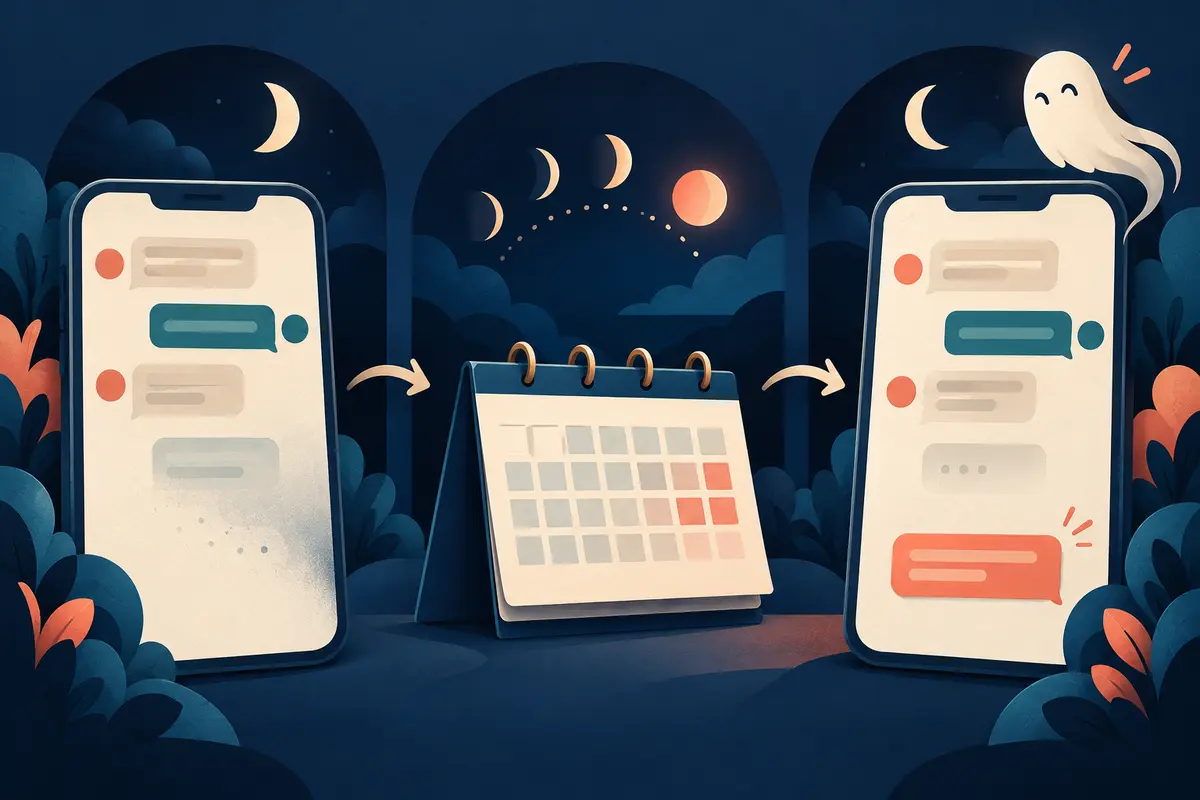
The labels can overlap because they describe different parts of communication. Instead of debating which word is perfect, note the timeline: regular contact, unexplained silence, a new message, and whatever follow-through occurs next.
How to respond when a ghost returns
You do not owe an immediate reply. Pause long enough to decide what you want: an explanation, a casual conversation, a renewed relationship, or no further contact. Your choice can reflect the history and your current priorities rather than the urgency of the message.
If you want clarity, ask a direct, limited question: “We stopped talking without an explanation. What made you reach out now?” A useful response acknowledges the gap and answers the question. Deflection, blame, or another vague greeting gives you information too.
If you are open to reconnecting, move slowly and look for consistent behavior. A sincere message is a start, not proof that the pattern has changed. You might say: “I’m willing to talk, but I need direct communication if plans change.”
If you do not want contact, a short boundary is enough: “I’m not interested in restarting this connection. Please don’t contact me again.” You may also choose not to respond. Block or report the account when contact is unwanted, repeated, threatening, or ignores a clear request to stop.
Questions to consider before reconnecting
Consider whether the person takes responsibility without demanding instant forgiveness. Do they explain what happened in proportion to the relationship, or do they act as though no time passed? Do their actions over the next few weeks match what they say now?
Also notice what you are agreeing to. One conversation does not require resuming the previous level of access. You can accept an apology without restarting the relationship, or hear an explanation and still decide that the communication pattern does not work for you.
If you send one follow-up and receive no answer, our guide to double texting explains why a second message can be ordinary. Repeatedly pursuing another explanation, however, may recreate the uncertainty you were trying to resolve.
When a return may deserve a different reading
Context matters. An emergency, illness, loss of phone access, or safety issue can interrupt contact. If the person explains a genuine constraint and communicates responsibly afterward, “zombieing” may be a less useful label than “an interruption followed by reconnection.”
Safety also changes the usual expectations. Someone does not owe a closing message when direct contact could expose them to harassment or harm. Likewise, a returning message should not be treated as an invitation if the other person has already asked for no contact.
Research on ambiguous endings helps explain why people seek clarity without proving what any individual should do. A study in Personal Relationships examined how people tried to reduce uncertainty after being ghosted and documented the ambiguity participants experienced. Its findings concern ghosting generally, not a rule for accepting or rejecting a later return.
A practical way to use the label
The most useful zombieing dating meaning is descriptive: a person disappeared without explanation and later contacted you again. The label can help name the sequence, but it cannot tell you whether the return is sincere or whether reconnecting is right for you.
Use the new contact as one piece of evidence. Ask what you need to know, set a boundary that matches your goals, and judge the connection by consistent follow-through rather than by the drama of a sudden return.
Frequently asked questions
What does zombieing mean in dating?
It means that someone who previously ghosted you returns and makes contact again. The reappearance may be a text, call, direct message, or other clear attempt to restart communication.
Is liking a social media post zombieing?
It can be described that way, but a passive like is often closer to orbiting. Zombieing usually implies a more direct re-entry into conversation after a period of unexplained silence.
Why do people come back after ghosting?
Possible reasons include curiosity, regret, loneliness, or changed circumstances, but a message alone does not prove any motive. Ask directly and evaluate whether later behavior is consistent.
Should you reply to someone who zombied you?
You may reply, decline, or ignore the message. Consider the prior pattern, whether the return acknowledges the disappearance, what you want now, and any safety concerns before choosing.
Sources
- Dictionary.com: Zombieing
- Heliyon: Development and Validation of the GHOST Questionnaire
- Personal Relationships: Ghosted? Navigating Strategies for Reducing Uncertainty
- Pew Research Center: Personal Experiences and Attitudes of Daters
A return after unexplained silence is zombieing; ghosting vs no contact explains how that differs from an intentionally stated boundary.