Ghosting vs No Contact: What Is the Difference?
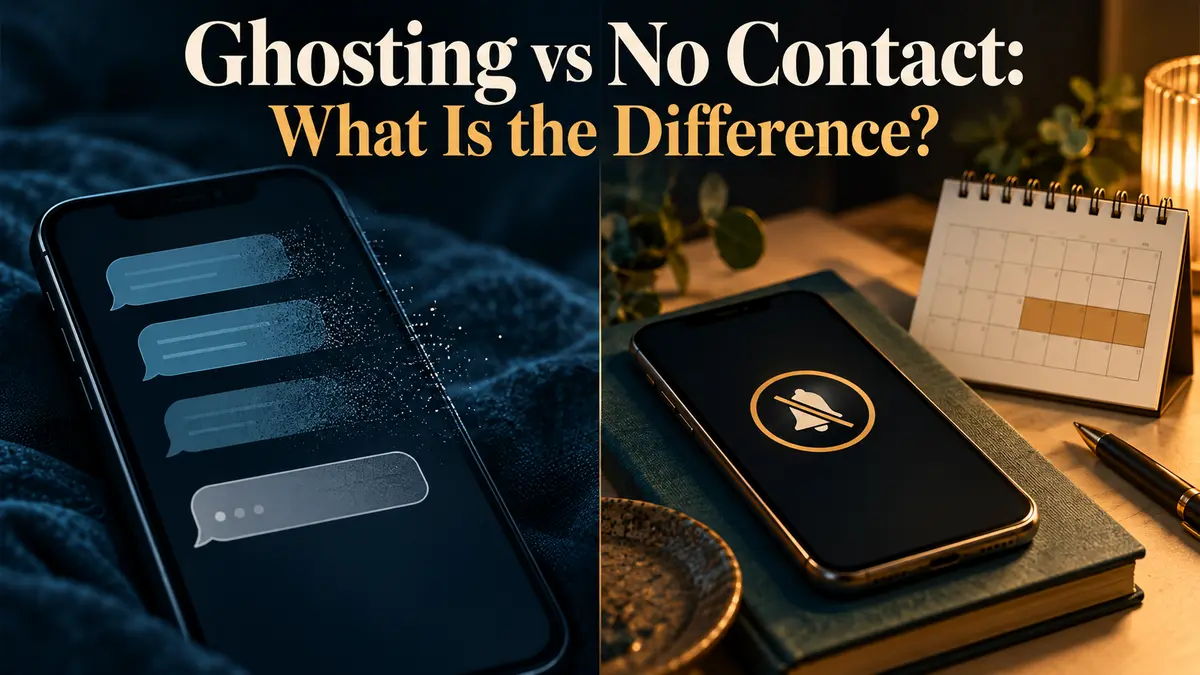
Ghosting vs no contact comes down to communication and context. Ghosting is an unexplained withdrawal from an ongoing connection. No contact is a boundary: one or both people intentionally stop communicating, usually after the relationship has ended or after the boundary has been stated.
The same outward fact—silence—can therefore mean very different things. The label should describe what happened, not claim to reveal someone’s thoughts. No fixed number of days turns a delayed reply into ghosting, and “no contact” is not a guaranteed method for changing another person’s feelings.
Ghosting vs no contact at a glance
| Question | Ghosting | No contact |
|---|---|---|
| Was the ending communicated? | Usually no; contact stops without an explanation | Often yes; the relationship or boundary has been made clear |
| What is the immediate purpose? | Unknown unless the person explains it | To create distance, protect a boundary, or allow recovery |
| What does the other person expect? | They may still expect a reply or planned meeting | They have usually been told not to expect contact |
| Can silence be appropriate? | The term describes an unexplained ending, not a moral verdict in every case | Yes, especially after a clear boundary or when direct contact is unsafe |
A useful test is not “How long has it been?” but “What had already been communicated?” If two people explicitly ended the relationship and stopped speaking, the silence is normally no contact rather than ghosting. If regular communication and plans ended without explanation, ghosting is the closer description.
What ghosting means
Ghosting generally means ending communication with someone without telling them that the connection is over. A peer-reviewed study that developed the GHOST questionnaire describes it as a sudden, unexplained exclusion from communication and examines features such as ambiguity, avoidance, blocking, and withdrawal.
The key word is unexplained. A person may stop replying to messages, miss a planned date, or disappear across several channels while leaving the other person unsure whether the connection has ended. The term can apply to dating, friendships, and other relationships, although expectations differ with the closeness and length of the connection.
Not every conversation that fades is ghosting. A match who exchanged two brief messages and then stopped may simply be a conversation that never developed. A single late reply may reflect work, illness, travel, or another ordinary interruption. The pattern becomes clearer when there was an established rhythm, an unresolved plan, or a reasonable expectation of a response.
What no contact means
No contact is an intentional period or ongoing boundary in which people do not call, message, meet, or interact online. It often follows a breakup, a direct request for space, or a decision that continued communication is not healthy or workable. It can be mutual, or one person can set the boundary for themselves.
Unlike ghosting, no contact usually has a known starting point. Someone might say, “I’m ending this relationship and won’t be in contact,” or “I need thirty days without messages so I can reset.” The exact duration is personal. It may be temporary, indefinite, or permanent, and it does not require the other person’s agreement to be a valid boundary.
No contact is sometimes promoted online as a tactic that will make an ex miss you or return. That is a prediction no one can promise. A more grounded purpose is to reduce repeated conflict, create space to process an ending, or maintain a clear limit. The boundary concerns your own availability and actions, not control over someone else’s response.

The core differences
Communication is the main distinction. Ghosting leaves the ending unstated. No contact generally follows a stated ending, an understood breakup, or an explicit request for distance. One creates ambiguity; the other is meant to define a boundary.
Expectation is different too. Before ghosting, the other person may reasonably expect a reply, a date, or a continuation of regular contact. With no contact, the expected behavior is silence. Reaching out repeatedly after someone has clearly asked for no contact does not turn their boundary into ghosting.
Motive cannot be read from silence alone. Ghosting describes the communication pattern, not why the person vanished. They may be avoiding discomfort, overwhelmed, uninterested, or dealing with circumstances you cannot see. Similarly, someone choosing no contact may want space, safety, or a clean ending. The observable facts support the label; a notification history does not prove an inner motive.
When silence is not ghosting
Silence after a clearly communicated breakup is not usually ghosting, even when it feels abrupt. The ending has already been stated. The same applies when someone says they will not continue a conversation after disrespect, repeated pressure, or an ignored boundary.
Safety is the most important exception to the preference for a closing message. A person does not owe direct notice if communicating could expose them to intimidation, stalking, retaliation, or harm. Resources from Love is Respect on ending unhealthy relationships emphasize planning around safety because leaving can increase risk. Blocking without another explanation can be a protective action.
Silence may also be a temporary interruption rather than an ending. If there is no history of withdrawal, leave room for a reasonable delay before assigning a label. One concise check-in can clarify whether plans changed; repeated messages are less likely to produce useful clarity.
Why the distinction matters
Calling every period of silence ghosting can blur an important difference between ambiguity and a stated limit. It may also encourage someone to keep pursuing contact after a boundary was made clear. On the other hand, calling unexplained disappearance “no contact” can make it sound as though both people understood a decision that was never communicated.
The distinction helps you choose a response. With possible ghosting, you can send one direct message asking whether the person wants to continue. With a no-contact boundary, the appropriate response is to respect the distance, manage practical matters through an agreed channel if necessary, and avoid testing the limit through friends or alternate accounts.
If you are unsure which one happened
Review the last clear exchange rather than trying to decode social-media activity. Was the relationship ended? Did either person ask for space? Was there an upcoming plan? Had the contact become intermittent before stopping? These details are more useful than a story view or a “like.” Continued passive online visibility after direct contact ends is often described as orbiting in dating.
If no boundary or ending was communicated, a brief message can make your position clear: “I haven’t heard from you and don’t want to guess. If you’re no longer interested, please let me know. If I don’t hear back, I’ll assume this has ended.” Then follow through rather than opening several new conversations.
A second message is not automatically excessive. Our guide to double texting explains why context matters. The practical difference is whether the message seeks clarity once or becomes repeated contact after silence or a stated boundary.
If you want to start no contact
When it is safe, communicate the boundary in plain language. Keep it specific enough to follow: “I’m not available for further personal contact. Please do not call or message me.” If shared work, children, housing, or property requires coordination, name the narrow channel and topics that remain open.
Decide what the boundary includes. You may mute or block accounts, stop checking stories, return belongings through a third party, or ask friends not to relay updates. This is different from breadcrumbing, where intermittent signals continue without meaningful progress.
If the person ignores a clear request, you do not need to keep restating it. Save relevant records, use platform blocking and reporting tools, and seek local support if contact becomes threatening. Love is Respect also provides guidance on identifying and communicating boundaries.
What if someone returns after ghosting?
A later message does not rewrite the unexplained disappearance. That return is often called zombieing. You can ask what happened, decline to restart the connection, or ignore the message. Look for an acknowledgment of the gap and consistent follow-through rather than assuming the return proves regret or change.
You can also set no contact at that point: “I’m not interested in reopening this connection. Please don’t contact me again.” In that sequence, ghosting describes the earlier disappearance and no contact describes the boundary you establish afterward. The terms are not opposites; they can occur at different stages of the same relationship.
Decision tree: ghosting or no contact?
- Was the relationship or conversation clearly ended? If yes, move to question 2. If no and regular communication simply stopped, ghosting is the closer description.
- Was distance or no further communication requested? If yes, the silence is a no-contact boundary. If no, consider whether both people nevertheless understood that the relationship had ended.
- Was there an unresolved plan or a reasonable expectation of a reply? If yes and contact disappeared without explanation, that supports the ghosting label.
- Is there a safety concern? If direct communication could create risk, silence or blocking can be an appropriate protective boundary even without a final conversation.
The decision tree is about communication history, not elapsed time. Three silent days after a clearly stated breakup can be no contact, while a sudden disappearance before a confirmed date can create ghosting-type ambiguity much sooner.
Three scenarios compared
| Scenario | Best description | Reason |
|---|---|---|
| Two people text daily, confirm a Friday date, and one person suddenly stops responding without explanation. | Likely ghosting | There was an active connection and an unresolved expectation of contact. |
| After a breakup, one person says, “I need space and will not be messaging for the next month.” | No contact | The boundary and the expected silence were communicated. |
| A person ends a relationship, asks not to be contacted again, and blocks further messages after the request is ignored. | No contact / boundary enforcement | The ending was clear, and blocking enforces a stated limit rather than creating ambiguity. |
What to do next
If the situation looks like ghosting and contacting the person is safe, one concise message can ask for clarity. If a no-contact boundary has already been stated, respect it. If safety or harassment is involved, prioritize blocking, documentation, and appropriate support rather than trying to obtain a final explanation.