Hamsa Hand Meaning: Symbolism, History, and Cultural Context
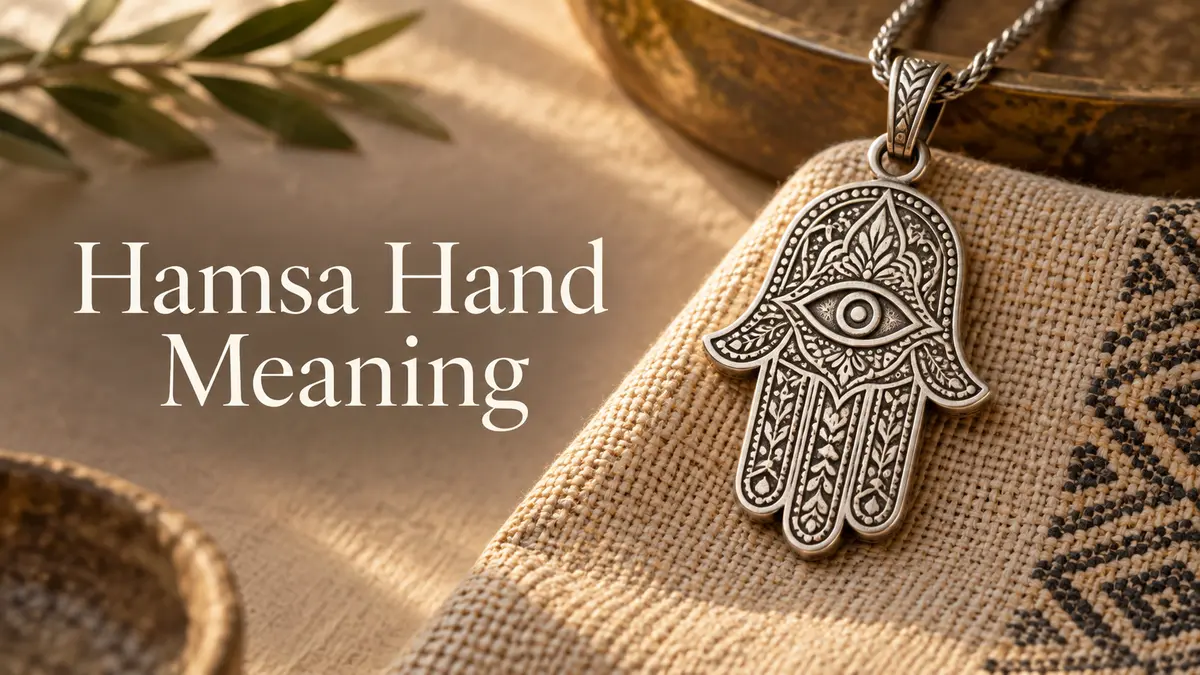
Hamsa hand meaning is usually connected with protection, blessing, welcome, and good fortune. The familiar design is a stylized open hand, sometimes with an eye in the palm and sometimes filled with floral or geometric decoration. It appears on jewelry, wall hangings, textiles, and other objects across North Africa, West Asia, and Mediterranean communities.
No single definition covers every hamsa. Muslim, Jewish, regional, family, and secular uses overlap without becoming identical. This guide explains the names, museum evidence, evil-eye connection, jewelry, tattoos, and modern décor while keeping cultural practice separate from supernatural promises.
Hamsa hand meaning at a glance
| Name or feature | Common context | Important distinction |
|---|---|---|
| Hamsa or khamsa | A hand-shaped amulet associated with protection, blessing, and good fortune | The design does not belong to only one religion or country |
| Hand of Fatima | A name used in many Muslim and North African contexts | Its precise religious or family meaning varies |
| Hand of Miriam | A name used in some Jewish communities | It is not a universal label for every Jewish hand motif |
| Eye in the palm | Protective imagery often connected with the evil-eye tradition | Not every hamsa includes an eye, and an eye charm is not automatically a hamsa |
What does hamsa or khamsa mean?
Hamsa and khamsa are English spellings of the Arabic word for “five,” a reference to the five fingers of the hand. The spelling changes because Arabic sounds can be represented in more than one way in the Latin alphabet. Neither spelling changes the basic object: a stylized hand used as an amulet or decorative motif.
An educational guide from the Museum of International Folk Art describes the khamsa as a hand-shaped amulet or good-luck charm and notes that hands may symbolize welcome, protection, and blessing. Those are documented cultural associations. They do not establish that an object can physically control luck or prevent harm.
A history without a single origin story
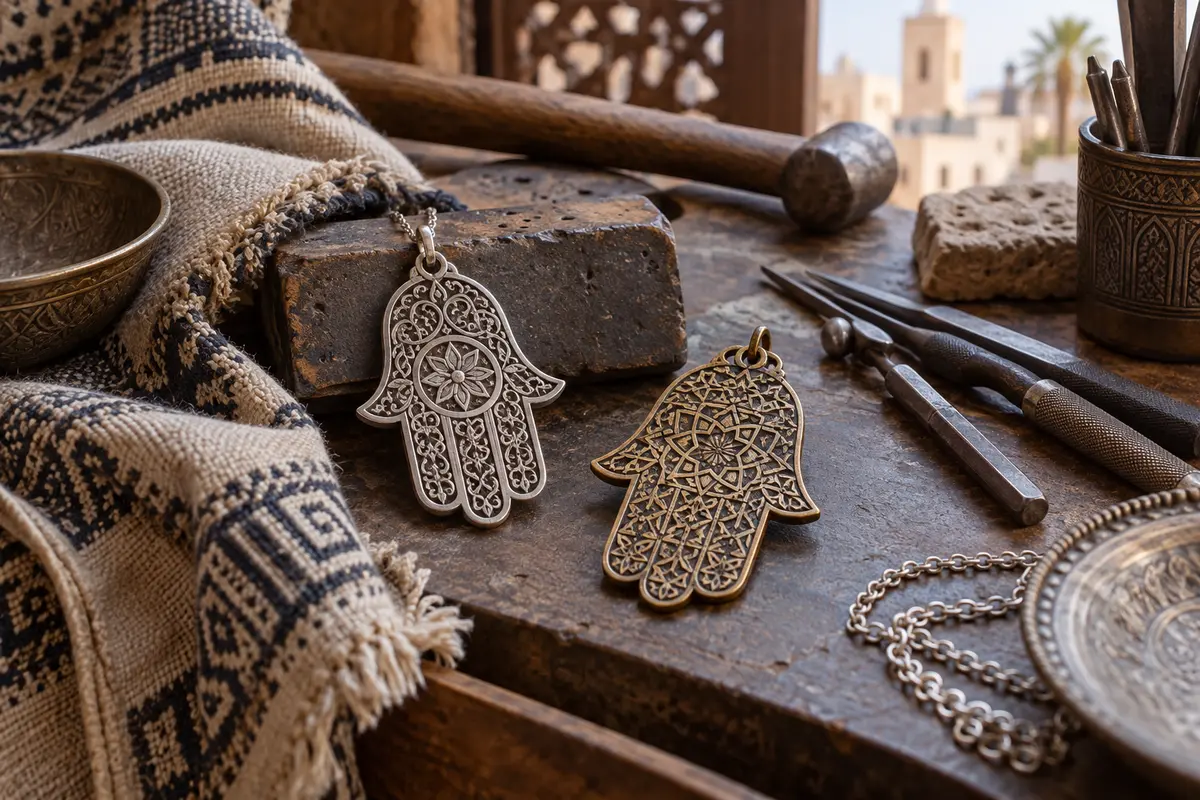
Hand imagery is ancient and widespread, but that fact does not give every hand-shaped object the same history. Museum collections show hamsas in different materials, places, and communities, especially in North Africa and the wider Mediterranean. A responsible history therefore starts with dated objects rather than one dramatic claim about the symbol’s first appearance.
The Metropolitan Museum of Art records a nineteenth- or twentieth-century Moroccan ornament called a foulet khamsa. Made from silver and glass, it was worn by Moroccan Amazigh women as a pendant or at the waist. That specific record tells us who used one object and how it was worn; it should not be stretched into a rule for all hamsas.
A Moroccan belt buckle in The Jewish Museum collection, dated around 1900–1925, combines a six-pointed star with a hamsa form. The museum’s catalog also cautions that an object’s place in a Jewish collection does not by itself prove exclusively Jewish ownership or use. That care is useful: shared visual traditions rarely fit a single label.
Hamsa hand meaning in Muslim and Jewish contexts
The name Hand of Fatima refers to Fatima, daughter of the Prophet Muhammad, in many Muslim and North African settings. Depending on the household or maker, the five fingers may be linked with faith, family, blessing, or protection. Some modern explanations assign a fixed religious concept to every finger, but those neat lists are not universal doctrine.
Hand of Miriam is a name used in some Jewish contexts, referring to Miriam, sister of Moses and Aaron in the Hebrew Bible. Here too, the hand may express protection, blessing, identity, or continuity. Its appearance beside Jewish motifs in North African objects reflects a regional history in which communities lived near one another and shared artistic forms while maintaining distinct traditions.
Neither name erases the broader term hamsa. A wearer may choose the design because of Muslim heritage, Jewish heritage, Amazigh identity, family memory, fashion, or a general wish for well-being. The most accurate interpretation comes from the maker or wearer, not from appearance alone.
The hamsa and the evil eye
Many hamsas include an eye in the palm. In those examples, the eye is usually protective imagery associated with averting an envious or harmful gaze. The Museum Europäischer Kulturen in Berlin describes a stylized Hand of Fatima amulet with blue eyes that were intended to protect its wearer from the evil eye and envy.
The hand and the eye remain distinguishable motifs. A plain hand can be a hamsa, while a circular blue-and-white nazar bead is an eye charm rather than a hand. Our guide to evil eye meaning and the history of protective eye symbols explains why the feared gaze and the object meant to avert it should not be confused.
Museum language such as “intended to protect” reports a belief and a use. It does not prove that envy acts as a measurable force or that jewelry can guarantee safety.
Does the direction of the hand change its meaning?
Hamsas appear with fingers pointing up or down. Modern shops often say an upward hand means protection while a downward hand means blessing or abundance. That can be a maker’s chosen symbolism, but it is not a reliable universal rule. Historical objects may be oriented by how a pendant hangs, how a buckle closes, or how a wall piece is displayed.
Look for stronger evidence: the object’s date, place, inscription, material, maker, and explanation from its owner. If a contemporary artist explicitly assigns a meaning to the direction, that statement applies to the artist’s work. It should not be projected backward onto every museum object.
Common details: eyes, fish, flowers, and geometric patterns
The central eye is the best-known addition, but hamsas may also carry fish, stars, leaves, flowers, Hebrew letters, Arabic calligraphy, or repeating geometry. Decoration can signal a region, workshop, faith, or simply an artist’s style. An inscription may make the context clearer; ornament alone often cannot.
Color works the same way. Blue glass is common in evil-eye imagery, yet silver, brass, enamel, wood, ceramic, and textile hamsas are also widespread. Online color charts that promise a fixed benefit for every shade usually describe recent marketing systems, not a shared historical code.
Hamsa hand meaning in jewelry and gifts
On a necklace or bracelet, hamsa hand meaning may be as direct as “I wish you protection and well-being.” It can also communicate cultural identity, remembrance of home, or affection from the person who gave it. Someone else may wear the design only because they appreciate its shape and craftsmanship.
When giving a hamsa, explain why you chose it and consider the recipient’s relationship to the symbol. A museum-shop reproduction, family-made pendant, and mass-market fashion charm do not carry identical stories. Buying from an artist who names their materials and cultural context provides more useful information than a generic product description.
If the gift accompanies a difficult transition, it can function as a tangible reminder of care rather than a promise. That personal use resembles the reflective role discussed in our guide to white feather meaning in remembrance, although the symbols have different histories.
Hamsa tattoos and respectful design
A hamsa tattoo can represent protection, family heritage, faith, resilience, or mindful conduct. Before choosing one, identify which version you mean. Ask whether an eye, inscription, or religious name has a specific significance, and check the spelling of any Hebrew or Arabic text with a fluent reader.
Respect does not require pretending the symbol has only one owner. It does require avoiding careless mixtures that turn distinct traditions into decoration. A tattoo artist can help adapt a documented pattern, but the wearer should still research its source and be ready to explain the personal connection without claiming a universal definition.
Hamsa décor in the home
A wall hanging near an entrance may express welcome, blessing, or protection. In a family home it may also preserve a memory of migration, a wedding gift, or a regional craft tradition. In a design shop, the same shape may be sold as contemporary décor with little historical explanation.
Placement does not create a guaranteed effect. If the piece matters spiritually or culturally, follow the practice of the community or family it comes from. Otherwise, treat it as an object whose meaning comes from its provenance and the intention of the people who display it.
Seeing a hamsa repeatedly or in a dream
Repeatedly noticing a hamsa can have ordinary explanations: you recently learned the symbol, encountered it in jewelry, or became more attentive to a familiar shape. In a dream, the hand may connect with your own thoughts about safety, welcome, family, boundaries, or cultural identity.
No fixed dream dictionary can identify a hidden threat or predict good fortune. A better reflection asks what the object looked like, how you felt, and what was happening in your life. Personal meaning can be valuable without being a supernatural forecast.
How to interpret a hamsa responsibly
Begin with provenance. Hamsa hand meaning becomes clearer when you ask where the object was made, what its owner calls it, when it was acquired, and whether the design includes an inscription or documented religious reference. Museum records are especially helpful because they separate known details from uncertain interpretation.
Next, distinguish shared form from identical meaning. A Moroccan silver pendant, a Jewish family heirloom, and a modern Hand of Fatima wall tile may all use the open-hand shape while carrying different stories. The same approach helps with lotus flower meaning across religious art and history: context is more reliable than a universal symbol chart.
Finally, describe beliefs accurately. Say that an amulet is worn for protection or that a family sees it as a blessing. Avoid promising that the object prevents illness, envy, accidents, or other events.
Frequently asked questions
What is the hamsa hand meaning?
The hamsa commonly represents protection, blessing, welcome, and good fortune. Its exact meaning varies across Muslim, Jewish, Amazigh, regional, family, and secular contexts. The open hand may appear with or without an eye.
Is the hamsa the same as the evil eye?
No. The hamsa is a hand-shaped motif. An eye in its palm can connect it with traditions intended to avert the evil eye, but many hamsas have no eye, and many eye charms have no hand.
What is the difference between the Hand of Fatima and the Hand of Miriam?
Both names can refer to versions of the hamsa, but they arise in different religious and cultural contexts. Hand of Fatima is used in many Muslim settings; Hand of Miriam appears in some Jewish settings. Neither label defines every hamsa.
Can anyone wear a hamsa necklace?
People from many backgrounds wear hamsa jewelry. Wearing it respectfully means learning the source of the design, not treating distinct traditions as interchangeable, and avoiding claims that it guarantees protection. The maker’s and wearer’s explanations matter most.
Sources
- Museum of International Folk Art: Folk Art for You—Khamsa.
- The Metropolitan Museum of Art: Foulet khamsa ornament from Morocco.
- The Jewish Museum: Moroccan belt buckle with hamsa form.
- Museum Europäischer Kulturen: Hand of Fatima amulet in Traces of European Muslims.
A modern floral motif whose meaning comes primarily from color and rarity appears in blue rose meaning in gifts and tattoos, which likewise separates personal symbolism from guaranteed effects.
A floral symbol used for endings, resilience, and dark elegance appears in black rose meaning in gifts and tattoos, which also separates personal interpretation from promised effects.