Evil Eye Meaning: Symbol, Belief, and Cultural History
Evil eye meaning begins with a belief found in many places: an envious or admiring look may bring misfortune to another person. The familiar blue-and-white eye charm is usually meant to protect against that danger. These two ideas are related, but they are not the same thing. The “evil eye” can name the harmful gaze, the belief surrounding it, or—informally—the protective eye-shaped object.
This guide separates those uses, traces documented objects from the ancient Mediterranean to later jewelry, and explains modern necklaces, tattoos, and home décor. It describes cultural beliefs without presenting envy, luck, illness, or protection as supernatural facts.
Evil eye meaning at a glance
| Term or object | What it commonly refers to | What not to assume |
|---|---|---|
| The evil eye | A belief that a harmful or envious gaze can cause trouble | That the belief works as a measurable force |
| Eye-shaped charm | An apotropaic object—that is, one intended to turn away harm | That every eye design comes from one culture |
| Nazar bead | A concentric eye-like glass bead widely associated with Türkiye and neighboring regions | That every blue eye charm is historically identical |
| Modern tattoo or jewelry | Protection, cultural identity, watchfulness, or a personal reminder | That its wearer shares a particular religion or belief |
The harmful gaze and the protective symbol are different
In the belief itself, the evil eye is the threatening look. The eye-shaped bead or amulet is used against it. English conversation often blurs this distinction by calling the protective charm “an evil eye,” but knowing the difference makes museum descriptions and family traditions easier to understand.
Scholars and museums use the word apotropaic for imagery or objects intended to avert harm. A Roman bronze amulet at The Metropolitan Museum of Art, dated to the first century CE, combines three protective devices that the museum says were intended to ward off the Evil Eye. Its form is not the modern blue bead, which shows how the protective idea has appeared through many different objects.
That long history does not prove that a gaze causes events. It documents what makers and wearers believed an object could do.
A short history of evil eye meaning
Fear of a damaging gaze appears in texts, images, and amulets across parts of the ancient Mediterranean and West Asia. Traditions developed in Greek, Roman, Jewish, Christian, Islamic, and other communities, but they should not be collapsed into a single origin story. Each community has its own language, practices, and explanations.
Ancient Roman objects show how varied the visual vocabulary could be. The Met describes a carnelian ring stone engraved with a composite creature as a type worn for supposed efficacy against the evil eye. A separate bone amulet from Egypt’s Fayum region has a dot-in-circle motif that the museum cautiously identifies as a likely abstract eye with an apotropaic function. The uncertainty matters: responsible interpretation leaves room for what an object record cannot establish.
Protective materials also extended beyond eye imagery. A sixteenth-century Italian pendant jewel in the Met collection includes coral, which its record says was valued for its supposed power to ward off dangers including the evil eye. The history is therefore larger than one color or one bead.
What is a nazar bead?
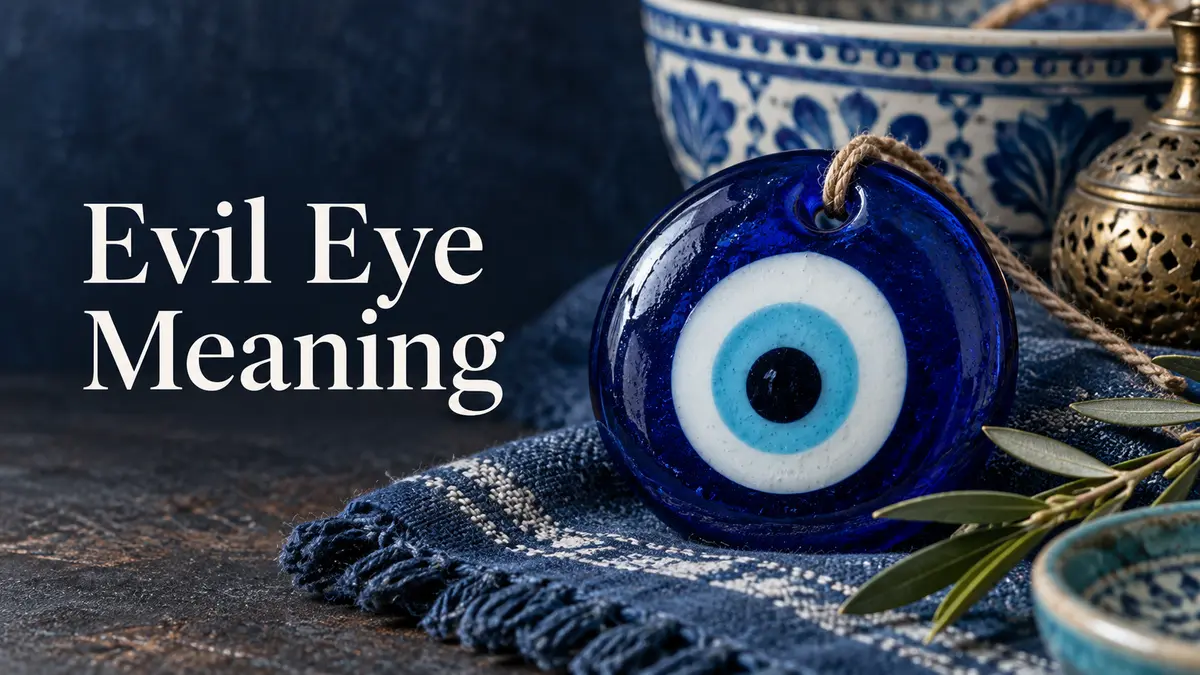
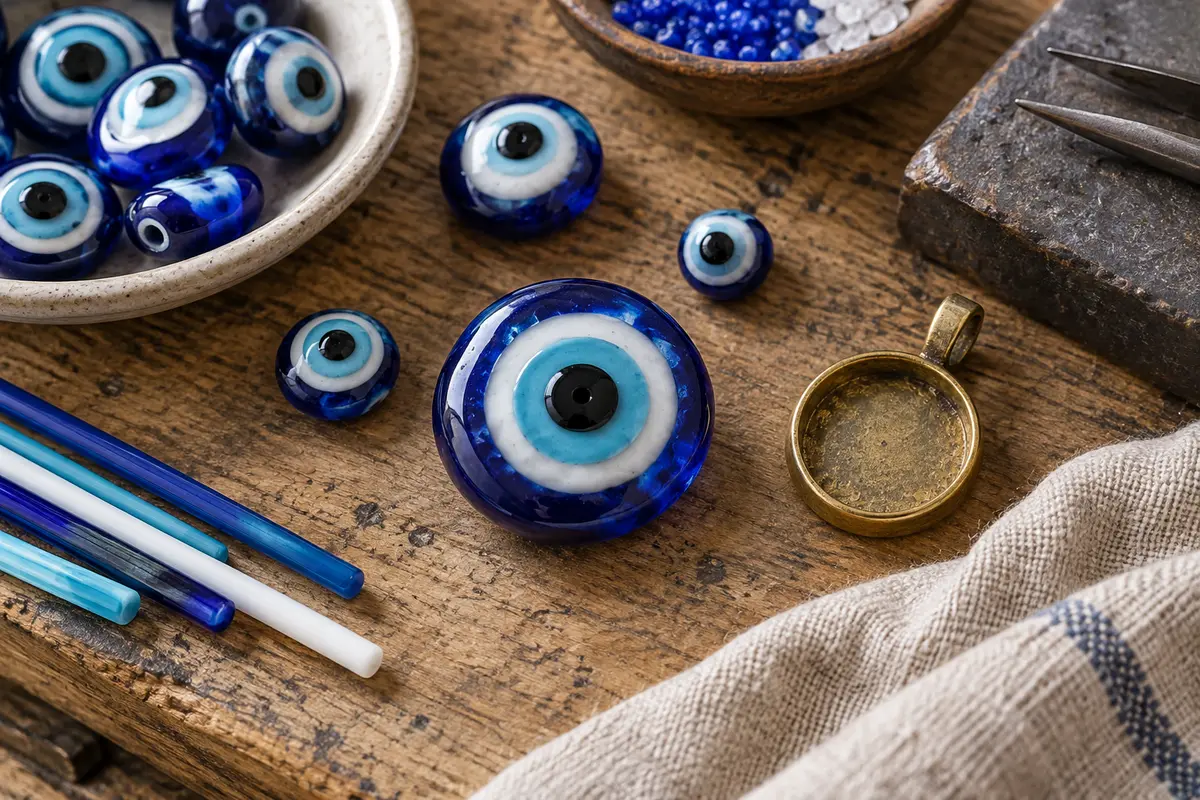
A nazar bead is a glass charm built from concentric circles that resemble an eye, commonly in dark blue, white, light blue, and black. It is especially associated with Türkiye, though related objects and beliefs circulate more broadly. The word nazar can refer to sight, a gaze, or the evil-eye concept in several languages and contexts.
Its recognizable blue design is now sold worldwide as jewelry, a wall hanging, a key chain, or a small decorative bead. Global popularity can make the symbol look universal, yet a shop listing cannot explain every family’s practice. When the cultural origin matters, ask the maker how the piece is named and used.
Why blue appears so often
Blue is strongly associated with contemporary nazar beads, but online color charts often assign fixed promises to blue, red, green, or white without historical evidence. Some colors reflect glassmaking traditions, regional taste, fashion, or modern marketing rather than a universal symbolic code.
A blue eye-shaped charm may be recognized as protective imagery, but color alone cannot identify its date, community, or exact intention. The material, maker, place, inscription, and owner’s explanation offer better evidence.
Evil eye meaning in jewelry and gifts
On necklaces, bracelets, and rings, the symbol may communicate protection, care, identity, or connection to family tradition. A gift can mean “I want you to be safe” without the giver making a literal supernatural claim. For another person, it may be a fashionable motif with no devotional meaning.
Context also distinguishes the symbol from other protective imagery. Our guide to lotus flower meaning in religious art and modern design shows why a familiar motif can carry different meanings across traditions. Likewise, an eye charm should be interpreted through its named origin and use.
If you receive one, the most accurate question is simple: “What does this mean to you?” That respects the giver’s intention more than applying a generic internet definition.
What does a broken charm mean?
Some people interpret a cracked or broken charm as having absorbed danger. Others replace it as a practical matter because glass can chip, thread can wear, and jewelry can catch on objects. There is no reliable way to prove that a break records envy or a supernatural event.
If the object is culturally or emotionally important, photograph it, ask the person who gave it to you, and decide whether repair or respectful disposal fits your tradition. Handle broken glass carefully. The physical explanation does not erase the personal meaning a family may attach to the moment.
Evil eye tattoos
In tattoo design, evil eye meaning may include protection, resilience, watchfulness, heritage, or a boundary against negativity. Placement and accompanying images can change the emphasis. A hand, geometric border, flower, name, or date may connect the eye to a particular memory rather than to a general belief.
Before using a design tied to a culture outside your own, learn its name and source. Avoid claiming that the tattoo guarantees safety or reveals the intentions of other people. Asking the wearer remains more accurate than diagnosing their beliefs from an image.
This is similar to black feather meaning in art and personal reflection: a symbol can support a chosen story without predicting what will happen next.
Seeing the symbol repeatedly
After noticing an eye charm once, you may begin seeing it in shops, feeds, jewelry, and décor. Attention makes familiar patterns easier to spot. Repetition does not by itself show that someone is sending envy or that the universe is issuing a warning.
Psychologists describe superstition as a common way people search for patterns and a sense of control when outcomes are uncertain. The British Psychological Society’s overview of everyday superstition discusses how such thinking can persist even when people know a causal link is unlikely.
If the symbol prompts reflection, use a grounded question: Have I recently encountered it in a shop, conversation, or social feed? Do I associate it with a person or place? What boundary or source of stress is already on my mind? These questions explain your response without treating the image as a forecast.
Evil eye dreams and personal interpretation
A dream about an eye charm has no verified universal meaning. It may draw on recent jewelry, family memories, worries about judgment, or an image seen online. The dream’s setting and emotion are more informative than a fixed dictionary entry.
You might use the dream to ask whether you feel watched, envied, protective, or culturally connected. Those are reflection prompts, not evidence that another person intends harm. A dream cannot identify a hidden enemy or guarantee protection.
How to interpret the symbol respectfully
Start with the object rather than a universal chart. Identify where it was made, what the seller or family calls it, what material it uses, and whether it belongs to a religious, regional, or personal practice. Museum records are especially useful when they provide a date, place, and documented interpretation.
Then separate cultural description from causal claims. It is accurate to say that people have worn an amulet for protection; it is a different claim to say that the object physically blocks envy. This distinction preserves the history without dismissing the meaning people find in the practice.
The same method works with white feather meaning and modern remembrance: name the documented context, leave room for personal significance, and avoid promises.
Frequently asked questions
What is the evil eye meaning?
The term usually refers to a belief that an envious or admiring gaze can cause harm. It can also refer informally to a protective eye-shaped charm. Historically and culturally, the harmful gaze and the object intended to avert it are distinct.
Is the evil eye symbol good or bad?
The eye-shaped charm is generally used as protective imagery, while “the evil eye” names the harmful gaze in the belief. A modern design may also be decorative or personal. Its meaning depends on the maker, wearer, and cultural setting.
Does an evil eye charm have to be blue?
No. Blue is strongly associated with the modern nazar bead, but protective eye imagery and related amulets have appeared in many colors and materials. Fixed color charts found online are not universal historical rules.
What does it mean if an evil eye bracelet breaks?
Some traditions interpret the break as the charm having absorbed harm; ordinary wear, impact, and weak thread are also common explanations. A broken bracelet cannot prove that someone envied you. Follow your own family practice, and handle chipped glass safely.
Sources
- The Metropolitan Museum of Art: Bronze amulet with apotropaic devices.
- The Metropolitan Museum of Art: Carnelian ring stone with composite creature.
- The Metropolitan Museum of Art: Bone amulet from the Fayum region.
- The Metropolitan Museum of Art: Pendant jewel with coral.
- British Psychological Society: Everyday magic and superstition.
For a related hand-shaped protective motif, explore hamsa hand meaning and its cultural context, which separates museum evidence from promises that an object can prevent harm.
For a modern flower symbol rather than an amulet, explore blue rose meaning and modern symbolism, including how rarity and context shape its use in gifts and tattoos.