Lotus Flower Meaning: Symbolism in Buddhism, Hinduism, and History
Lotus flower meaning is often summarized as purity, awakening, rebirth, or resilience. Those ideas have real roots in religious art and historical imagery, but they do not form one universal code. A lotus held by a Hindu deity, a Buddhist lotus throne, an ancient Egyptian water-lily motif, and a modern tattoo belong to different contexts.
This guide explains the plant first, then looks at documented meanings in Buddhism, Hinduism, ancient Egyptian art, and contemporary design. It treats sacred traditions with specificity and avoids turning a flower into a prediction about someone’s future.
Lotus flower meaning at a glance
The lotus is an aquatic plant that roots in mud while its leaves and flowers rise above the water. That visible contrast has made it a powerful image for purity, spiritual development, renewal, and beauty arising from difficult conditions. The meaning becomes clearer when the tradition, artwork, and speaker are identified.
| Context | Documented or common association | Important distinction |
|---|---|---|
| Buddhist art | Purity, awakening, compassion, and the elevated seat of a Buddha or bodhisattva | Details vary by region, school, figure, and artwork |
| Hindu art | Purity, divine presence, prosperity, creation, and the watery origins of life | The associated deity and attributes determine the reading |
| Ancient Egyptian art | Solar renewal, creation, rebirth, and rejuvenation | The plants called “lotus” are usually water lilies, not the Asian sacred lotus |
| Modern tattoos and jewelry | Resilience, calm, recovery, or personal growth | The wearer chooses the personal meaning |
Begin with the real lotus plant
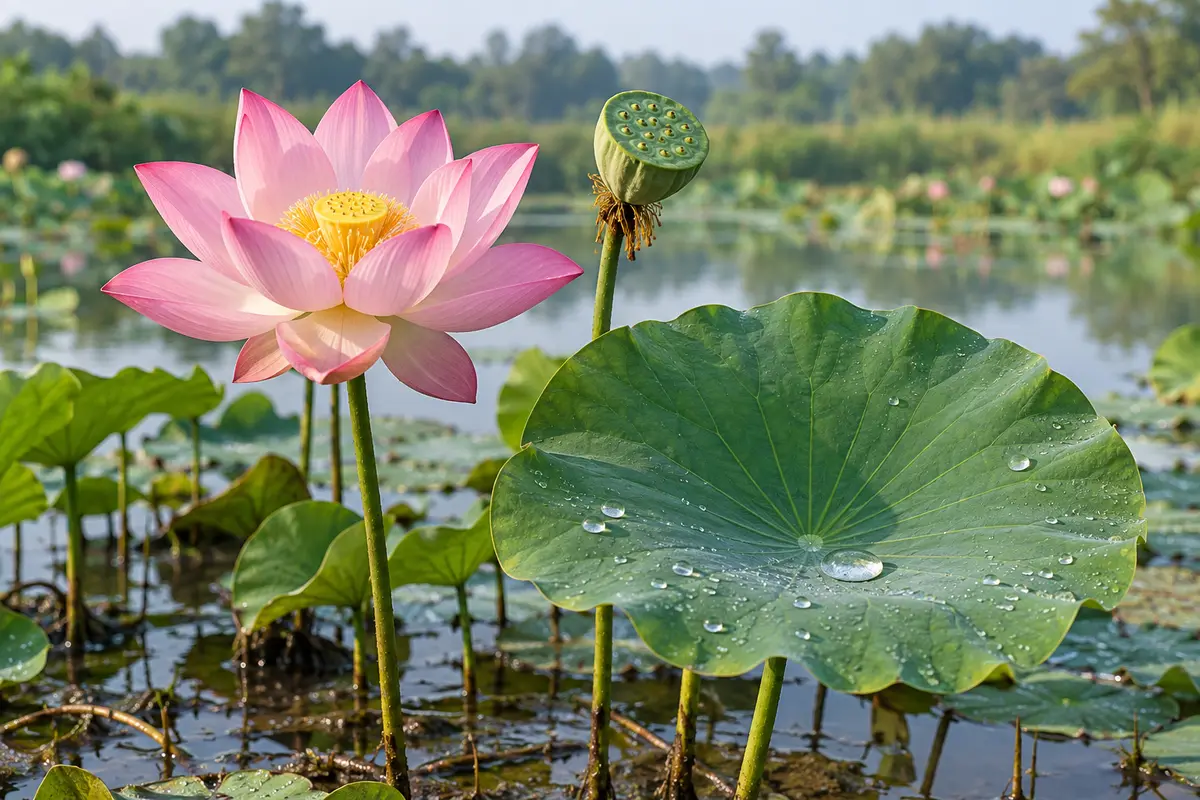
The sacred lotus, Nelumbo nucifera, is an aquatic perennial. Its rhizomes grow in mud beneath rivers, lakes, and marshes, while long stalks hold leaves and flowers at or above the surface. The Royal Botanic Gardens, Kew profile of sacred lotus describes that growth form and distinguishes the plant from superficially similar water lilies.
Its round leaves can shed water efficiently, and the flower develops into a distinctive flat-topped seed pod. These physical traits help explain why the lotus became such an effective visual metaphor: it is visibly connected to mud and water yet blooms cleanly above them.
Botany does not assign a moral message to the plant. Symbolism begins when communities, artists, and worshippers use its form in stories, ritual, architecture, or art.
Lotus flower meaning in Buddhist art
Across many Buddhist visual traditions, lotus imagery can express purity, awakening, compassion, and spiritual development. Buddhas and bodhisattvas are often seated or standing on stylized lotus bases. The flower therefore does more than decorate the scene; it helps identify the figure’s elevated or awakened status within the artwork.
The Rubin Museum’s account of the lotus connects the flower with purity, awakening, transformation, and compassion in Buddhist and Hindu art. It also emphasizes the familiar contrast between roots in muddy water and a blossom opening above the surface.
That metaphor should be used carefully. “Rising from the mud” can inspire a modern reader, but it does not mean every Buddhist image carries the same message or that color charts found online apply to every school. The identity of the figure, the period, inscriptions, and regional conventions all matter.
Lotus flower meaning in Hindu art
Lotus imagery is also central to Hindu art and devotion. Deities may hold a lotus, stand upon one, or appear within compositions built around the flower. The motif can relate to purity, prosperity, beauty, creation, fertility, or the emergence of ordered life from water.
A sculpture of Vishnu with consorts in the Smithsonian’s National Museum of Asian Art identifies the lotus in Vishnu’s hand with purity while the conch refers to the watery origins of life. The object demonstrates why attributes must be read together rather than reduced to a single generic flower definition.
Lakshmi has an especially strong lotus association. A Rubin Museum image of the lotus goddess Lakshmi includes lotuses on her throne, pedestal, attributes, and tiara. The museum relates the plant’s growth after monsoon rain and its autumn flowering to harvest and wealth, while noting that lotus symbolism developed in multiple ways in Hinduism and Buddhism.
Why purity and resilience appear so often
The plant’s growth provides an intuitive visual structure. Roots and rhizomes remain in sediment; stalks pass through water; leaves and blossoms emerge into air and light. People can therefore use the lotus to speak about remaining grounded while developing, or about maintaining purpose under difficult conditions.
Modern resilience language is an interpretation, not a diagnosis. A lotus tattoo cannot prove that someone has overcome trauma, and seeing a lotus does not promise that a difficult period will soon end. The symbol becomes meaningful when a person connects it with a specific commitment or memory.
Our guide to black feather meaning in nature and personal reflection makes a similar distinction: a natural object can support reflection without predicting an event.
The “lotus” in ancient Egyptian art
Ancient Egyptian art contains abundant blue and white flowers commonly called lotuses. Botanically, these are water lilies such as Nymphaea caerulea and Nymphaea lotus, not Nelumbo nucifera. Keeping that distinction visible prevents separate plant histories from being collapsed into one.
The Metropolitan Museum of Art’s lotus-flower inlay explains that the Egyptian water lily closes at night and opens again in the morning. Ancient viewers connected that cycle with the rising sun, creation, daily rebirth, and rejuvenation.
This historical association is specific and documented. It does not mean a lotus tattoo today automatically has an Egyptian meaning, nor does it turn every flower opening at sunrise into a supernatural sign. An Egyptian reference is clearest when the design includes recognizable period imagery and the maker names the source.
Lotus colors and why context matters
Pink, white, blue, red, and purple lotus designs circulate with fixed meanings online, but color rules are not universal. Some charts combine conventions from unrelated religious schools, commercial jewelry descriptions, and recent wellness culture. Treat them as design suggestions unless a reliable source ties a color to a named tradition or artwork.
In a modern composition, white may be chosen for simplicity, pink for warmth, blue for contrast, or purple for a contemplative mood. Those visual choices can be meaningful without being presented as ancient doctrine.
The same caution applies to white feather meaning: color can shape a response, but the surrounding history and intended use carry more information than color alone.
Lotus flower meaning in yoga and meditation spaces
Lotus imagery often appears in yoga studios, meditation apps, and wellness branding. The flower can suggest calm, balance, or inward attention, while the Sanskrit word padma appears in names such as padmasana, commonly called lotus pose.
A decorative logo is not automatically a religious teaching. If a business uses sacred imagery, accurate naming and respectful context are better than claiming that the image guarantees healing, energy, or enlightenment. Practitioners may value the symbol deeply, while others may simply recognize it as a flower associated with contemplative practice.
Lotus flowers in dreams
A dream about a lotus has no verified universal translation. It may draw on a temple image, a pond, a yoga class, a tattoo idea, or a recent conversation. The setting and emotion are more useful than a one-line dream dictionary.
A closed bud may personally suggest patience; an open flower might suggest clarity; muddy water could reflect a difficult situation already on your mind. These are prompts for reflection, not forecasts. A dream image cannot confirm spiritual rank, future success, pregnancy, or a coming relationship.
Lotus tattoos and jewelry
In contemporary tattoos, lotus flower meaning often centers on growth, recovery, self-respect, or spiritual practice. Geometry, names, dates, deities, script, and color can completely change the design’s emphasis. Ask what the wearer intended before assigning a meaning.
If the design includes a Buddha, Hindu deity, mantra, or sacred script, research the tradition and placement rather than treating the element as decoration. A simple botanical lotus can carry a personal story without claiming to represent a community’s full theology.
Like owl symbolism in religious art and literature, the lotus is most accurately interpreted by identifying the particular object, culture, and source.
Frequently asked questions
What is the main lotus flower meaning?
Purity, awakening, renewal, and resilience are common associations because the plant roots in mud and blooms above water. The main meaning still depends on context: Buddhist art, Hindu art, ancient Egyptian water-lily imagery, and modern tattoos do not use the motif in exactly the same way.
What does the lotus mean in Buddhism?
In many Buddhist artworks, it can signify purity, awakening, compassion, or spiritual elevation. A lotus throne may support a Buddha or bodhisattva. Interpretation should consider the figure, school, region, date, and other attributes rather than rely on a universal color chart.
What does the lotus mean in Hinduism?
Lotus imagery can relate to purity, prosperity, beauty, creation, harvest, and life’s emergence from water. Lakshmi and Vishnu are among the deities associated with it, but the meaning changes with the deity and composition.
Does seeing a lotus predict a new beginning?
No. A lotus can be chosen as a personal reminder of renewal or a new commitment, but seeing one does not guarantee that circumstances will change. Its value as a symbol does not depend on it predicting an event.
Sources
- Royal Botanic Gardens, Kew: Sacred lotus.
- Rubin Museum: The lotus flower as a sacred symbol.
- Rubin Museum: Lotus Goddess, Lakshmi.
- National Museum of Asian Art: Vishnu with Consorts.
- The Metropolitan Museum of Art: Lotus Flower Inlay.
To compare another widespread protective motif whose interpretation changes with culture, read evil eye meaning and its cultural history.
Another motif interpreted across several communities appears in hamsa hand meaning in history and modern design, where museum objects provide more context than a universal symbol chart.