Blue Jay Spirit Animal Meaning: Voice, Courage, and Context
Blue jay spirit animal symbolism is often associated with voice, courage, alertness, social intelligence, and the confidence to take up space. Those ideas make sense because Blue Jays are loud, highly social corvids with complex calls, strong family bonds, and flexible behavior. But a sighting is not proof that a hidden message or prediction has been sent to you. A grounded interpretation starts with what the bird was actually doing, how you reacted, and what part of the encounter stayed with you.
This guide uses “spirit animal” in the broad modern sense of a personal animal symbol or reflective archetype. It does not assign one universal spiritual meaning to Blue Jays, and it does not claim that every cultural tradition interprets the bird the same way.
Why the Blue Jay became a strong symbol of voice and presence
Blue Jays are difficult to ignore. Their calls are loud and varied, and Cornell Lab of Ornithology notes that they can produce clear whistles, gurgling sounds, harsh jeers, and imitations of hawks. That makes communication one of the most natural symbolic themes connected with the species.
The bird is also visually assertive. Its crest, black facial markings, blue-and-white pattern, and deliberate movements create an impression of confidence even when the bird is simply foraging. Symbolically, that combination can suggest speaking clearly, making yourself visible, and being willing to defend a boundary when necessary.
Five grounded themes in Blue Jay spirit animal meaning
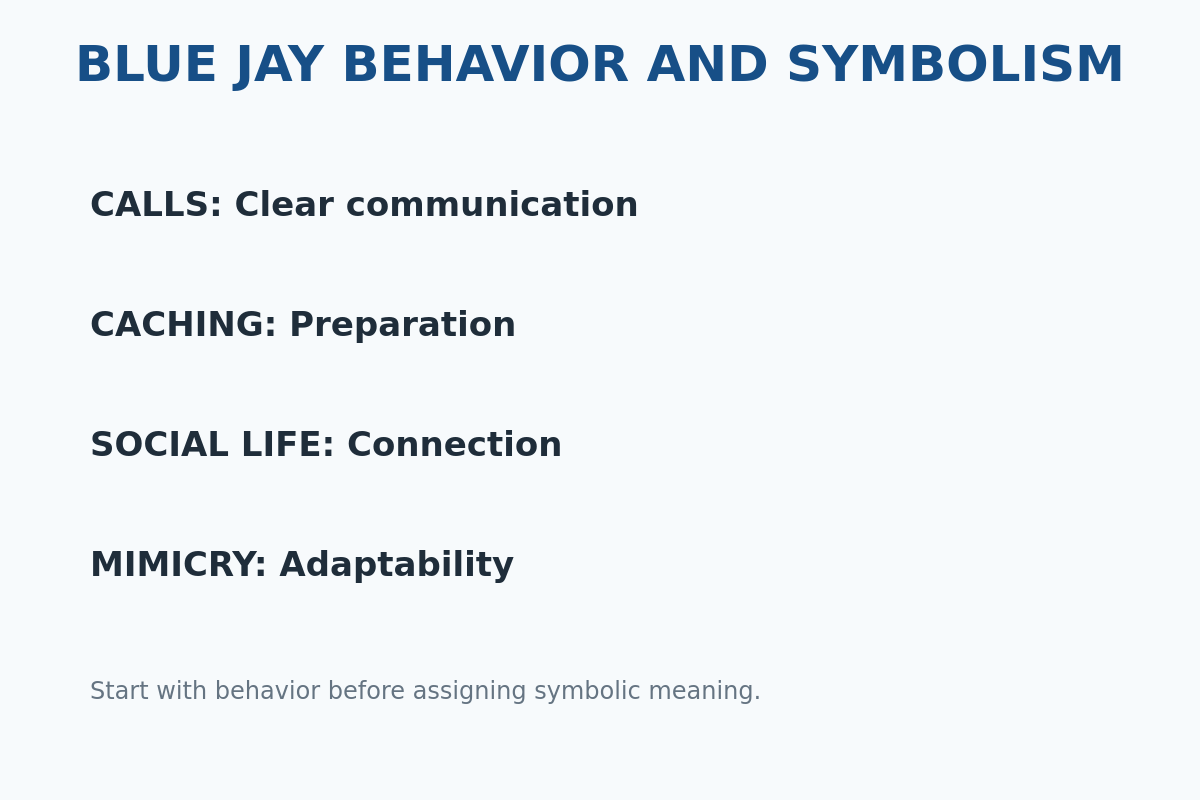
1. Use your voice deliberately
The most obvious Blue Jay theme is communication. Blue Jays are vocal birds, but loudness alone is not the useful lesson. Their calls serve different purposes, from contact and alarm to social interaction. Cornell also documents their frequent imitation of hawk calls.
As a personal symbol, the Blue Jay can therefore represent purposeful communication rather than simply talking more. The reflective question is: where do you need to be clearer, more direct, or more precise about what you mean?
2. Courage does not require constant aggression
Blue Jays have a reputation for being bold around feeders and predators, yet their behavior is more nuanced than the stereotype. Audubon describes them as intelligent and adaptable, and Cornell notes that other birds and even squirrels can dominate them at feeders. They can be assertive, but they also know when to retreat, wait, or change tactics.
That makes the bird a better symbol for strategic courage than for endless confrontation. Standing your ground can matter, but so can choosing the right moment, conserving energy, or changing approach.
3. Social intelligence and loyalty to the group
Blue Jays belong to the corvid family, a group known for sophisticated behavior. Cornell describes Blue Jays as having complex social systems and close family bonds. Pairs cooperate in nesting, and Blue Jays may associate in family groups or flocks.
In symbolic reflection, this can point toward the quality of your relationships rather than the quantity of them. It may be useful when you are thinking about who you trust, how you communicate inside a group, and whether you are contributing to the relationships that support you.
4. Planning, memory, and preparing ahead
Blue Jays cache food, especially acorns. Cornell reports that individual jays can carry several acorns at once and store thousands over a season. This behavior has ecological consequences because forgotten caches can contribute to oak dispersal.
That gives the Blue Jay a strong practical symbolism of preparation. Instead of reading the bird as a promise that “abundance is coming,” a more grounded interpretation is to ask whether you are building reserves of time, money, skill, information, or energy before you need them.
5. Adaptability and reading the room
Blue Jays live in forests, suburban areas, parks, and towns. They exploit multiple food sources, visit feeders, change tactics around competitors, and use a wide vocal repertoire. Their flexibility makes adaptability one of the species’ most defensible symbolic themes.
That does not mean changing your values to fit every environment. It can instead mean adjusting the method while protecting the goal: changing timing, tone, route, or strategy when conditions change.
Context changes the symbolism
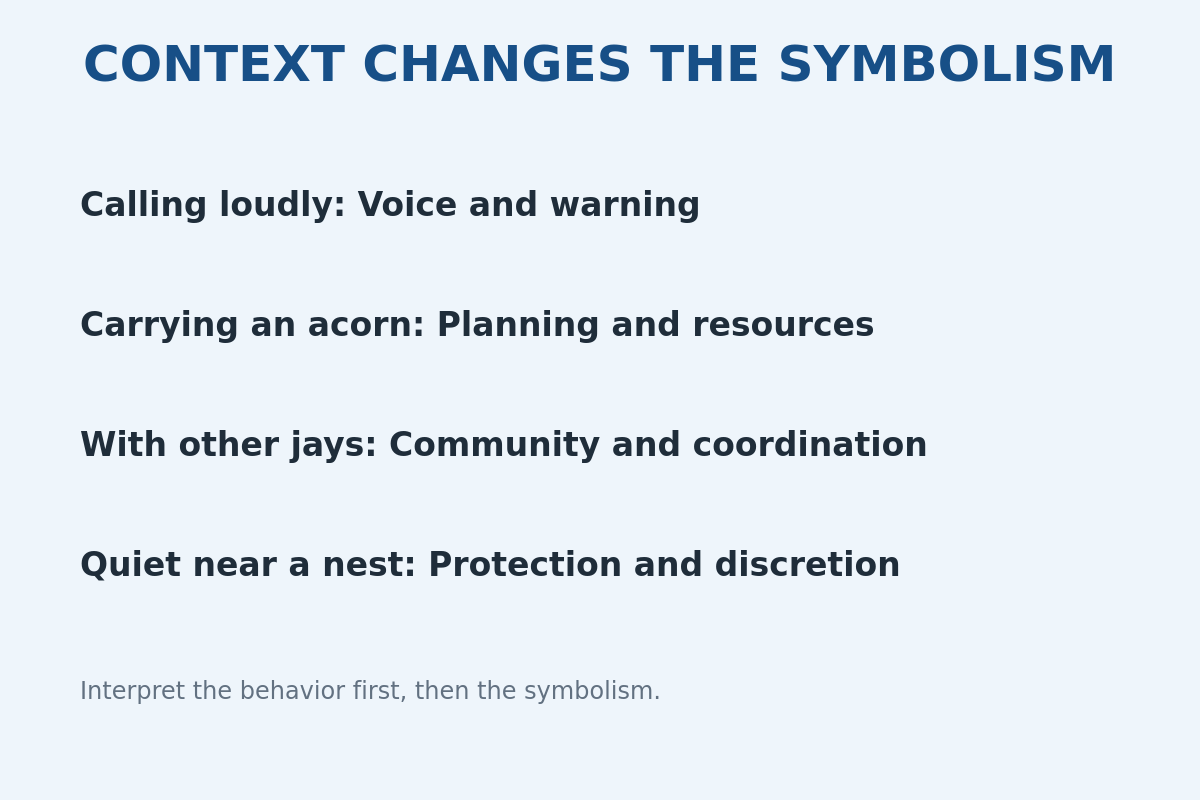
The same bird can suggest different things depending on what you actually noticed. A Blue Jay calling repeatedly carries a different symbolic weight from one quietly carrying an acorn or tending a nest.
| What you notice | Possible symbolic theme | Grounded question |
|---|---|---|
| A loud Blue Jay calling | Voice, warning, visibility | Where do I need to communicate more clearly? |
| A Blue Jay carrying food | Preparation, planning, resourcefulness | What can I prepare now instead of reacting later? |
| Several Blue Jays together | Community, coordination, social awareness | Which relationships deserve more attention? |
| A Blue Jay chasing another bird | Boundary, competition, territoriality | Am I protecting something important or overreacting? |
| A Blue Jay quietly near a nest | Care, discretion, protection | What should be protected without making it public? |
| A Blue Jay mimicking a hawk | Strategy, signaling, ambiguity | Am I reading signals carefully rather than taking them at face value? |
The blue color adds another layer, but not a supernatural one
Blue is often associated in modern symbolic language with calm, truth, communication, and clarity. That can reinforce the “voice” theme of the Blue Jay, but the bird’s color has a fascinating biological explanation too. Cornell notes that Blue Jay feathers contain brown melanin; the blue appearance comes from the way feather structures scatter light.
This detail is useful symbolically because appearance depends on structure and light. If that idea resonates, it can become a metaphor for perspective: what looks fixed may change when the angle, environment, or information changes.
Repeated Blue Jay sightings do not automatically mean a message
Once a symbol becomes important to you, you are more likely to notice it. Blue Jays are also common in many eastern North American neighborhoods, parks, and wooded edges, so repeated encounters may simply reflect local habitat and season.
You can still use repetition as a prompt for reflection without treating it as evidence of fate. Ask what was happening each time, what the bird was doing, and whether your own attention was already centered on communication, boundaries, planning, or social tension.
Blue Jay symbolism compared with other bird symbols
Blue Jay symbolism has a more assertive and social tone than many other bird symbols. Owl symbolism tends to center on observation, night, and quiet awareness. Crow symbolism often emphasizes intelligence, adaptability, and social complexity, while cardinal symbolism is usually shaped by visibility, color, memory, and personal association.
Comparing birds this way prevents every species from being reduced to the same vague list of “wisdom, transformation, and protection.” The strongest symbolic meanings are anchored in what makes the animal distinctive.
When the Blue Jay symbol may feel especially relevant
A Blue Jay may feel like a useful personal symbol during periods when you are trying to speak up, set firmer boundaries, prepare for a demanding season, or navigate a group dynamic. The bird’s behavior offers several practical metaphors: be visible when it matters, communicate with purpose, plan ahead, and adjust tactics when the environment changes.
It can also be a useful counterweight if you tend to stay silent to avoid conflict. Blue Jay symbolism does not require becoming louder than everyone else. It can simply mean making your position clear enough that others do not have to guess.
A practical way to interpret a Blue Jay encounter
- Start with behavior. Was the bird calling, feeding, caching, chasing, flying with others, or sitting quietly?
- Name your emotional response. Did you feel energized, irritated, curious, reassured, or alert?
- Separate fact from symbolism. The bird has ordinary ecological reasons for being there even if the encounter feels meaningful to you.
- Choose the most relevant theme. Voice, planning, boundaries, social connection, and adaptability are stronger when tied to what you actually observed.
- Turn the symbol into an action. Make the phone call, clarify the boundary, prepare the plan, or reconnect with the person who matters.
Blue Jay spirit animal meaning in a concise form
At its most useful, blue jay spirit animal symbolism points toward clear communication, strategic courage, social intelligence, preparation, and adaptability. The meaning is strongest when it is grounded in real Blue Jay behavior and your own context rather than treated as a prediction. A calling jay may emphasize voice, a caching jay may emphasize preparation, and a quiet nesting bird may emphasize protection and discretion.
Sources and further reading
- Cornell Lab of Ornithology — Blue Jay overview.
- Cornell Lab of Ornithology — Blue Jay life history.
- Cornell Lab of Ornithology — Blue Jay sounds and calls.
- Audubon Field Guide — Blue Jay.
- Audubon — Blue Jay behavior and natural history.
For a related guide, read Lone Wolf Symbolism: Independence, Distance, and the Meaning of Walking Alone.
For a related guide, read White Deer Symbolism: Why This Rare Sight Feels Different.